Friday, August 7, 2009

Laos travel advice

Travel Summary

  • The World Health Organisation (WHO) Pandemic Threat Alert has been raised to Level 6. There are confirmed human cases or Influenza A (H1N1) - Swine Flu in Laos. The WHO website at http://www.who.int/csr/disease/swineflu/en/index.html has further details. You should monitor local media reports for any developments and advice. There is a dedicated Swine Flu page on the FCO website. Guidance on pandemic flu can be obtained on the UK Department of Health website at www.dh.gov.uk.

  • There is no British consular representation in Laos. Routine consular matters are covered by the Australian Embassy in Vientiane. The British Embassy in Bangkok is accredited to Laos and is responsible for non-routine consular matters. See the General (Representation in Laos) section of this advice for more details.

  • There is a low threat from terrorism in Laos. But you should be aware of the global risk of indiscriminate terrorist attacks which could be in public areas, including those frequented by expatriates and foreign travellers.

  • You should be aware of and respect local conventions at all times. See the Local Laws and Customs section of this advice for more details.

  • Unexploded ordnance in rural areas is an ongoing danger.

  • Outbreaks of Avian Influenza (Bird Flu) in Laos have led to a small number of human fatalities. The last fatality was in March 2007. See the Health (Avian Influenza) section of this advice and Avian and Pandemic Flu for more details.

  • Most visits to Laos are trouble free. The main types of incident for which British nationals required consular assistance in Laos in 2007 were for: dealing with deaths; and replacing lost or stolen passports. You must carry an ID document or passport at all times, you will be heavily fined if you do not present any documentation on request by the authorities.

  • We recommend that you obtain comprehensive travel and medical insurance before travelling. You should check any exclusions, and that your policy covers you for all the activities you want to undertake. See the General (Insurance) section of this advice and Travel Insurance for more details.

Safety and security

Terrorism/Security

There is a low threat from terrorism in Laos. But you should be aware of the global risk of indiscriminate terrorist attacks which could be in public areas, including those frequented by expatriates and foreign travellers.

In February 2007, there were reports of armed clashes between Lao government forces and unidentified groups north of Vang Vien. There continue to be small-scale skirmishes between anti-government groups and government troops in isolated areas along the Lao-Thai border. There is a danger you may inadvertently get caught up in unpredictable acts of violence.

You should be particularly vigilant when travelling by road on Route 13 from Vang Vien north through Phou Khoun, to south of Luang Prabang, on Route 7 from Phou Khoun to Phonsavan and on Route 6. Armed bandits have carried out attacks on this route and two foreign nationals were killed in 2003.

Local law enforcement agencies in Laos have limited capability to counter these threats.
For further information see Terrorism Abroad.

Crime

Violent crimes such as robbery, are on the increase. Foreigners have been assaulted after having their drinks drugged. You should be careful about taking drinks from strangers.
For more information see Rape and Sexual Assault Abroad.
It has been reported that some restaurants in popular tourist destinations offer drug laced food and drink which has led to the victim being assaulted. These products can contain harmful substances and consuming them can result in serious injury or even death. You should never leave food or drink unattended.
The theft of passports is a particular problem. You should have insurance cover for unexpected losses such as cancelled flights, stolen cash, cards, passports or luggage. There are reports of a visa scam affecting travellers to Laos.
For more general information see Victims of Crime Abroad.
Local Travel
There is a risk of banditry in rural areas as well as the risk of further bombings and attacks (see Terrorism/Security section).
You should be aware of the dangers of unexploded ordnance, particularly in Xieng Khouang Province (Plain of Jars), increasingly in Luang Prabang Province (as a result of scrap metal collection) and areas of the Lao-Vietnamese border, which were formerly traversed by the Ho Chi Minh Trail. Mined areas are frequently unmarked. You should therefore not stray off main routes in rural areas.
There is no curfew in Vientiane but you should be aware that people travelling in the city and elsewhere in Laos might be stopped by the police at any time, particularly in the evening. You may be asked to show identification papers before being allowed to travel on. You should comply with requests to stop at checkpoints and roadblocks.
Road Travel
The majority of roads in Laos are in a poor condition. Travel should only be undertaken during daylight hours. Travel after dark significantly increases the risk of an accident and vehicles often do not have lights. Livestock often stray on to the roads causing accidents.
The numbers of road accidents and fatalities in Laos have risen sharply in recent years along with the increase in the number of motor vehicles, especially motorbikes. If you are involved in a road accident you will generally be required to pay compensation for third party property damage and injury, even if you are not judged to be at fault. Lao insurers will generally only meet a small proportion of the costs of an accident and will not cover this compensation, which can be the largest part of the expense.
If you are planning to travel by road or river you should check with a travel company on arrival for an update on local conditions.
For further information see Driving Abroad.
River Travel
Travel on the Mekong River by speedboat is dangerous, particularly in the dry season, November to April. Life-vests and crash helmets should be provided and worn. White water rafting and kayaking are also dangerous. Incidents of drowning have been reported.
For more general information see River and Sea Safety
Air Travel
As no airlines from Laos operate to the UK or the EU it has not been possible assess their safety standards.

Departure tax is now included in the price of the air ticket and no longer paid in cash on departure.

Local laws and customs

Do not get involved with illegal drugs. Possession, trafficking and manufacture of such drugs are serious offences in Laos. Those caught face lengthy prison sentences or the death penalty.
There have been several deaths as a result of drug abuse among foreigners visiting Laos.

The Lao Government prohibits sexual relationships between foreign citizens and Lao nationals, except when the two parties have been married in accordance with Lao Family Law. It is not unknown for Lao authorities to demand entry into hotel rooms or guest houses where they suspect this regulation is being broken. Permission for marriage or engagement to a Lao citizen must be submitted in a formal application to the Lao authorities. Penalties for engaging in prohibited sexual contact or failing to register a relationship range from US$500 to US$5,000 and may also involve imprisonment.
It is illegal not to carry an ID document or a passport, and fines for not having documentation for presentation on demand can be high.

Photographing or visiting military sites is prohibited and can result in arrest or detention.
For more general information for different types of travellers see Travel Advice Relevant to You.

Entry requirements

Visas
Visa conditions change regularly. Please contact the nearest Laos Embassy or Consulate for the most up to date information.

You should be aware of reports of a visa scam where travel agents are supplying 5-day or 15-day visas to customers who pay for 30-day permits. Proper long-stay visas can also be obtained from the Laos Embassy in either Hanoi or in Bangkok.

The Lao People’s Democratic Republic does not have an embassy in the United Kingdom.

When you enter Laos, you should make sure you obtain an entry stamp in your passport. Immigration offices at some border crossings are sometimes difficult to identify. Fines for not having a legitimate entry stamp can be high.

Passport validity
Your passport should have a minimum validity of 6 months, or entry to Laos may not be permitted.

Travelling with children
Single parents or other adults travelling alone with children should be aware that some countries require documentary evidence of parental responsibility before allowing lone parents to enter the country, or, in some cases, before permitting the children to leave the country. For further information on exactly what will be required at immigration, please check with the Laos Embassy in Paris.

Health

If you have an unstable medical condition you should seriously consider not travelling to Laos. Medical care in Vientiane is extremely basic and outside the capital there are no reliable facilities to deal with medical emergencies. Medical evacuation is difficult to organise and very expensive.

Dengue and malaria occur in Laos. These diseases are transmitted by mosquitoes. There are no vaccinations against these diseases, but there are preventative measures that you can take, as advised on the National Travel Health Network and Centre (NaTHNaC) website.

Poor sanitation and eating contaminated food can increase the risk of cholera and other diarrhoeal illness. You should drink or use only boiled or bottled water and avoid ice in drinks. If you suffer from diarrhoea during a visit to Laos you should seek immediate medical attention.

In the 2008 Report on the Global AIDS Epidemic the UNAIDS/WHO Working Group estimated that around 5,400 adults aged 15 or over in Laos were living with HIV; the prevalence rate was estimated at around 0.2% of the adult population. This compares to the prevalence rate in adults in the UK of around 0.2%. You should exercise normal precautions to avoid exposure to HIV/AIDS. For more general information on how to do this see HIV and AIDS.

You should seek medical advice before travelling to Laos and ensure that all appropriate vaccinations are up-to-date. For further information on vaccination requirements, health outbreaks and general disease protection and prevention you should visit the websites of the National Travel Heath Network and Centre (NaTHNaC) or NHS Scotland's Fit For Travel or call NHS Direct on 0845 46 47.
For more general health information see Travel Health and for food/drink hygiene see Eat and Drink.

A (H1N1) - Swine Flu

The World Health Organisation (WHO) Pandemic Threat Alert Phase has been raised to Level 6. There are confirmed human cases or Influenza A (H1N1) - Swine Flu in Laos. The WHO website at http://www.who.int/csr/disease/swineflu/en/index.html has further details. You should to monitor local media reports for any developments and advice. There is a dedicated Swine Flu page on the FCO website: http://www.fco.gov.uk/en/travelling-and-living-overseas/swine-flu. Guidance on Pandemic Flu can be obtained on the UK Department of Health website at: www.dh.gov.uk

Avian Influenza (Bird Flu)

There have been outbreaks of Avian Influenza (also known as Bird Flu) in poultry in Laos, most recently in February 2009. The only two human fatalities in Laos occurred in March 2007.
The risk to humans from Avian Influenza is believed to be very low. However, as a precaution, you should avoid visiting live animal markets, poultry farms and other places where you may come into close contact with domestic, caged or wild birds; and ensure poultry and egg dishes are thoroughly cooked.
The World Health Organisation (WHO) has warned of the possibility that the Avian Influenza outbreaks could lead at some point to a human flu pandemic, if a virus mutates to a form which is easily transmissible between people.
British nationals living longer term in an Avian-Influenza affected region should take personal responsibility for their own safety in the event of a future pandemic, including considering their access to adequate healthcare and ensuring travel documents are up to date.
You should read this advice in conjunction with Avian and Pandemic Influenza, which gives more detailed advice and information.
Natural Disasters
Earthquakes
On 16 May 2007 a magnitude 6.1 earthquake occurred at a point 155 kms (97 miles) north-west of Luang Prabang in western Laos.
Monsoon Season
The rainy season in Laos normally runs from June to November, coinciding with the typhoon season in South East Asia. Mountain areas are particularly vulnerable to landslides in the rainy season and flooding may occur along river basins and elsewhere. Travel to some provinces can be seriously disrupted during this time. You should monitor local news and weather reports. And international weather updates from the World Meteorological Organisation (WMO) You can also access the National Hurricane Centre for updates. See Tropical cyclones for more details.

Heavy rain due to Tropical Storm Mekkhala could result in localised flooding and landslides. Please monitor the local news and weather reports for updates.

The Mekong River Commission, an international organisation, posts official updates on the Mekong River on their website at: http://ffw.mrcmekong.org/.

General

Insurance
We recommend that you obtain comprehensive travel and medical insurance before travelling. You should check any exclusions, and that your policy covers you for all the activities you want to undertake. See Travel Insurance for more details.
If things do go wrong when you are overseas then this is how we can help.
Representation in Laos

There is no British consular representation in Laos. Routine consular matters are provided by the Australian Embassy in Vientiane (please see below for contact details). The British Embassy in Bangkok is responsible for non-routine consular matters.
Replacing a passport in Laos
If you require a new passport, application forms can be downloaded from the Internet. Applications for new and replacement passports are processed by the British Embassy in Bangkok and can be submitted by post or the local courier service (known as EMS). Where possible, you are advised to apply at least 15 working days before you need to use your passport. In the event of an emergency, the Australian Embassy in Vientiane can issue an emergency travel document to allow you to enter Thailand, and will ask you to complete a lost/stolen report form. We strongly advise you to keep a photocopy of the relevant pages of your passport, to avoid any complications.
Registering your presence
If you are a British national and plan to stay for an extended period in Laos, you are advised to register with the Australian Embassy in Vientiane upon arrival.
The Australian Embassy in Vientiane can be contacted at: KM4, Thadeua Road, Watnak Village, Sisattanak District, Vientiane; (Tel: + 856 21 353 800; Fax: 856-21 353-801). Email: austemb.laos@dfat.gov.au.
Consular Registration

Register with our LOCATE service to tell us when and where you are travelling abroad or where you live abroad so our consular and crisis staff can provide better assistance to you in an emergency. More information about registering with LOCATE can be found here.

Money
The majority of international ATMS’s are generally reliable. However, there is a limit to the amount of money you are able to withdraw per day (1,000,000 LAK = approx £65). Major credit cards are accepted at the larger international hotels and main tourist orientated establishments. Travellers’ cheques can be cashed at most banks in Vientiane and major towns. Most transactions are conducted in cash, American Dollars, Thai Baht or Lao Kip (LAK). Western Union, United Kingdom freephone 0800 833 833, offers international money transfer facilities in Vientiane through a branch of the Bank of Ayudhya on Lane Xang Avenue.

Thursday, August 6, 2009

Cambodia travel advice

Travel Summary

  • On 15 October 2008, fighting broke out along the disputed border area near the Preah Vihear temple (Khao Pra Viharn in Thai) between Thai and Cambodian troops. On 2 April 2009, further hostilities broke out close to Preah Vihear. We advise against all travel to the temple area. Although talks continue between the two countries, tensions remain. You should remain alert to the local situation when travelling in other border regions, and at land crossings between the two countries.

  • There is human A (H1N1) - Influenza in Cambodia. See the Health (A (H1N1) Influenza - Swine Influenza) section of this advice; and the dedicated “Swine Flu” page of the FCO website at: http://www.fco.gov.uk/en/travelling-and-living-overseas/swine-flu for further information.

  • There is a low threat from terrorism in Cambodia. But you should be aware of the global risk of indiscriminate terrorist attacks which could be in public areas, including those frequented by expatriates and foreign travellers. On 2 January 2009, three small explosive devices were found and safely detonated in Phnom Penh. Visitors should avoid demonstrations and political gatherings.

  • Cambodian registered and operated airlines do not meet international safety standards. See the Air Travel section of this advice for more details.

  • Outbreaks of Avian Influenza (Bird Flu) in Cambodia have led to a small number of human fatalities. The last fatality was in April 2007. See the Health (Avian Influenza) section of this advice and see Avian and Pandemic Influenza for more details.

  • 98,000 British nationals visited Cambodia in 2008 (Source: Cambodia Ministry of Tourism). Most visits to Cambodia are trouble-free. The main type of incidents for which British nationals required consular assistance in Cambodia in 2008 were: lost and stolen passports (48 cases), hospitalisations (15 cases), bag snatches (14 cases) and deaths (12 cases).

  • We recommend that you obtain comprehensive travel and medical insurance before travelling. You should check any exclusions, and that your policy covers you for all the activities you want to undertake. See the General (Insurance) section of this advice and Travel Insurance f or more details.

Safety and security

Terrorism/Security

There is a low threat from terrorism in Cambodia. But you should be aware of the global risk of indiscriminate terrorist attacks which could be in public areas, including those frequented by expatriates and foreign travellers.

There have been serious attacks in other parts of South East Asia. In Indonesia, Westerners were killed and injured following the terrorist attacks in Bali (October 2002 and October 2005) and Jakarta (August 2003 and September 2004).
There have been serious attacks in other parts of South East Asia. In neighbouring Indonesia, Westerners were killed and injured following the terrorist attacks in Bali (October 2002 and October 2005) and Jakarta (August 2003 and September 2004).
On 2 January 2009, three small explosive devices were found and safely detonated in Phnom Penh. One device was found in front of the Ministry of National Defence Head Quarters, the others in a building site near to the studios of the state television company, TV3. On 29 July 2007, two small explosive devices were found and a third exploded at the Cambodian/Vietnamese Friendship Monument in Phnom Penh. There were no injuries in any of these attacks, which were believed to be the work of domestic groups. There was no evidence that foreign nationals were targeted in any attacks.

For more general information see Terrorism Abroad.

Crime

Disparity in wealth may make tourists an attractive target for crime: sensible precautions should be taken to avoid opportunistic theft. You should be on your guard against pickpockets and bag snatchers. You are advised to remain particularly vigilant against theft when using public transportation, including inter-city buses, tuk-tuks and motos.

Particular areas where crime levels have been relatively high in recent months have been the riverfront area of Phnom Penh, and the beaches and tourist areas of Sihanoukville. You should be particularly vigilant at night, and in deserted areas, although incidents have occurred at all times of day. Thieves do not generally use violence, but some incidents have involved criminals carrying weapons.

ATMs have recently been installed in Phnom Penh and other cities. You should take care when withdrawing cash and be aware of your surroundings.

There have been a small number of grenade/bomb attacks and shootings, although most have been linked to business, personal and traffic disputes. There is no evidence to suggest that British nationals, or Western interests more generally, have been the targets of these attacks. However, there is a danger foreigners might be caught up in any further attacks.

There have also been a small number of rapes and sexual assaults in various locations. For more general information, see Rape and Sexual Assault Abroad.

For more general information see Victims of Crime Abroad


Political Situation

Cambodia Country Profile


The political situation in Cambodia is stable, and incidents of politically motivated violence have fallen significantly in recent years, but particular events or political disputes may occasionally trigger violent protests. You are advised to keep away from any large gatherings, demonstrations and political meetings, and to avoid expressing forcible opinions on Cambodian politics or culture.

Local Travel


The line of the international border in the vicinity of the Preah Vihear temple (Khao Pra Viharn in Thai) is the subject of dispute between Cambodia and Thailand

Fighting broke out on 15 October between Thai and Cambodian troops along the disputed border area near the Preah Vihear temple (Khao Pra Viharn in Thai). On 2 and 3 April 2009, further hostilities were reported to have broken out at Veal Antri near Preah Vihear. We advise against all travel to the temple area. Although talks continue between the two countries, tensions remain. You should remain alert to the local situation when travelling in other border regions, and at land crossings between the two countries.

Disputes also exist over control of the Ta Moan and Ta Krabey temples, which lie close to the Thai-Cambodia border. There has been no fighting in these areas, but we recommend that you should avoid them.

Cambodia remains heavily affected by land mines and unexploded ordnance. Mined areas are frequently unmarked. You should therefore not stray off main routes in rural areas, including around temple complexes.

Seasonal flooding occurs both in Phnom Penh and in the rest of Cambodia, particularly between the end of July and November. Travel to some provinces can be seriously disrupted during this time.

Some visitors have reported local officials at land border entry points imposing unofficial fees or inflating visa prices. You should inform yourself about the correct visa requirements and fees before travel.

Road Travel

A Cambodian driver’s license is required to drive in Cambodia, including to drive motorcycles. Holders of International Driving Permits can apply for one at a cost of US $25. Some local travel agencies can arrange a licence for an additional administrative fee. Driving without a licence may invalidate your travel insurance in the event of an accident. Drivers not in possession of a valid Cambodian driver’s licence have had motorcycles impounded with the police imposing a hefty charge for release. You are advised not to use your passport as security for motorcycle rental.

The majority of roads in Cambodia are in a very poor condition. Travel after dark significantly increases the risk of an accident. Hazards include overloaded vehicles, erratic driving, vehicles without lights and stray cattle.Cambodia has one of the highest rates of road traffic accidents in the region, resulting in high numbers of fatalities and serious injuries.

Due to the high number of accidents involving tourists on motorcycles in Siem Reap and in Sihanoukville, the local police periodically ban rental outlets from hiring motorcycles to tourists. The police are known to stop tourists on motorcycles to advise them to return bikes immediately occasionally also levying an unofficial on-the-spot fine.

You are advised against travelling as a passenger by motorcycle taxi because of poor road and vehicle maintenance, the low level of driver skills and the risk of bag snatching. However, if you travel by motor cycle you are advised to take precautions including the use of an international-standard helmet and protective clothing as either a driver or passenger. A helmet is required by law, and the police began enforcing on-the-spot fines. You should also ensure that your insurance policy provides coverage for riding motorcycles either as a driver or as passenger.

For more general information see Driving Abroad.

Rail Travel


There are no scheduled passenger trains operating. You should not ride on the occasional goods trains. Trains and rail track are poorly maintained which increases the risk of accidents.

Air Travel


A charge of $25 per person is levied on departure for passengers on international flights. A smaller charge may be levied for domestic flights.

Domestic air services in Cambodia are limited. Cambodia is currently unable to ensure that its airlines meet international safety standards.

Siem Reap Airways International has been refused permission to operate services to the EU because it does not comply with Cambodian civil aviation regulations and does not meet the requirements of the International Civil Aviation Organisation. All flights previously operated by Siem Reap Airways International have been taken over by Bangkok Airways, which is not affected by the ban.

The Cambodian authorities suspended the operating licence of PMT Air until 12 April 2009 and revoked the licenses of four other carriers: Sarika Air Services, Royal Air Services, Royal Khmer Airlines and Imtrec Aviation. PMT Air has not yet applied for a renewed licence. You should be aware that there may also be safety risks associated with travel on Cambodian Government aircraft, including those operated by the Royal Cambodian Armed Forces.

A list of carriers banned from the EU may be found at the following link: http://europa.eu.int/comm/transport/air/safety/flywell_en.htm.

Further information on airlines is available from organisations such as the International Civil Aviation Organisation http://www.icao.int and the Civil Aviation Safety Authority http://www.casa.gov.au/airsafe/index.htm.

For more general information see Airline Security.

Sea/River Travel


Accidents have occurred due to overloaded or poorly maintained boats on all routes. Life-vests and other safety equipment are not routinely provided, even on modern vessels. Boat travel on rivers becomes difficult in the dry season (March – May).

There have been attacks against ships in the South China Sea and surrounding seas. Mariners should be vigilant; reduce opportunities for theft; establish secure areas on-board; and report all incidents to the coastal and Flag State authorities.

For more general information see River and Sea Safety.

Local laws and customs

The Royal Government of Cambodia has recently put in place new procedures for marriages between foreign and Cambodian nationals in Cambodia. An application form together with details of the supporting documentation required may be obtained from the British Embassy in Phnom Penh, via the Embassy's website (ukincambodia.fco.gov.uk) or directly from the Cambodian Ministry of Foreign Affairs and International Co-operation of the Kingdom of Cambodia. The Cambodian Government verbally advised the Embassy on 22 January 2009 of the lifting of the previous ban on marriage to foreigners, but the Embassy can give no guarantees that the local authorities will process individual applications. Certificates of No Impediment and marriage affidavits are issued at the applicant's request and the onus is on applicants to check with the local authorities that they can get married in Cambodia.

The sexual abuse of children is a serious crime. The UK and Cambodian authorities are committed to combating travelling child sex offenders. Those arrested and convicted can expect to receive long sentences in a Cambodian prison where facilities are very poor. The UK has no prisoner transfer agreement with Cambodia and those found guilty can expect to serve their full prison term in Cambodia. Legislation in the UK, The Sex Offenders Act 1997, can be used to prosecute in the UK those who commit sex offences against children abroad and has been used successfully in cases of British nationals who have committed such offences in Cambodia.

Penalties for drug offences, including those involving Class C, drugs are severe. Prison sentences can be long and served in grim conditions. In addition to the criminal penalties, you should be aware that drugs have been the cause of a number of deaths of travellers in Cambodia. These are suspected to be a result of the high purity, or adulteration by unknown substances, of the drugs involved.

You should not take photographs in or near airports or military bases. You should ask permission before taking pictures of members of the public especially monks and other religious figures. When entering religious and cultural sites it is a courtesy to dress in appropriate clothing. You are expected to remove your shoes when entering temples and private accommodation.
For more general information for different types of travellers, see Travel Advice Relevant to You.

Entry requirements

Visas

You need a visa for Cambodia. Visas for Cambodia can be obtained on arrival at Phnom Penh and Siem Reap International airports and some other border points. The current price is US $20 for a one-month tourist visa. A tourist visa can be extended for one extra month. A business visa costs US $25 for one month and can be renewed indefinitely. Two passport photographs are required and should be brought with you. The Cambodian Ministry of Foreign Affairs operates an electronic visa ("e-Visa") facility for tourist visas only. The e-Visa costs US $20. Applications should be made through the Cambodian Ministry of Foreign Affairs' website: http://evisa.mfaic.gov.kh, where full terms and conditions of the e-Visa are also listed.

You should ensure that your passport is stamped on arrival, especially if you cross over a land border. Those that overstay their authorised visa can expect a fine calculated on an incremental daily rate, currently $5 per day for the first 30 days. Stays in excess of 30 days attract fines of $6 per day. Additionally, you will be expected to pay for the visa extension that you should have sought. We are aware of some instances of travellers being imprisoned and deported at their own expense for overstaying their visa. The London Embassy of the Kingdom of Cambodia can be contacted at the Royal Embassy of Cambodia, 64 Brondesbury Park, Willesden Green, London NW6 7AT (tel: 020-8451 7850); (fax: 020-8451 7594); (email address: cambodianembassy@btconnect.com; (website:The Royal Cambodian Embassy).

Passport validity

Passports should have minimum three-month validity beyond your intended date of departure.

Departure tax

You should be aware that the US$25 airport departure tax is not included in your ticket, and is payable on departure from Phnom Penh and Siem Reap international airports. Domestic flights attract a tax of US $6.

Travelling with children

Single parents or other adults travelling alone with children should be aware that some countries require documentary evidence of parental responsibility before allowing lone parents to enter the country or, in some cases, before permitting the children to leave the country. For further information on exactly what will be required at immigration, please contract the Royal Cambodian Embassy in London.

Overland Border Crossings


You are advised to check local conditions with reputable travel agencies before you set out to cross some of the more remote border crossings as matters are subject to change with little notice. Conditions can be basic with few facilities at the more remote crossings. Both Vietnam and Laos require visas for onward travel from Cambodia. Visas for these countries cannot be obtained at many border points.

Entry from Thailand


Visas can be obtained on arrival in Cambodia from Thailand at most border crossings. There are currently six overland entry points from Thailand: Poipet, Koh Kong, O Smach, Anlong Veng, Phsar Prom Pailin and Daung Lem. The most popular entry point for tourists heading for Siem Reap and Angkor Wat is Poipet. With the recent addition of new entry points from Cambodia to Vietnam the southernmost entry point from Thailand, at Koh Kong, is becoming increasingly popular with travellers. Route 48 from Koh Kong to Sre Amble has recently been upgraded and, with the addition of new bridges, this has reduced journey times.

Visas to enter Thailand from Cambodia can be obtained at the border. See travel advice for Thailand.

Entry from Vietnam


Visas can now be obtained on arrival in Cambodia from Vietnam at most border crossings. There are currently eight overland entry points from Vietnam: Bavet, Kaam Samnor, Phnom Den, Trapeang Phlong, Prek Chak, O Yadaw, Trapeang Srer and Banteay Chakrey. Please note that a visa to enter Vietnam from Cambodia must be obtained prior to arrival at the border. See travel advice for Vietnam.

Entry from Laos

Visas can now be obtained on arrival in Cambodia from Laos at the Dom Krolor checkpoint. There is also a river checkpoint at Vern Kham (9 km from the road checkpoint) but visas cannot be obtained directly from this border crossing. Please note that a visa to enter Laos from Cambodia must be obtained prior to arrival at the border.

Health

Public health facilities in Cambodia are very poor. Private clinics and hospitals in Phnom Penh are often better equipped but are of variable quality and can be expensive. The standards maintained by Cambodian emergency services are poor in comparison to the UK and evacuation is recommended for medical emergencies. Hospitals are not recommended for anything but immediate stabilisation prior to an air medical evacuation or for minor medical concerns.

Local pharmacies provide a limited supply of medications, and some may sell counterfeit products. You are advised to bring adequate supplies for the duration of your stay.

There are no proper mental health care facilities in Cambodia and professional treatment including medication, if available at all, is difficult and expensive to obtain. Emergency mental health treatment is likely to require an air ambulance transfer to a country offering appropriate facilities.

The administrative processes for dealing with deaths in Cambodia is very different to that of the UK. For more information, please visit the Consular pages of the British Embassy, Phnom Penh.

There has recently been a steady and prolonged increase in the number of dengue fever and dengue haemorrhagic fever cases in Cambodia, due to an earlier-than-usual start to the wet season, and there have been a number of deaths. Dengue fever is transmitted by mosquitoes, which are present near standing water, and are active during the day. It is also prevalent in both rural and urban areas (including, in particular, Phnom Penh). There is no vaccination against dengue fever, but there are preventive measures that you can take, as advised on the National Travel Health Network and Centre (NaTHNaC) website.

Malaria is also present in rural areas of Cambodia. If you are planning to travel outside the major towns, you should seek advice from your GP on the need for malaria prevention tablets and take other preventive measures, as advised on the NaTHNaC website.

In the 2008 Report on the Global AIDS Epidemic the UNAIDS/WHO Working Group estimated that around 70,000 adults aged 15 or over in Cambodia were living with HIV; the prevalence rate was estimated at around 0.8% of the adult population. This compares to the prevalence rate in adults in the UK of around 0.2%. You should exercise normal precautions to avoid exposure to HIV/AIDS. For more general information on how to do this see HIV and AIDS.

You should seek medical advice before travelling to Cambodia and ensure that all appropriate vaccinations are up-to-date. For further information on vaccination requirements, health outbreaks and general disease protection and prevention you should visit the websites of the National Travel Heath Network and Centre NaTHNaC and NHS Scotland's Fit For Travel or call NHS Direct on 0845 46 47.
For more general health information see Travel Health and for food/drink hygiene see Eat and Drink Safely.

A (H1N1) influenza - Swine Influenza

There is human A (H1N1) - Influenza in Cambodia, and increased surveillance and control measures are in place. Thermal scanning is in operation at Cambodian airports, and all travellers arriving on international flights are required to complete a questionnaire about their recent travel and medical history. Passengers with a temperature of over 38°C, or who exhibit influenza symptoms, are being referred for further diagnosis. Any person with suspected A (H1N1) will be kept isolated under medical supervision at their home or hotel in the first instance. Those exhibiting serious symptoms or who are unable to be isolated elsewhere will be quarantined in a public hospital.

If you experience flu like symptoms while visiting Cambodia you should telephone the Ministry of Health advice line - 115 from any mobile phone - who will be able to provide guidance and assistance.

The World Health Organisation (WHO) has raised its Pandemic Threat Alert Phase to Level 6. The WHO website at http://www.who.int/csr/disease/swineflu/en/index.html has further details. You should monitor local media reports for any developments and advice. There is a dedicated Swine Flu page on the FCO website: http://www.fco.gov.uk/en/travelling-and-living-overseas/swine-flu. Guidance on Pandemic Flu is available on the UK Department of Health website at: http://www.dh.gov.uk.


Avian Influenza

There have been outbreaks of Avian Influenza (Bird Flu) in poultry in Cambodia (most recently in December 2008). This has led to a small number of human infections, most recently a single case in November 2008. There have been a number of fatalities, the last being in April 2007. The cases are all believed to have arisen through close contact with infected poultry.

The risk to humans from Avian Influenza is believed to be very low. However, as a precaution, you should avoid visiting live animal markets, poultry farms and other places where you may come into close contact with domestic, caged or wild birds; and ensure poultry and egg dishes are thoroughly cooked.

The World Health Organisation (WHO) has warned of the possibility that the Avian Influenza outbreaks could lead at some point to a human flu pandemic, if the virus mutates to a form, that is easily transmissible between people.

British nationals living longer term in an Avian-Influenza affected region should take personal responsibility for their own safety in the event of a future pandemic, including considering their access to adequate healthcare and ensuring travel documents are up to date.
You should read this advice in conjunction with Avian and Pandemic Influenza, which gives more detailed advice and information.

General

Insurance

We strongly recommend that comprehensive travel and medical insurance be obtained before travelling. You should check any exclusions, and that your policy covers you for the activities you want to undertake, including cover for medical evacuation by air ambulance.

For more general information see Travel Insurance.

If things do go wrong when you are overseas then this is How We Can Help.

Honorary Consuls

We have Honorary Consuls in both Sihanoukville and Siem Reap. They will only deal with emergency consular cases and cannot provide either passports or visas. To obtain their contact details please contact the British Embassy in Phnom Penh.

Issuing replacement passports

The British Embassy in Phnom Penh is only able to issue passports with a limited validity. Commercial couriers forward applications for full validity passports to the British Embassy in Bangkok for processing. Processing the application takes at least 10 working days, excluding the courier time. Applicants should therefore allow at least 15 working days for this service. The courier cost, of approximately US $43, will be added to the passport fee. If you are replacing a lost or stolen passport (rather than one that is full) you must also apply for a new exit visa from the Cambodian authorities. This can take up to three working days, and a fee may be charged.

You should keep a photocopy of your passport separate from the original and carry this with you at all times. Your passport, when not in your possession, should be stored in a secure location.

Registration
Register with our LOCATE service to tell us when and where you are travelling abroad or where you live abroad so our consular and crisis staff can provide better assistance to you in an emergency. More information about registering with LOCATE can be found here.

Money
ATMs are available in Phnom Penh, Sihanoukville and Siem Reap. Not all banks accept international cards and you should check with your own bank prior to travel as to whether your card may be used abroad.

Credit cards are not widely used, but a few hotels and businesses in larger cities accept them. Travellers cheques can be exchanged at many banks and bureaux de change.

The local currency is Cambodian Riel although US dollars are widely accepted all over the country. In practice, US dollars are used for most transactions over US$1. In certain border areas with Thailand it is possible to use Thai Baht.

You may have difficulty in changing Northern Irish and Scottish bank notes although it should be possible to change Sterling.

Consular responsibilities


The British Embassy in Phnom Penh also has consular responsibility for Commonwealth citizens whose countries are not represented in Cambodia and citizens of the Netherlands, Sweden, Ireland, Lithuania, Malta, Cyprus and the Czech Republic. We advise nationals of all these countries to register at the British Embassy in Phnom Penh through the LOCATE service.

Review of the Temporary suspension of adoptions of Cambodian children by UK residents

The Department for Children, Schools and Families (DCSF) conducted a review of the temporary suspension of adoptions of Cambodian children by UK residents in 2007/08, the findings of which were published on 2 April 2008. Following the review, the government decided to maintain a ban on adoptions of children from Cambodia by UK residents. Further information is available from the DCSF's website.

Wednesday, August 5, 2009

Indonesia travel advice

Summary


Around 220,000 British nationals visit Indonesia every year. Most visits are trouble free.
There is a high threat from terrorism. Terrorist groups continue to plan attacks and have the capacity and intent to carry out these attacks at anytime and anywhere in the country. You should be particularly vigilant during holiday periods such as Easter, Christmas, New Year, Nyepi (Balinese New Year, 21 March) and Independence Day (17 August). See Terrorism.
During the morning of 14 January there were explosions and gunfire reported in the vicinity of the Sari Pan Pacific Hotel and Sarinah Plaza on Jalan Sudirman Thamrin, Jakarta in central Jakarta. You should avoid the affected area, limit your movements and follow the advice of local authorities.
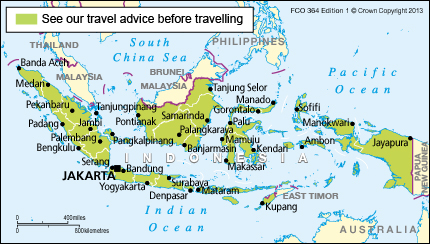
You should exercise caution when travelling to Aceh, Central Sulawesi Province (especially Palu, Poso and Tentena), Maluku Province (especially Ambon), Papua and West Papua Province due to potential for violence or violent conflict.
Clashes in late July 2014, resulted in the death of security service personnel and civilians in the Lanny Jaya regency of Papua province. If you’re travelling in the region you should exercise extreme caution.
Following the abduction of a British national in the Aceh region of Northern Sumatra in June 2013, you should exercise caution in the area. While the risk of abduction is not high, you should be aware that 1 French national and 5 Chinese nationals were abducted in separate incidents in 2008. See Local travel
Possession, trafficking and manufacture of drugs are serious offences in Indonesia. Some offences carry the death penalty. Don’t get involved. See Local laws and customs
Indonesia sits along a volatile seismic strip called the ‘Ring of Fire’. Volcanic eruptions and earthquakes occur regularly and tsunamis are possible. Flash floods and more widespread flooding occur regularly. See Natural disasters
With the exception of Garuda Airlines, Mandala Airlines, Airfast and Ekspres Transportasi Antarbenua (operating as PremiAir) and Indonesia Air Asia, all other Indonesian passenger airlines are refused permission to operate services to the EU because of safety concerns. See Air travel
There have been a number of deaths and cases of serious illness of tourists in Indonesia, caused by drinking alcoholic drinks contaminated with methanol. See Safety and security
The Overseas Business Risk service offers information and advice for British companies operating overseas on how to manage political, economic, and business security-related risks.
Take out comprehensive travel and medical insurance before you travel.


Travel Summary

  • On 17 July 2009 suicide bombers carried out attacks against the Ritz Carlton and Marriott Hotels in Jakarta. Seven people were killed and 55 injured.
  • There are a number of confirmed human cases of A (H1N1) – Swine Flu in Indonesia. The Indonesian Ministry of Health has announced that all passengers arriving in Indonesia from H1N1 affected countries will be asked to undergo medical screening. Anyone arriving with a temperature is likely to be taken to a nearby hospital for tests and will have to remain in hospital until given the all-clear. Quarantine for persons found infected with the virus will last for two weeks. The authorities would inform the British Embassy of any British nationals affected by these measures. Travellers should monitor the Indonesian Embassy website at http://www.indonesianembassy.org.uk/ for any further measures the Government of Indonesia may introduce.
  • The Pandemic Threat Alert System of the World Health Organisation (WHO) is at Level 6. The WHO website at: http://www.who.int/csr/disease/swineflu/en/index.html has further details. You should also monitor local media reports for any developments and advice. There is a dedicated “Swine Flu” page on the FCO website: http://www.fco.gov.uk/en/travelling-and-living-overseas/swine-flu. Guidance on Pandemic Flu can be obtained on the UK Department of Health website at: www.dh.gov.uk.
  • We advise you to exercise caution when travelling to Aceh, Central Sulawesi Province (especially Palu, Poso and Tentena), Maluku Province (especially Ambon) and Papua (including Papua province and West Papua Province). Since 11 July at least three people have been killed and a number injured in armed attacks on vehicles travelling between Timika and Tembagapura towns in Papua. You should be alert to the potential for politically motivated violence. See the Local Travel section of this advice for more details.
  • There is a high threat from terrorism throughout Indonesia. Terrorist groups continue to plan attacks and have the capacity and intent to carry out these attacks at any time and any where in the country. Attacks could be indiscriminate, including in places frequented by expatriates and foreign travellers. Terrorist attacks in Jakarta on 17 July and in Bali in October 2005 and October 2002 killed and injured a number of British nationals. See the Terrorism section of this advice for more details of previous attacks and precautions that you should take.
  • With the exception of Garuda Airlines, Mandala Airlines, Airfast and Ekspres Transportasi Antarbenua (operating as PremiAir), all Indonesian airlines are refused permission to operate services to the EU because Indonesia is unable to ensure that other airlines meet international safety standards. It is recommended that you avoid flying with Indonesian carriers subject to the EU operating ban. See the Air Travel section of this advice for more details.
  • Indonesia sits along a volatile seismic strip called the 'Ring of Fire' and volcanic eruptions, earthquakes occur regularly and tsunamis are possible. See the Natural Disasters section of this advice for more details.
  • Outbreaks of Avian Influenza (Bird Flu) in Indonesia have led to over 100 reported human fatalities. The last confirmed fatality was in January 2009. See the Health (Avian Influenza) section of this advice and also Avian and Pandemic Influenza for more details.
  • Around 150,000 British nationals visit Indonesia every year (Source: Office for National Statistics (ONS)). 2,294 British nationals required consular assistance in Indonesia in the period 01 April 2006 – 31 March -2007. The main types of incident for which they required consular assistance were for replacing lost or stolen passports (44 cases); dealing with deaths (2 cases); and hospitalisations (25 cases); and dealing with arrests, for a variety of reasons (18 cases). Penalties for illegal drug importation and use are severe and can include the death penalty.
  • We recommend that you obtain comprehensive travel and medical insurance before travelling. You should check any exclusions, and that your policy covers you for the activities you want to undertake. See the General (Insurance) section of this advice and Travel Insurance for more details.

Safety and security

Terrorism

There is a high threat from terrorism throughout Indonesia. Terrorist groups continue to plan attacks and have the capacity and intent to carry out these attacks at any time and any where in the country. Attacks could be indiscriminate, including in places frequented by expatriates and foreign travellers.
Terrorists have shown that they have the means and motivation to carry out successful attacks in Indonesia. On 17 July 2009 suicide bombers carried out attacks against the Ritz Carlton and Marriott Hotels in Jakarta. Seven people were killed and 55 injured. JI is believed to have been responsible for the Bali bombings in October 2002, which killed 202 people (including a number of British nationals), the Marriott Hotel bombing in Jakarta which killed 12 people in August 2003, and the Australian Embassy bombing in September 2004, which killed 11 people; and the Bali suicide bombings of 1 October 2005 which killed 20 people and injured a further 90.
These attacks underscore the ongoing terrorist threat in Indonesia. Venues known to be frequented by foreign visitors and expatriates, including beach resorts, bars and restaurants, hotels and shopping malls hosting major international brand outlets are potentially targets for such groups.
If you are visiting, or are resident in Indonesia, you should exercise caution at all times. We advise you to ensure that you are comfortable with, and regularly review, you and your family’s security arrangements.
You should be particularly vigilant during holiday periods such as Easter and Christmas, which can be a time of heightened tensions in Indonesia. In the past, attacks have occurred during holiday periods in Indonesia. In recent years, the Indonesian Police have announced tightened security in public places such as airports and major tourist areas over the Christmas and New Year period. You should exercise caution when visiting locations where large groups of people gather or which are known to be frequented by foreigners. If you are planning to travel overland or by boat to Malaysia or the Philippines, you should be aware that Philippines based terrorist groups also pose a risk. We advise against all travel to Mindanao, in the Philippines because of ongoing terrorist activity. Foreign nationals have also been kidnapped in the past in East Malaysia and we believe that this threat remains. Please see the FCO Travel Advice for Philippines and Malaysia.

You should be aware that the long-standing policy of the British Government is not to make substantive concessions to hostage takers. The British Government considers that paying ransoms and releasing prisoners increases the risk of further hostage taking.

For further information see Terrorism Abroad.
Crime

You should beware of street crime and pickpockets. Take personal security measures such as:

  • Taking particular care to safeguard your passport and credit/ATM cards. We receive regular reports of credit card theft after shop employees copied card details. You are advised not to lose sight of your credit card during transactions. In June 2009, police sources in Jakarta warned of a new form of fraud targeting bank customers who experience problems withdrawing cash from ATMs. The fraudsters reportedly display a fake assistance number on the ATM advising customers to report problems by telephone. Customers dialing the number are asked for their PIN and their card is never released from the machine.
  • Beware of thieves while travelling on public transport. We receive regular reports of extortionate fares or robberies by unlicensed airport taxi drivers. Their vehicles are usually in poor condition, are unmetered, and do not have a dashboard identity licence. When taking a taxi, use one from a reputable firm, preferably booked by phone or arranged by your hotel, or booked by a registered taxi firm inside the airport. British Embassy, Jakarta, staff are advised to use only taxis from the Bluebird and Silverbird group. These are widely available at hotels and shopping malls in central Jakarta and at Sukarno-International Airport. Care should be take to distinguish Bluebird and Silverbird vehicles from "look-alike competitors. For further details see: http://www.bluebirdgroup.com/taxis_in_jakarta.html.
  • For longer journeys it is a sensible precaution to notify friends of travel plans, contact them on arrival and where possible travel in convoy. Always carry a reliable means of communication with you. Keep doors locked at all times and avoid travelling alone.
  • We receive occasional reports of tourists who have been robbed after bringing visitors to their hotel rooms. In some cases their drinks were drugged and the Indonesian National Police have reported an increase in drink-spiking incidents in 2008. In June 2009 the Indonesian National Police began investigating a series of tourist deaths on Bali and Lombok (Gili Islands), including one British citizen. Their deaths may have been caused by drinking the traditional rice wine, arak, spiked with methanol. Arak is often used as a base for cocktails. If possible, seek local advice about reputable bars in the area which you are visiting and try to ensure that cocktails are prepared in your sight. Ensure your passport and wallet and other valuables are secure at all times.
For more general information see Victims of Crime Abroad.

Political Situation

Whilst the overall political situation is stable, developments elsewhere, including the Middle East, resonate in Indonesia. You should follow news reports and be alert to any developments which might trigger public protests or unrest.
You should avoid any demonstrations or large gatherings of people. If you become aware of any nearby violence you should leave the area immediately. You should keep yourself informed of developments, including by regularly checking this advice.
Indonesia Country Profile

Local Travel

You should ensure that you have the necessary permits when planning adventure trips in Indonesia. You should also ensure that you have a reliable and reputable guide in place for such a trip. Failure to do so can lead to difficulties with local authorities should you need their help.

Flash floods and more widespread flooding occur regularly during the rainy season from November to March. Cities - especially Jakarta - are frequently subject to severe localised flooding which can result in major disruption, and occasionally fatalities. Previous floods in Jakarta have affected a main toll road to the Soekarno-Hatta International Airport. You should allow extra time for meeting flight connections in line with the prevailing weather conditions.

Our additional advice for British nationals in Indonesia who are travelling outside Jakarta is as follows:

Central Sulawesi Province
We advise you to exercise caution when travelling to Central Sulawesi Province, especially Palu, Poso and Tentena because of the unsettled political situation. You should be alert to the potential for politically motivated violence.
Sectarian violence broke out in Central Sulawesi Province in 1998, which claimed almost 600 lives between 1998 and 2001. A peace deal signed in December 2001 dramatically reduced sectarian conflict in the region. From 2003-2006 violence continued in the form of bombings and assassinations, predominantly in the towns of Poso and Palu. Since 2007 the situation has been much calmer but sporadic incidents continue to occur.
Maluku Province
We advise you to exercise caution when travelling to Maluku Province, especially Ambon, including Haruku Island (Pulau Haruku), which was the scene of serious civil unrest between different religious and tribal gorups between 1999 and 2002. The region has continued to experience sporadic unrest, which has resulted in a number of deaths and serious injuries.

Aceh
We advise you to exercise caution when travelling to Aceh, especially if travelling to remote areas. Aceh is emerging from a long period of internal conflict. You should remain alert to the risk of politically motivated violence.
If you are visiting Aceh, you should make sure that you are well informed about the local situation at the time of your visit. You should avoid large crowds, demonstrations or political rallies, as elsewhere in Indonesia.
We have in the past received reports of Shari'a (religious) police harassing foreigners in Aceh. You should therefore exercise caution and ensure that your behaviour does not offend local sensitivities.
If you are travelling to Aceh to engage in humanitarian or reconstruction work, you should do so in conjunction with a well-established and reputable organisation that has permission to operate in Indonesia. You should ensure that your organisation has a security plan approved by the Indonesian authorities, and is actively linked to the local security advice of the UN Office for Crisis and Humanitarian Affairs in Banda Aceh.
You should ensure that you comply with local immigration controls and register with the police. Regulations regarding entry into and permission to remain in Aceh can change at any time. You should check with the Indonesian Embassy in London prior to travel to obtain the most recent information on entry requirements and registration procedures while in Aceh.
Aceh continues to suffer the after-effects of the December 2004 Indian Ocean tsunami. Reconstruction work is largely complete, roads, medical care and accommodation facilities for visitors in the western and northern coasts of Sumatra and outlying islands are still being improved.

Papua and West Papua
We advise you to exercise caution when travelling to Papua (including the Province of Papua and the Province of West Papua, formerly known as Irian Jaya Barat) and to seek local advice on your travel plans. Political tensions in Papua have given rise to sporadic violence. There is a heavy security presence in some areas, especially along the border with Papua New Guinea. If you are visiting Papua, you should exercise caution. As elsewhere in Indonesia, you should avoid large crowds and demonstrations, which can turn violent.
Papuan separatists have kidnapped foreigners in the past. There remains a small but significant risk.

Throughout 2009 there have been increased tensions in Papua province. Since 11 July a series of armed attacks on vehicles using the main road between Timika and Tembagapura have resulted in at least three deaths and a number of injuries. During April and May 2009 there were a series of incidents = including small-scale attacks on police and military posts in the Abepura and Jayawijaya districts, as well as a number of civilians killed in the vicinity of Wamena town. On 6 May protestors blocked the main road linking Sentani airport to the provincial capital Jayapura following the shooting of an individual after an altercation between a group of local residents and the police.

Permits are required to travel to Papua Regulations for entry into and permission to remain in Papua can change at any time. You should seek the latest information on entry requirements and registration procedures from the Indonesian Embassy in London.

Road Travel
You cannot drive in Indonesia on a UK driving licence, but are permitted to use an International licence which can be obtained in Indonesia. An International licence is obtained in the UK it may need to be endorsed by the Indonesian licensing office in Jakarta.

Traffic discipline is very poor; city streets are congested; and foreigners involved in even minor traffic violations or accidents may be vulnerable to exploitation. You should therefore think seriously about employing a private driver or hiring a car with a driver, which is not especially expensive. Some multinational companies refuse permission to their expatriate staff to drive in Indonesia. British Embassy, Jakarta, staff are advised to avoid driving themselves whenever possible.

Should you be involved in an incident such as an accident or breakdown you should ensure someone remains with your vehicle. You may wish to consider leaving your driver, if you have one, in charge of your vehicle in such circumstances, if you have any concerns for your security and can move to another location safely. You should make yourself available for questioning by the police if requested to do so.

Reports suggest that motorcyclists are more likely to be involved in road accidents than those driving cars.
For further information see Driving Abroad.
Air Travel
You should be aware that there have been a number of major aircraft crashes in Indonesia over the last ten years, for reasons including bad weather, poor maintenance and mechanical failure. The most recent major incident occurred on 7 March 2007, when an aircraft burst into flames on landing in Yogyakarta, Java, killing over 20 people.

With the exception of Garuda Airlines, Mandala Airlines, Airfast and Ekspres Transportasi Antarbenua (operating as PremiAir) all Indonesian airlines are refused permission to operate services to the EU because Indonesia is unable to ensure that all its airlines meet international safety standards. It is recommended that you avoid flying with Indonesian carriers subject to the EU operating ban.
A list of carriers banned from the EU can be found at the following link: http://ec.europa.eu/transport/air-ban/list_en.htm.

If you already have a flight booked with an airline from Indonesia and it is part of a journey which commenced in the EU you should consult your travel agent.

British Government employees are advised to use carriers which are not subject to an operating ban or restrictions within the EU unless this is unavoidable. You should bear this in mind when making your travel plans.

When leaving the country by plane, departure tax varies by Airport from 60,000 to 150,000 Rupiah. You will need to pay an Airport Tax of 150,000 Rupiah if departing through Jakarta International Airport, or from Bali International Airport.

Sea Travel

Inter-island travel by small boats can be dangerous as storms appear quickly and navigational equipment is often limited. There have been attacks against ships in and around the waters of Indonesia. Mariners are advised to be vigilant; reduce opportunities for theft; establish secure areas onboard; and report all incidents to the coastal and flag state authorities.

There have been a number of instances of passenger boats sinking in Indonesia. Most recently, on 11 January 2009, a passenger ferry carrying 267 passengers and crew capsized off the island of Sulawesi, reportedly killing 99 people following the rescue of 168 by Search and Rescue and local fisherman.
For more general information see River and Sea Safety

Local laws and customs

You should respect local traditions, customs, laws and religions at all times and be aware of your actions to ensure that they do not offend other cultures or religious beliefs, especially during the holy month of Ramadan or if you intend to visit religious areas. For more general information see Travelling During Ramadan.
You should be aware of offending Muslim sensitivities. Westerners have occasionally been harassed by fundamentalists in bars and nightclubs, particularly around major Islamic holidays such as Ramadan.
Do not get involved with illegal drugs. Possession, trafficking and manufacture of such drugs are serious offences in Indonesia. Those caught face lengthy prison sentences or the death penalty, usually after a protracted and expensive legal process. Police often raid locations (particularly in Bali) known to be frequented by foreigners, and are empowered to compel an individual to take a urine or blood test where they have reasonable suspicion that drugs have been taken, even where no actual illegal substances have been found on the person. Drug use or even the possession of small amounts of drugs such as marijuana or ecstasy can lead to prison sentences longer than four years. Convicted traffickers or users of hard drugs such as cocaine or heroin face the death penalty in Indonesia.
Gambling is illegal in Indonesia. There have been cases where tourists have fallen victim to organised gambling gangs, resulting in the loss of large amounts of money.
You must show evidence of your identity if it is requested by, for example, the Police. You should carry photocopies of the relevant pages of your passport and your arrival card to avoid losing the original, which should be kept in a safe place..
For more general information for different types of travellers see Travel Advice Relevant to You.

Entry requirements

Visas

Visas are required for UK nationals entering Indonesia, a tourist visa can be obtained on arrival for a specific short period. You are advised to consult the Indonesian Embassy in London.

Passport validity

You should ensure that your passport is valid for a minimum period of six months upon arrival. Entry to Indonesia may be refused and airlines may not carry passengers holding passports with less than six months validity. You are required to retain you arrival card for presentation to Immigration upon your departure.

Overstaying your visa

Overstaying without the proper authority is a serious matter and visitors can be held in detention or refused permission to leave the country until a fine is paid.

Registering
If you stay in private accommodation in Indonesia (not a hotel) you must register your presence with the local police or you could face a fine of Rp 5 million (£290). If you stay in a hotel you will be registered automatically.

Travelling with children

Single parents or other adults travelling alone with children should be aware that some countries require documentary evidence of parental responsibility before allowing lone parents to enter the country or, in some cases, before permitting the children to leave the country. They may want to see birth certificates, a letter of consent from the other parent or some evidence as to your responsibility for the child. Contact the Indonesian Representation in London for further information.

Health

The standard of local medical care in Indonesia can be poor and some medical tests cannot be done reliably. Good medical care can be very expensive and in remote areas attention for serious injuries or illness is likely to be unobtainable. You may require expensive medical evacuation costing up to tens of thousands of pounds. Therefore you should ensure your policy covers you for medical evacuation by air ambulance.
Indonesia suffers from periodic problems with air quality reaching hazardous levels because of seasonal smoke haze from forest fires. You are advised to check news reports and follow local advice.

Dengue, chikungunya and malaria occur in Indonesia. These diseases are transmitted by mosquitoes. There are no vaccinations against these diseases, but there are preventative measures that you can take, as advised on the National Travel Health Network and Centre (NaTHNaC) website. You should visit your GP to discuss malaria prevention tablets.

There is a risk of rabies throughout Indonesia, in particular in Bali. In December 2008, local officials reported an outbreak of rabies in Bali, following a small number of deaths in the village of Ungasan in Uluwatu district (Badung Regency). In January 2009, the presence of rabies was also confirmed in the Kutah area of Bali. Sanglah Hospital in Bali has prepared a special area to treat people suspected of being exposed to the rabies virus and doctors in other clinics in Bali have been trained to care for potential victims. Two people were reported to have died from rabies at Sanglah Hospital at the end of March 2009. In April 2009, a further outbreak of rabies in wild dogs was reported in Pecatu village, near Nusa Dur. Travellers to Indonesia should avoid contact with animals and seek immediate medical attention if bitten or scratched by an animal. For further information about rabies see the NaTHNaC website.

In the 2008 Report on the Global AIDS Epidemic the UNAIDS/WHO Working Group estimated that around 270,000 adults aged 15 or over in Indonesia were living with HIV; the prevalence rate was estimated at around 0.2% of the adult population. This compares to the prevalence rate in adults in the UK of around 0.2%. You should exercise normal precautions to avoid exposure to HIV/AIDS. For more general information on how to do this see HIV and AIDS.
You should seek medical advice before travelling to Indonesia and ensure that all appropriate vaccinations are up-to-date. For further information on vaccination requirements, health outbreaks and general disease protection and prevention you should visit the websites of the National Travel Health Network and Centre (NaTHNaC) or NHS Scotland's Fit For Travel or call NHS Direct on 0845 46 47.
For more general health information see Travel Health and for food/drink hygiene see Eat and Drink Safely.

A (H1N1) - Swine Flu

Britons travelling abroad should be aware and prepared for the fact that should they enter Indonesia they may be required to pass through a screening process which identifies persons with high temperatures. Should a person be identified with a higher than normal temperature or display any other flu symptoms, the authorities have the right to place the person in medical quarantine and administer tests for the H1N1 (Swine Flu) virus. It may take up to three days for the test results to be known and if found positive the person will be quarantined for a further two weeks. A further test will then be carried out and if all clear the person will be allowed to continue their journey. However if the test is positive the second time, a further quarantine period of two weeks will be imposed. The British Embassy staff has no authority to interfere with a medically imposed quarantine, and due to the quarantine restrictions is unlikely to be able to do more than make contact with the person by telephone. The authorities would inform the British Embassy of any British nationals affected by these measures. Travellers should monitor the Indonesian Embassy website at http://www.indonesianembassy.org.uk/ for any other measures the Government of Indonesia may introduce.
The Pandemic Threat Alert system of the World Health Organisation (WHO) is at Level 6. The WHO website at: http://www.who.int/csr/disease/swineflu/en/index.html has further details.
You should also monitor local media reports for any developments and advice. There is a dedicated “Swine Flu” page on the FCO website: http://www.fco.gov.uk/en/travelling-and-living-overseas/swine-flu. Guidance on Pandemic Flu can be obtained on the UK Department of Health website at: www.dh.gov.uk.

Avian Influenza (Bird Flu)

There have been outbreaks of Avian Influenza (Bird Flu) in commercial and backyard poultry and a small number of pig farms in Indonesia. Infected birds have been found in all of Indonesia's 33 provinces (most recently in February 2009 in Badung, the southernmost regency of Bali) with the exception of Gorontolo and North Maluku and there are ongoing outbreaks. Indonesia has more confirmed cases of human fatalities than any other country with over 100 reported fatalities (most recently in February 2009). Most human cases had direct contact with sick/dead poultry or were exposed to environments with recent outbreaks of the virus.

The WHO have confirmed that the deaths of seven members of one family in the TanaKaro district of North Sumatra in May 2006, were likely to be the result of limited, non-sustained human-to-human transmission of the virus. However, to date, there has been no evidence of widespread or sustained human-to-human transmission in Indonesia.

The risk to humans from Avian Influenza is believed to be very low. However, as a precaution, you should avoid visiting live animal markets, poultry farms and other places where you may come into close contact with domestic, caged or wild birds; and ensure poultry and egg dishes are thoroughly cooked.

The World Health Organisation (WHO) has warned of the possibility that the Avian Influenza outbreaks could lead at some point to a human flu pandemic, if the virus mutates to a form, which is easily transmissible between people.

British nationals living longer term in an Avian-Influenza affected region should speak to their employers about any pandemic influenza contingency plans which they may have in place and take personal responsibility for their own safety in the event of a future pandemic, including considering their access to essential supplies and adequate healthcare and ensuring travel documents are up to date.
You should read this advice in conjunction with Avian and Pandemic Influenza, which gives more detailed advice and information.

Natural disasters

Indonesia sits along a volatile seismic strip called the 'Ring of Fire' in the Pacific. Volcanic eruptions, earthquakes occur regularly in Indonesia which can, where the severity and conditions of the quake combine, present a potential threat of tsunamis within the region. The 'ring-of-fire' is a horse-shoe-shaped zone of frequent earthquakes and volcanic eruptions that surrounds the basin of the Pacific Ocean. It is 40,000kms long and is associated with a nearly continuous series of oceanic trenches, island arcs, and volcanic mountain ranges and/or plate movements.

It is understood that 90% of the world's earthquakes and 81% of the world's largest earthquakes occur along the Ring of Fire which is a direct consequence of plate tectonics and the movement of collisions of crustal plates.

Earthquakes

Visitors currently planning to visit West Papua Province (formerly West Irian Jaya Province) should be aware that earthquakes which occurred on Sunday 4 January 2009, have caused considerable damage to buildings including hotels in the coastal town of Manokwari, some damage to the airport was also reported. If planning a visit to this region you should check with your tour operator before travelling.

On 16 November 2008 an earthquake struck Gorontalo Province off the northern coast of the island of Sulawesi causing fatalities and structural damage to a number of buildings, and on 12 September 2007 an earthquake in Southern Sumatra resulted in a number of fatalities.

The 26 December 2004 earthquake and tsunami caused massive devastation to coastal areas in Aceh and parts of North Sumatra.

Floods

Flash floods and more widespread flooding occur regularly during the rainy season from November to March. Cities - especially Jakarta - are frequently subject to severe localised flooding which can result in major disruption, and occasionally fatalities. The collapse of the dam at Lake Situ Gintung on the outskirts of Jakarta on 27 March resulted in the death of 98 people, over a hundred missing and many hundreds of people homeless. Landslides occur in rural areas during the wet season. In December 2007, landslides in Central Java killed over 80 people.

Volcanoes

There are numerous volcanoes in Indonesia, any of which can erupt without warning. Since April 2008, Mount Soputan in North Sulawesi, Mount Egon on Flores island, Nusa Tengarra, Mount Ibu in North Maluku and Anak Krakatoa in the Sunda Strait have shown significant increased volcanic activity.
On Monday 20 April 2009 the Indonesian Vulcanology Agency raised the alert status of Anak Krakatoa to “Warning – eruption possible within two weeks”. Local people have been advised to remain outside of a three kilometre exclusion zone. On 2 June 2009, Mount Karangetang (North Sulawesi) erupted, forcing the evacuation of villagers in the area. If you are planning to visit these areas you should monitor local media reports and follow advice of the local authorities.
You are advised to exercise caution, check news reports and follow local advice before travelling to volcanic areas. The capacity of the Indonesian emergency and rescue services to deal with large natural disasters is limited.
On 14 July 2007 poisonous fumes from Salak Volcano, just south of Jakarta killed six school children who were camping on the Volcano.

For further information, you should visit the Indonesian Centre for Vulcanology's website.

General

Insurance
We recommend that you obtain comprehensive travel insurance before travelling. You should check any exclusions and make sure your policy covers you for all the activities you want to undertake, particularly if you plan to engage in adventure sports. Good medical attention for serious injuries or illness is likely to be unobtainable in remote areas, and may require expensive medical evacuation costing up to tens of thousands of pounds. You should therefore ensure that your policy covers you for medical evacuation by air ambulance. For more information see Travel Insurance.
If things do go wrong when you are overseas then this is how we can help.

Registering with the British Embassy
It is important that all resident British nationals register with the Embassy on the new online LOCATE system to tell us when and where you are travelling abroad or where you live abroad so our consular and crisis staff can provide better assistance to you in an emergency. More information about registering with LOCATE can be found here.

Tuesday, August 4, 2009

Singapore travel advice


Summary update

Haze can affect air quality in Singapore. You should monitor the Pollutant Standards Index (PSI) updates and health advisories from the Singapore government. See Health
It’s illegal to drink alcohol in public places (eg beyond the premises of bars and restaurants) from 10.30pm to 7am and all day at weekends in certain areas. Offenders will be fined. See Local laws and customs
Don’t become involved with drugs of any kind. Possession of even very small quantities can lead to imprisonment, corporal punishment or the death penalty.
There is an underlying threat from terrorism. See Terrorism
The offence of ‘outrage of modesty’ (molestation) can result in a fine, jail or corporal punishment. Scams involving false claims of molest are thought to exist. See Local laws and customs
There is a risk from Dengue fever. See Health
Around 450,000 British tourists visit Singapore every year. Most visits are trouble-free.
The Overseas Business Risk service offers information and advice for British companies operating overseas on how to manage political, economic, and business security-related risks.
Take out comprehensive travel and medical insurance before you travel.


Travel Summary

  • There are confirmed human cases of Swine Flu, Influenza A (H1N1), in Singapore with confirmed human to human transmission. If you are suspected of having Swine Flu you may be instructed by health authorities to quarantine yourself within your accommodation and not to travel for a set number of days.
  • If you develop flu like symptoms you are advised to visit your nearest 'pandemic preparedness clinic' (see map: http://www.street-directory.com/hpb.ppc/) and if possible wear a surgical mask and avoid public transport on the way there. If you are very ill (e.g. difficulty breathing, chest pain, severe vomiting) call 995 for an ambulance. Everyone should observe good hygiene practices such as regularly washing hands.
  • You can check for updates on Swine Flu on the Singapore government's flu alert webpages: www.crisis.gov.sg/FLU . You should monitor local media reports for any developments and advice. The World Health Organisation (WHO) has raised its Pandemic Threat Alert Phase to Level 6. The WHO website at http://www.who.int/csr/disease/swineflu/en/index.html has further details. There is a dedicated Swine Flu page . Guidance on Pandemic Flu can be obtained on the UK Department of Health website at www.dh.gov.uk .
  • You should not become involved with drugs of any kind: possession of even very small quantities can lead to imprisonment or the death penalty.
  • There is an underlying threat from terrorism. Attacks could be indiscriminate, including in places frequented by expatriates and foreign travellers.
  • Around 500,000 British tourists visit Singapore every year (Source: Singapore Immigration and Checkpoints Authority). Most visits to Singapore are trouble-free.
  • There is a risk from Dengue fever in Singapore. You should take normal precautions against being bitten by mosquitoes. See the Health section of this travel advice for more details.
  • We strongly recommend that you obtain comprehensive travel and medical insurance before travelling. You should check any exclusions, and that your policy covers you for all the activities you want to undertake. See the General (Insurance) section of this advice and Travel Insurance for more details.

Safety and security

Terrorism
There is an underlying threat from terrorism. Attacks could be indiscriminate, including in places frequented by expatriates and foreign travellers.
The Singaporean Government has put in place extensive measures to combat terrorism and has arrested a number of terrorist suspects.
For further information see Terrorism Abroad.

Crime
Violent crime is rare. You should be aware of the dangers of street crime, particularly bag‑snatching.

You should:
  • take particular care of your passport;
  • leave tickets and unneeded cash/travellers cheques in the hotel safe or at (hosts') home;
  • when going out, avoid carrying valuables with you, and be aware of your surroundings;
  • not leave possessions in unattended vehicles.
Police permission is required for certain kinds of public gatherings in Singapore. You should therefore avoid street gatherings and public demonstrations, which might place you at risk.
For more general information see Victims of Crime Abroad.
Political Situation

Singapore Country Profile

Local Travel

Road Travel
Road conditions in Singapore are generally good. If you are involved in an accident, you should not leave the scene until the police have attended.

A foreign driving licence can be used in Singapore for as long as it is valid. But if you are staying in Singapore for longer than one year you should get a Singaporean driving licence or an annually-renewable International Driving Permit. These are more readily recognised by the Singaporean authorities.
For further information see Driving Abroad.
Air Travel

The restrictions on the carriage of liquids, aerosols and gels in aircraft cabins, implemented across the EU in 2006, also applies in Singapore and is rigorously enforced. For more general information see Airline Security.

Sea Travel
There have been attacks against ships in and around the waters of Singapore and the Malacca Straits. Mariners are advised to be vigilant and take appropriate precautions; reduce opportunities for theft; establish secure areas onboard; and report all incidents to the coastal and flag state authorities.
For more general information see River and Sea Safety

Local laws and customs

The mandatory death penalty exists in Singapore for certain capital offences, including murder and drug trafficking. There are severe penalties for all drug offences in Singapore. Trafficking is defined by possession of drugs above a certain amount (eg 500g in the case of cannabis).

Penalties for visa overstayers include fines, imprisonment and corporal punishment (the rattan cane) depending on the length of overstay. A wide range of lesser offences such as "outrage of modesty" (inappropriate behaviour by men towards women) carries corporal punishment (the rattan cane).
Driving under the influence of alcohol is a serious offence in Singapore, and the traffic police regularly carry out breath tests. Sentences for driving whilst under the influence of alcohol can include a fine or imprisonment. The Singaporean authorities will prosecute cases of air rage within their jurisdiction.
On-the-spot fines are common. You will be fined for smoking in any public place or indoor restaurant, for chewing gum on the Mass Rapid Transit (MTR) system or littering.
You should be aware that thorough checks are being conducted on departing travellers' vehicles at checkpoints in Singapore. This includes the scanning of fingerprints.
Dual nationals and Permanent Residents
Singapore does not recognise dual nationality beyond the age of 21. If you are male and a citizen of Singapore or you hold Singapore Permanent Resident (SPR) status you are liable for national service from the age of 16 up to 50. Male children granted Permanent Resident status as part of their parents’ SPR applications are also liable for national service. For further information see the following websites for Singapore - Immigration and Checkpoints Authority and Ministry of Defence (MINDEF).
For more general information for different types of travellers see Travel Advice Relevant to You.

Entry requirements

Visas
You do not normally need visas to enter Singapore for up to 30 days stay for tourism, business discussions or social visits. However, women who are 6 or more months pregnant must obtain permission to enter before travelling. Prior entry clearance is also required to give birth in Singapore. Applications can be made at the nearest Singapore visa issuing office. For further information contact the High Commission for the Republic of Singapore in London.

Passport validity
Singaporean immigration authorities require that you have at least six months' validity on your passport beyond your departure date from Singapore. Likewise, if you are intending to transit Singapore to neighbouring countries, you should ensure that your passport is valid for at least six months. You may be refused entry or be turned away by airlines if your passport does not meet this requirement. Check departure tax is included in the cost of your airfare.
Customs Regulations
You should be careful to comply with Singaporean customs regulations. Importation of controlled drugs and pirated copyright material is prohibited and there are restrictions on entering with items such as replica guns, radio communications equipment, and weapons and ammunition (including empty cartridge cases). For more information we recommend that you visit the travellers section of Singapore Customs government website before arrival.
Travelling with children
Single parents or other adults travelling alone with children should be aware that some countries require documentary evidence of parental responsibility before allowing lone parents to enter the country or, in some cases, before permitting the children to leave the country. They may want to see birth certificates, a letter of consent from the other parent or some evidence as to your responsibility for the child. For further information contact the High Commission for the Republic of Singapore in London.

Health

There are confirmed human cases of Swine Flu, Influenza A (H1N1), in Singapore with confirmed human to human transmission. If you are suspected of having Swine Flu you may be instructed by the health authorities to quarantine yourself within your accommodation and not to travel for a set number of days.
If you develop flu like symptoms you are advised to visit your nearest 'pandemic preparedness clinic' (see map: http://www.street-directory.com/hpb.ppc/) and if possible wear a surgical mask and avoid public transport on the way there. If you are very ill (e.g. difficulty breathing, chest pain, severe vomiting) call 995 for an ambulance. Everyone should observe good hygiene practices such as regularly washing hands.
You can check for updates on Swine Flu on the Singapore government's flu alert webpages: www.crisis.gov.sg/FLU. You should monitor local media reports for any developments and advice. The World Health Organisation (WHO) has raised its Pandemic Threat Alert Phase to Level 6. The WHO website at: http://www.who.int/csr/disease/swineflu/en/index.html has further details. There is a dedicated Swine Flu page on this website. Guidance on Pandemic Flu can be obtained on the UK Department of Health website at www.dh.gov.uk.
You may be placed in quarantine for up to seven days if you arrive in Singapore on a flight on which a fellow passenger is subsequently found to have Swine Flu. The Singaporean government advises travellers arriving from areas with community transmission of Swine Flu to monitor their health and call 993 for an ambulance should they develop flu symptoms with a fever (a temperature of 38 degrees Celsius or more).

As a preventative measure against Swine Flu the temperature of all people entering Singapore at the airports, at the two bridge crossings from Malaysia and at the ferry terminals are being checked with non-obtrusive body scanners (this is not applied to those who are only transiting in the airport). Those with high temperatures are being sent for further medical examinations.
Healthcare in Singapore is of a high quality and expensive. Local hygiene standards are high. You should take enough medication to cover your stay and carry it in your hand baggage. Not all UK prescribed drugs are available in Singapore. Some over-the-counter medications (eg Ibuprofen) need a prescription.
For entry into Singapore a valid yellow fever vaccination certificate is required from travellers (over one year of age) who, within the preceding six days, have been in or have passed through any country where yellow fever is endemic (most tropical African and South American countries - please see http://www.ica.gov.sg/page.aspx?pageid=95&secid=94 for details).
Singapore periodically suffers from smoke haze caused by forest fires in Indonesia.
Dengue occurs in Singapore. Clusters of chikungunya cases have also been reported in 2008. Chikungunya and dengue are transmitted by mosquitoes. There are no vaccinations against these diseases but there are preventative measures that you can take, as advised on the National Travel Network and Centre (NaTHNaC) website. For up to date information on the local dengue hotspots please see the website of Singapore’s National Environment Agency at: http://app.nea.gov.sg/cms/htdocs/category_sub.asp?cid=239
During 2008, an increase in cases of Hand, Foot and Mouth Disease (HFMD) were reported compared to 2007. The World Health Organisation has advised that there is no cause for alarm and that you should take normal precautions and be vigilant about washing hands.

In the 2008 Report on the Global AIDS Epidemic the UNAIDS/WHO Working Group estimated that around 4,100 adults aged 15 or over in Singapore were living with HIV; the prevalence rate was estimated at around 0.2% of the adult population. This compares to the prevalence rate in adults in the UK of around 0.2%. You should exercise normal precautions to avoid exposure to HIV/AIDS. For more general information on how to do this see the HIV and AIDS.

You should seek medical advice before travelling to Singapore and ensure that all appropriate vaccinations are up to date. For further information on vaccination requirements, health outbreaks and general disease protection and prevention you should visit the websites of the National Travel Health Network and Centre (NaTHNaC) and NHS Scotland's Fit For Travel or call NHS Direct on 0845 46 47.

For more general health information see the Travel Health and for food/drink hygiene see Eat and Drink Safely.

Avian Influenza (Bird Flu)

The World Health Organisation (WHO) has confirmed cases of Avian Flu in Southeast Asia but none have been reported in Singapore.
You should read this advice in conjunction with Avian and Pandemic Influenza, which gives more detailed advice and information.

General

Insurance
We strongly recommend that you obtain comprehensive travel and medical insurance before travelling. You should check any exclusions, and that your policy covers you for all the activities you want to undertake. For more general information see Travel Insurance.

If things do go wrong when you are overseas then this is How We Can Help.
Money
The local currency is the Singapore Dollar. Major credit cards are accepted in most hotels, restaurants and department stores. Credit card fraud is not a major problem in Singapore, but check your statements carefully. Keep your credit card company’s telephone number to hand: your card may be stopped if they think it has been stolen or cloned.
Registration

Register with our LOCATE service to tell us when and where you are travelling abroad or where you live abroad so our consular and crisis staff can provide better assistance to you in an emergency. More information about registering with LOCATE can be found on the here.