Saturday, February 13, 2010

Ethiopia travel advice

Summary


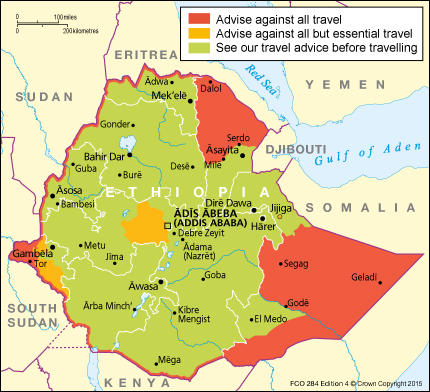
The Foreign and Commonwealth Office (FCO) advise against all travel to:
  • within 10 km of the border with Eritrea, with the exception of the main road through Axum and Adigrat, and tourist sites close to the road (e.g. Debre Damo and Yeha)
  • areas off the principal roads/towns within 10 km of the borders with Sudan and Kenya
  • within 10 km of the border with South Sudan
  • the Nogob (previously Fik), Jarar (previously Degehabur), Shabelle (previously Gode), Korahe and Dollo (previously Warder) zones of the Somali region.
  • within 100 km of the Ethiopian border with Somalia and Kenya in the Afder and Liben zones of Ethiopia’s Somali region
  • the Danakil desert area: north of the Mille-Djibouti and Mille-Chifra roads, and east of the towns of Bere-Ale, Shehet, Didigsala and Chifra
  • the four woredas (districts) (Akobo, Wantawo, Jikawo and Lare) of the Nuer zone and the Jore woreda of the Agnuak zone of the Gambella region
The FCO advise against all but essential travel to:
  • west and south-west Shewa zones in the Oromia region (this area includes the popular tourist destination of Wenchi Crater)
  • Jijiga town
  • Three woredas of the Agnuak zone of the Gambella region that border on South Sudan (Dima, Goge, and Etang) and the Gambella Wildlife Reserve (taking into account the advice against all travel to within 10km of the border with South Sudan)
Widespread protests have occurred across the Oromia region in recent weeks; some have turned violent resulting in casualties and others have caused disruption to road travel. There is a heightened risk of travel across the region. If you travel there, seek information about the situation before you leave and avoid large crowds and demonstrations.
There have been heavy clashes including gunfire between protesters and security forces on 17 December in Sululta, 20km north of Addis Ababa on the road to Bahir Dar. Localised clashes in the Galabat area resulted in the closure of the Metema-Galabat border post with Sudan on 15 and 16 December 2015 and further crossing point closures may occur.
There was an explosion at the Anwar Mosque in the Merkato area of central Addis Ababa on 11 December. You should remain vigilant.
There were reports of a shooting incident in the Mago Park in the Omo Valley in December 2014. No injuries were reported. Take extra care if you’re in this region.
There is a high threat from terrorism. There are credible reports that Al Shabaab plan, and have the capability, to attack targets in Ethiopia. In October 2014 the US Embassy in Addis Ababa issued a travel warning advising “those in Addis Ababa to avoid areas where both Ethiopians and westerners frequent”, and citing threat reports of Al Shabaab’s intent to target the Bole area of the city.
You should be vigilant at all times, especially in crowded areas and public places like transport hubs, hotels, restaurants, bars and places of worship and during major gatherings like religious or sporting events. There is a high threat of kidnapping in Ethiopia’s Somali region, particularly in the eastern areas to which the FCO advise against all travel. See Terrorism
Crime levels are low, but you should avoid large gatherings and public demonstrations and be alert to the risk of street crime. See Crime
The Ethiopia-Eritrea border remains closed. Several security incidents have taken place along the border. The risk of cross-border tensions remains. There is a threat of kidnapping along the border. See Local travel
Owning ivory is strictly prohibited in Ethiopia. Anyone caught in possession of ivory can expect to be detained by police. See Local laws and customs
Around 20,000 British nationals visit Ethiopia every year. Most visits are trouble free.
The Overseas Business Risk service offers information and advice for British companies operating overseas on how to manage political, economic, and business security-related risks.
Take out comprehensive travel and medical insurance before you travel.

Safety and security

Crime

Petty theft and mugging is common and on the rise. Take particular care when visiting crowded public places, especially at night. There have been incidents of assaults occurring around the Bole area at night. Keep valuables like cameras and passports out of sight. Be aware of the risk of pick-pocketing, and bag and jewellery snatching including from vehicles stopped at traffic lights in Addis Ababa. Incidents involving parked and unattended cars are on the increase. When parking in Addis Ababa, leave your car in a well lit and guarded area. Consider fitting anti-shatter film to all windows on your vehicle.
Large crowds are common on key national and religious dates. These include 7 January (Ethiopian Christmas); 19 January (Epiphany/’Timket’); 2 March (Victory of Adawa); 5 May (Ethiopian Patriots’ Victory Day); 28 May (Downfall of the Derg); 11/12 September (Ethiopian New Year); 27 September (The Finding of the True Cross/’Meskel’). Large crowds also gather on Ethiopian Easter; Eid (End of Ramadan); Eid Al Arafa and the Birthday of the Prophet Mohammed.
There have been a small number of cases of arbitrary detention of British nationals in Ethiopia in recent years. There is a risk that this could reoccur – particularly where tensions are heightened (for example around major events, or in locations that might be deemed sensitive for security reasons). You should carry copies of your passport and the contact details of the British Embassy, Addis Ababa at all times. This may help if you’re questioned or detained. However, you should be aware that the Ethiopian authorities have in many cases failed to meet their international obligations to notify Embassies when foreign nationals have been detained. Even if requested, adequate consular access is not always granted.

Local travel

When travelling outside Addis Ababa consider travelling in a party and leave details of your travel itinerary with a reliable person. Carry a comprehensive medical pack. Telephones, including the sole mobile network, are unreliable. Wherever possible do not leave vehicles unattended. The Entoto hills near Addis Ababa are a popular spot with tourists and expatriates but there has been a recent increase in break-ins on unattended vehicles. In January 2014 there was an attempted robbery against a lone female on the Entoto walking trail.
There have been widespread protests across the Oromia Region in recent weeks, some of which have reportedly turned violent and resulted in casualties, and others which have caused severe disruption to road travel.
Since September 2014, there have been reports of ethnic conflict between communities in the Gambella region. The clashes began in Mejenger Zone but recently have spread wider, including to Gambella town. Reports have stated that dozens of people may have died.
There is local instability, lawlessness, military activity and a general risk of banditry in the Somali region. Since the mid-1990s, insurgent groups, some affiliated with terrorist organisations, have clashed with government forces, particularly in the Ogaden. Foreigners have been caught up in the violence or targeted. There have been attacks on staff working for international NGOs. Avoid overnight stays unless you are in secure accommodation.
In December 2011, two Swedish journalists were found guilty of supporting terrorism having entered Ethiopia illegally from Somalia. Any journalist wishing to operate legitimately in Ethiopia should get the necessary accreditation.
The Ethiopian military attacked targets across the Eritrean border in March 2012. There is a risk of further violence close to the border between Ethiopia and Eritrea.
There are cross-border tensions in the Tigray and Afar regions and the security situation has deteriorated. Take great care if you travel on the road from Addis Ababa to Djibouti, including via Asaita, due the high number of road traffic accidents.
In January 2013, an Austrian tourist was shot and killed near Bahir Dar while camping near the Nile. This is an area popular with tourists.
In May 2012, a group of tourists were attacked while travelling in the Surma region near the Omo River between the towns of El Dima and Kibbish. This is an area popular with tourists visiting the Omo valley.
There is banditry in the areas bordering Sudan, South Sudan and Kenya. If you are crossing into Kenya or Sudan, keep to the main road and seek advice from local authorities about travelling in convoy.
There has been violence, inter-tribal clashes and armed attacks in the Gambella region. While foreigners have not been targeted, there is a risk of being caught up in the violence.
Health and Safety precautions like life jackets in boats or protective railings at historical sites are rarely in place in Ethiopia.
An attack on a passenger bus in the Benishangul-Gumaz Region on 15 April killed 9 people and wounded 6. There have also been reports of an inter-ethnic attack which left as many as 9 people dead on 18 May. Both events occurred in the Sherkole woreda (district).

Air travel

On 17 February, there were reports of a hijacking of an Ethiopian Airline flight leaving Addis Ababa for Rome. The flight later landed safely in Geneva.

Road travel

Drivers should also be aware that under Ethiopian laws, drivers involved in car accidents can face severe punishments, including custodial sentences and fines.
Visitors to Ethiopia should be aware that driving standards are poor, and traffic accidents are common and sadly often fatal. Visitors should be very careful when travelling by car.
You should avoid driving after dark in rural areas: vehicles often have no lights and livestock may be roaming the roads.
Traffic accidents are a regular occurrence in Ethiopia and Addis Ababa specifically. If you are involved in a traffic accident you should remain with your vehicle and call the local police. You should avoid confrontation and await the arrival of the police to resolve the matter.

Political situation

Protests and demonstrations sometimes take place in Addis Ababa and other cities. In the past, some of these have become violent. You should avoid any protests or demonstrations.

Travel Summary
The Ethiopia-Eritrea border remains closed. Several security incidents have taken place along the border, particularly in the Humera region. The risk of cross-border tensions increasing and the security situation deteriorating very rapidly continues. With the exception of the main road through Axum and Adigrat, we advise against all travel within 50 kms of the border areas with Eritrea because of the risk of landmines and banditry. See the Local Travel (North and East Ethiopia) section of this Travel Advice.
We also advise against all travel to areas off the principal roads/towns within 50 kms of the borders with Sudan and Kenya; to the Danakil desert area bounded by the Dessie-Adigrat road, the Dessie-Djibouti road and to the Gambella region outside of Gambella town itself. This is because armed groups hostile to the Government of Ethiopia operate in several of these border areas. See the Terrorism/Security and Local Travel sections of this Travel Advice.
We advise against crossing the Ethiopia/Somalia or Somaliland border by road. We also advise against travel to the Fik, Degehabur, Gode, Korahe and Warder zones of the Somali region where rebels groups are active and the situation remains volatile. This is because of ongoing military activity and lawlessness in the region. We also advise against all but essential travel to Jijiga town. See the Terrorism/Security section and the Local Travel (North & East Ethiopia) section of this Travel Advice.
There is a high threat from terrorism in Ethiopia; attacks could be indiscriminate including places frequented by expatriates and foreign travellers. As of the beginning of December 2008 the Ethiopian authorities remain on alert following their announcement in November 2008 that they had information about plans to carry out a terrorist attack in Ethiopia. As a result security has been increased around government buildings and major hotels in the capital Addis Ababa and Embassies, including the British Embassy. British nationals are advised to remain extremely vigilant at all times in public places checking this Travel Advice for updates at regular intervals.
There is a low level of crime but you should avoid any public demonstrations. We do not advise against travel to the main tourist destinations including Bahir Dar, Gonder, Lalibela, Axum and the rift valley lakes and the Omo Valley.
Around 16,000 people visit Ethiopia from Britain each year (source: Ethiopian Ministry of Culture and Tourism). 26 British nationals required consular assistance in Ethiopia in the period 01 April 2008 – 31 March 2009 for the following types of incident; deaths (13 cases); hospitalisations (2 cases); and arrests, for a variety of offences (4 cases). During this period assistance was also requested with regard to lost or stolen passports (25 cases). See the Crime section of this Travel Advice.
We recommend that you obtain comprehensive travel and medical insurance before travelling. You should check any exclusions, and that your policy covers you for all the activities you want to undertake. See the General (Insurance) section of this Travel Advice .
Safety and security
Terrorism/Security There is a high threat from terrorism in Ethiopia, including in Addis Ababa. Attacks could be indiscriminate, including in places frequented by expatriates and foreign travellers. These include government buildings, major hotels and Addis Ababa and Embassies.

Since the beginning of December 2008 the Ethiopian authorities remain on alert following their announcement that they had information about plans to carry out a terrorist attack in Ethiopia. As a result security has been increased around government buildings and major hotels in the capital Addis Ababa and Embassies, including the British Embassy.
On 15 January 2009 there was an explosion reported at the main bus station in the Mercato Market area of western Addis Ababa. Thirty two people were reported injured.
On 28 September 2008 Ethiopian police reported that there had been an explosion in the "Musna Sefer" area of Jijiga, the capital of the Somali Region. This took place at a taxi terminal near the Andinet Hotel. Four people were killed and eight injured.
On 22 September 2008 two international staff members of Medicines du Monde were kidnapped by armed gunmen near the town of Lascanood in the Warder Zone of the Somali Region, near the border of Somalia. They were released in early January 2009 in Somalia.
On 28 May 2008 Ethiopian police reported two explosions in hotels in Negelle Borena, in the Oromiya region, a town 595 kilometres (320 miles) south east of the capital Addis Ababa. Several people were reportedly killed with others injured. A Somali Islamic militant Group claimed responsibility for the attack.
On 20 May 2008, a bomb exploded on a local minibus travelling from Arat Kilo to Meskel Square near the Ethiopian Mapping Agency in the Kirkos sub-city district of the capital Addis Ababa. Six people were reported killed and seven people seriously injured.
On 14 April 2008 there were two explosions at the petrol stations near the Gergi Imperial and Lem hotels (eastern Addis Ababa). Four people were reported killed and 15 people injured. You should remain extremely vigilant at all times in public places checking this Travel Advice for updates at regular intervals.
You should remain extremely vigilant at all times in public places, particularly at transport hubs, checking this Travel Advice at regular intervals. There remains a risk of similar attacks on petrol stations.Explosive devices, such as grenades, are readily obtainable throughout Ethiopia and are occasionally used during local disputes. There is a risk of British nationals and other foreigners becoming indiscriminately caught up in attacks.Because of ongoing military activity and lawlessness in the Somali region, we advise against all travel to the Fik, Degehabur, Gode, Korahe and Warder zones. We also advise against all but essential travel to Jijiga town, due to the risk of being caught up in a bomb attack following a number of incidents in the last 24 months, and recommend against overnight stays unless in secure accommodation. Recent incidents (in addition to those above) include:
On 5 August 2007 there were two bomb explosions in the town of Jigga – one near the Protestant church the other in a market area - which reportedly killed one and injured around a dozen.
On 28 May 2007, there was an explosion in the Jijiga stadium. At least five people were killed and 52 wounded in the blast.
On 24 April 2007, a terrorist group attacked an oil exploration facility in Obele, resulting in civilians, including foreign workers being killed and kidnapped.
There has been continuing unrest, sporadic violence, banditry and inter-tribal clashes in the West and South of the Gambella region. Although the situation is improving, it remains unpredictable and we advise against all travel outside of Gambella town.In the past, groups affiliated with terrorist organisations have also been active in other border states, including Tigray, Oromiya, and Afar. On 13 March 2008 eight people were killed and 11 seriously injured when a bomb exploded on a public bus travelling from Humera to Shire. On 1 March 2007, a group of western tourists and their tour guides were abducted by an armed group in the Danakil Depression. They were subsequently released. On 20 February 2008 the Ethiopian government reported that the police had foiled the attempted kidnap of a group of foreign tourists travelling in the region (see the Local Travel section of this Travel Advice).You are reminded to remain vigilant with your personal security and to exercise caution.For more general information see Terrorism Abroad.Crime Petty theft/mugging is common particularly in the Piazza or Mercato areas of Addis Ababa and is on the increase in other areas. You should exercise particular caution when visiting crowded public places and keep valuables, particularly cameras and passports out of sight. Be aware of bag and jewellery snatching, pick-pocketing and opportunistic snatching from vehicles stopped at traffic lights in Addis Ababa.For more general information see Victims of Crime.
Political Situation
Ethiopia Country Profile There were serious disturbances in Addis Ababa and other towns across Ethiopia following disputed elections in 2005. Since then the security situation has been generally calm although politically-motivated violence, whether in Addis Ababa or elsewhere in Ethiopia, could flare up again. Universities in Addis and elsewhere are often a source of tension and there were a number of violent incidents in April 2006.You are advised to remain prudent and keep a low profile, avoid public demonstrations and remain vigilant in public places throughout the country.
Local Travel
Independent travellers should keep themselves abreast of local and international news. You should avoid driving after dark in rural areas: vehicles often have no lights and livestock may be roaming the roads. This also presents a risk to pedestrians, who should remain vigilant at all times.
North & East Ethiopia
The Danakil desert: We advise against all travel to the Danakil desert bounded by the Dessie-Adigrat road, the Dessie-Djibouti road and the Ethiopian-Eritrean border. A number of landmines have exploded in the Danakil in April 2009, including on the road between Afdera and Logia. In the latest incident a tourist vehicle travelling to Erta Ale (the active volcano) hit a landmine on 15 April, killing two Ethiopians and injuring a foreign tourist.
On 1 March 2007, a group of western tourists and their tour guides were abducted by an armed group near lake Asele in the Danakil Depression region in North Eastern Ethiopia. Five of those abducted were released on 13 March. The others were released on 23 April 2007. On 20 February 2008 the Ethiopian government reported that the police had foiled the attempted kidnap of a group of foreign tourists travelling in the region.Tigray and Afar: With the exception of the main roads through Axum and Adigrat, we advise against all travel within 50kms of the Eritrean border in the Tigray and Afar regions, which remain a predominantly military zone. On 13 March eight people were killed and 11 seriously injured when a bomb exploded on a public bus travelling from Humera to Shire. Tensions between Ethiopia and Eritrea are high and the border remains closed. Since the relocation out of Eritrea of the UN Peacekeeping Mission (UNMEE) in March 2008, the risk of cross-border tensions increasing and the security situation deteriorating very rapidly has sharpened. You should exercise extreme caution if you intend to travel on the road from Addis Ababa to Djibouti, including travelling via Asaita, due to its historically high number of road traffic accidents.Somali Region: We advise against crossing the Ethiopia/Somalia or Somaliland border by road. Since the mid-1990's, insurgent groups, some affiliated with terrorist organisations, have clashed with government forces in the Somali Region, particularly in the Ogaden. Since April 2007 there has been an increase in the violence. We advise against travel to the Fik, Degehabur, Gode, Korahe amd Warder zones of the region where rebels groups are active and the situation remains volatile. We also advise against all but essential travel to Jijiga town and recommend against overnight stays unless in secure accommodation. (See Terrorism/security section above). On 20 September 2006, ICRC confirmed that two aid workers were kidnapped near Gode who were subsequently released. It is not clear who was responsible for the abduction.
South & West Ethiopia
We advise against all travel to areas off the principal roads/towns within 50 kms of the areas bordering Sudan and Kenya. Along the border with Kenya cross-border banditry related to the drought in the region have increased. Armed groups hostile to the Government of Ethiopia operate in several areas near the border with Kenya.If crossing into Kenya or Sudan, keep to the main road and seek advice from local authorities about travelling in convoy. If travelling overland to Kenya via Moyale, we recommend that you also consult the FCO Travel Advice for Kenya.Gambella: For the time being we continue to advise against all travel outside of Gambella town due to the risk of banditry and inter-tribal clashes in the West and South of Gambella region. The situation is improving but remains unpredictable (see Terrorism/Security section above).Beneshangul-Gumuz: During May and June 2008 there has been an increase in inter-tribal clashes in the region, including along the main road from Nekemte, Oromiya Region. On 16 April 2008 a commercial bus was set alight on the road from Shokole to Kurmuk resulting in numerous casualties. We advise against all but essential travel along this road at the current time.
Air Travel
Since 1 November 2005, all airport departure taxes for international flights departing Ethiopia and for internal flights within Ethiopia are included in the price of airline tickets.For more general information see Airline Security.
Local laws and customs
The Ethiopian Highlands are predominantly Orthodox Christian with ‘fasting’ each Wednesday, Friday and during Lent when only vegetarian dishes are available (except in larger hotels). The Julian calendar is used and the current year is 2002. Christmas is celebrated on 7 January and New Year on 11 September. Some Ethiopians set their clocks from dawn to dusk and there is a six-hour difference between Ethiopian time and Western time i.e. 6 o’clock can mean 12 o’clock. So take care when making appointments.

There is a large Muslim population and generally Ethiopians dress in a conservative manner. You should respect local traditions, customs, laws and religions at all times and be aware of your actions to ensure that they do not offend other cultures or religious beliefs, especially during the holy month of Ramadan or if you intend to visit religious areas. For more general information see Travelling During Ramadan.

Ethiopian antiques need an export certificate to be taken out of the country. Major tourist outlets in Addis Ababa can offer assistance in obtaining one.

Male homosexual behaviour is illegal and carries a penalty of up to five years imprisonment. Although there is no provision under Ethiopian law for lesbianism there is the presumption that the punishment would be the same.

Drug offences are treated seriously in Ethiopia. You should not become involved with drugs of any kind.

For more general information for different types of travellers see Your trip.
Entry requirements
VisasBritish nationals require a visa to enter Ethiopia. If you are flying into Ethiopia for as a tourist you may obtain your visa on arrival at Addis Ababa (Bole) and Dire Dawa International airports. If you are arriving by other means, or at another airport, you must obtain a visa prior to arrival, even when travelling from countries without an Ethiopian Embassy or Mission. Visa applicants in the United Kingdom should contact the Embassy of the Federal Democratic Republic of Ethiopia in London. Penalties for overstaying your visa can be severe.

Passport validity

There is no minimum passport validity requirements for entry to Ethiopia.
Yellow Fever CertificateYellow Fever vaccination certificates may be required for visitors from countries where it is endemic.
Travelling with childrenSingle parents or other adults travelling alone with children should be aware that some countries require documentary evidence of parental responsibility before allowing lone parents to enter the country, or in some cases, before permitting the children to leave the country. For further information on exactly what will be required at immigration, please contact the Embassy of the Federal Democratic Republic of Ethiopia in London.
Health
Check the FCO's dedicated Swine Flu page. Guidance on Pandemic Flu can be obtained on the UK Department of Health website.
GeneralThere are a number of hospitals in Addis Ababa but only private hospitals offer a reasonable standard of basic care for minor health problems. Elsewhere medical facilities (including dentistry) are extremely poor. The British Embassy has its own clinic, which tourists may consult in an emergency only. If you intend to take up residence in Ethiopia for a period of more than one year you may officially register your family with the Clinic.

Water-borne diseases and malaria are common to Ethiopia, the latter in areas of the country below 2000 metres.

Bilharzia is present in the majority of lakes in Ethiopia. Since August 2006 there have been approximately 60,000 reported cases of Acute Watery Diarrhoea resulting in about 600 deaths. You should drink or use only boiled or bottled water and avoid ice in drinks. If you suffer from diarrhoea during a visit to Ethiopia you should seek immediate medical attention.

Addis Ababa sits at 2,400 metres above sea level. Adjusting to the altitude may take several weeks. If you have a heart condition you should seek medical advice before travelling to Addis Ababa.

In the 2008 Report on the Global AIDS Epidemic the UNAIDS/WHO Working Group estimated that around 890,000 adults aged 15 or over in Ethiopia were living with HIV; the prevalence rate was estimated at around 2.1% of the adult population. This compares to the prevalence rate in adults in the UK of around 0.2%. You should exercise normal precautions to avoid exposure to HIV/AIDS. For more general information on how to do this see HIV and AIDS.

You should seek medical advice before travelling to Ethiopia and ensure that all appropriate vaccinations are up to date. For further information on vaccination requirements, health outbreaks and general disease protection and prevention you should check the websites of the National Travel Health Network and Centre NaTHNaC and NHS Scotland's Fit For Travel or call NHS Direct on 0845 46 47.

For more general information see Travel Health.
General
InsuranceYou should ensure that you obtain adequate medical insurance before arrival. You should also carry a comprehensive medical pack when travelling out of Addis Ababa. Medical insurance should cover the cost of air ambulance evacuation out of Ethiopia in the event of serious accident or illness. You should check any exclusions, and that your policy covers you for the activities you want to undertake. For more general information see Travel Insurance.If things do go wrong when you are overseas then see When things go wrong.
Consular registrationIf you are visiting Ethiopia either on a long or short-term basis you should register with the British Embassy in Addis Ababa on arrival. Full details are on the Embassy website, see below. Please ensure that you keep your entry up to date.

Register with our LOCATE service to tell us when and where you are travelling abroad or where you live abroad so our consular and crisis staff can provide better assistance to you in an emergency.

Money

Credit cards are accepted at only a very few outlets in Addis Ababa. It is not normally possible to obtain currency advances against a credit card in Ethiopia. You should ensure you have an adequate supply of hard currency or travellers-cheques.

Friday, February 12, 2010

Eritrea travel advice


Summary update


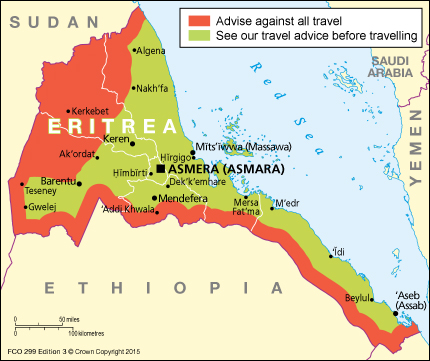
The FCO advise against all travel within 25km of Eritrea’s border with Ethiopia. Tensions between Eritrea and Ethiopia are high. See Local travel
The FCO advise against all travel within 25km of Eritrea’s border with Djibouti. See Local travel
The FCO advise against all travel to Eritrea’s border with Sudan, including the town of Tesseney and areas north and west of Nakh’fa, Ak’ordat and Barentu. See Local travel
All foreign nationals must apply in advance for a travel permit to leave Asmara. This includes diplomats. The British Embassy is unlikely to be able to provide consular support outside the capital. See Travel permits and Consular assistance
The Eritrean authorities consider all British nationals holding either Eritrean or PFDJ identity documents (including out of date documents) as Eritrean nationals. The British Embassy is unable to offer consular assistance to dual nationals in Eritrea. See Dual nationals
Eight British nationals were provided with consular assistance in Eritrea in 2015.  
There is a low threat from terrorism. See Terrorism
All British nationals travelling to Eritrea should register with the British Embassy in Asmara on arrival.
Take out comprehensive travel and medical insurance before you travel.

Safety and security

Crime

Crime levels are low but take sensible precautions with your personal safety. Don’t walk around late at night alone. Keep valuables, particularly cameras and passports, out of sight. Keep a photocopy of the personal details page of your passport in a safe place, or with friends or family in the UK.
A large proportion of the population has access to arms under the government of Eritrea’s civilian militia programme. We have no evidence that these weapons have increased the threat of violent crime.

Local travel

The FCO advise against all travel within 25km of Eritrea’s border with Ethiopia. In most places the border is neither marked nor obvious. There have been serious border clashes between Eritrea and Ethiopia in the past. Tensions remain high and there is a risk of further violence.
The border remains closed and is reported to be mined. In September 2011 a landmine exploded on the road between Senafe and Afoma killing five people.
The FCO advise against all travel within 25 km of Eritrea’s border with Djibouti. In 2008 there was fighting between Djibouti and Eritrea after an incursion of Eritrean forces into the disputed Djibouti border region. The situation remains unresolved.
The FCO advise against all travel to Eritrea’s border with Sudan, including the town of Tesseney and areas north and west of Nakh’fa, Ak’ordat and Barentu. In 2009, an attack on an international mining company vehicle on a road 35km north of Keren caused the deaths of one employee and two contractors.
There are extensive mine fields in Eritrea. Driving on main roads away from border areas is generally safe. Avoid driving on non-metalled roads and walking or hiking in the countryside.
Avoid travelling after dark in rural areas. Road signage and barriers are scarce, and steep drops are common. In many parts of the country roads are difficult or impassable during the rainy season.

Mobile telephones

Telephone networks are often unreliable and may only work for limited periods each day outside Asmara and larger towns. There are no agreements between Eritrean mobile telephone providers and international providers. You will not be able to receive or send calls or SMS text messages from any overseas mobile phone network on arrival in Eritrea. Local SIM cards can’t be purchased without a resident’s permit.

Electronic items

All electronic items (laptops, mobile phones, cameras etc) should be declared upon arrival. Failure to do so may result in their confiscation by Eritrean customs officials when you depart.

Travel permits

All foreign nationals need a travel permit to leave Asmara. Those working outside Asmara also need a travel permit to leave their area of residence or work. Applications in Asmara are handled by the relevant Ministry. For business travellers, applications are dealt with by the Ministry of Trade and Industry. Applications outside Asmara are handled by the local Zoba (Region) Administration Offices. Permission may take several days to be granted and is sometimes refused or delayed. Tourists wishing to travel outside Asmara should apply for a travel permit at the Ministry of Tourism located on Harnet Avenue in Asmara. Processing usually takes around 24 hours.
Restrictions on travel by foreign nationals apply equally to foreign diplomats. Staff from the British Embassy may therefore find it difficult or impossible to provide consular assistance to British nationals outside Asmara.

Sea travel

There have been attacks of piracy and armed robbery against ships in the Horn of Africa area. Be vigilant and take appropriate precautions.
Mariners must seek permissions and entry visas before attempting to land in Eritrea.
See our Piracy in the Indian Ocean page.

Consular assistance

There are serious constraints on what the British Embassy can do to help British nationals in Eritrea. Foreign diplomats in Asmara must apply ten days in advance for permission to travel outside Asmara. This means that the Embassy is unlikely to be able to offer consular assistance to British nationals outside Asmara.
There are obstacles to the provision of consular assistance even in Asmara. The Eritrean authorities may not inform the relevant Embassy if a foreign national is in need of help and there have been recent instances where the Eritrean authorities have refused consular access to detained foreign nationals.

Travel Summary

  • We advise against all travel within 25 kms of Eritrea’s border with Ethiopia and Djibouti. We also advise against travel to Eritrea's border with Sudan, including the town of Tesseney; and in the area north and west of Nakfa, Agordat and Barentu. See the Local Travel section of this advice for more details.
  • The Ethiopia-Eritrea border remains closed and unmarked. Several security incidents have taken place in recent months along the border, particularly in the areas of Humera, Tsorona and Zalambessa. Since the relocation out of Eritrea of the UN Peacekeeping Mission (UNMEE) in March 2008 the risk of cross-border tensions increasing and the security situation deteriorating very rapidly remains. See Local Travel section of this advice for more details.
  • All foreign nationals, including resident diplomats, are required to apply ten days in advance for travel permits to leave Asmara – these are not always granted. This means that diplomatic staff from the British Embassy are unable to offer emergency assistance to British nationals outside Asmara quickly. Eritrean authorities have not always informed the relevant Embassy when a foreign national is in need of consular assistance - this potential lack of any assistance outside Asmara is something to take into account fully before travelling. See the Local Travel (Travel Permits) section and General sections of this advice for more details.
  • Dual British/Eritrean nationals should be aware that, under the Vienna Convention on Consular Relations, the British Embassy is unable to offer assistance in Eritrea. The Eritrean authorities consider all British nationals holding either Eritrean or PFDJ identity documents (including out of date documents) as Eritrean nationals.
  • 4 British nationals required consular assistance in Eritrea in the period 01 April 2008 – 31 March 2009 for the following types of incident; deaths (1 cases); hospitalisations (0 cases); and arrests, for a variety of offences (0 cases). During this period assistance was also requested with regard to lost or stolen passports (2 cases).
  • The World Health Organisation (WHO) Pandemic Threat Alert Phase has been raised to Level 6. The World Health Organisation website has further details. You should monitor local media reports for any developments and advice. There is a dedicated Swine flu page on the FCO website. Guidance on Pandemic Flu can be obtained on the UK Department of Health website. Please see the Health section of the travel advice for further information.
  • There is an underlying threat from terrorism in Eritrea. Attacks could be indiscriminate, including in places frequented by expatriates and foreign travellers.
  • All British nationals travelling to Eritrea should register with the British Embassy in Asmara on arrival.
  • We recommend that you obtain comprehensive travel and medical insurance before travelling. You should check any exclusions, and ensure that your policy covers you for the activities you want to undertake. See the General (Insurance) section of this advice and Travel Insurance for more details.

Safety and security

Terrorism


There is an underlying threat from terrorism. Attacks could be indiscriminate, including in places frequented by expatriates and foreign travellers. For more general information see Terrorism Abroad.

A number of terrorist incidents have been reported along the border with Ethiopia.

Crime


Street crime such as theft and robbery is relatively rare in Asmara and other cities and towns, but appears to be on an upward trend. You should take normal and sensible precautions with regard to personal safety. We advise against walking around any town, late at night alone. Valuables, particularly cameras and passports should be kept out of sight.
Away from the main towns, crime is also rare but the usual precautions should be taken.
For more general information see Victims of crime.

Political Situation


Eritrea Country Profile

Local Travel

We advise against all travel within 25 km of the border with Djibouti. From 10 to 12 June 2008 there was fighting between Djibouti and Eritrea after an incursion of Eritrean forces into the disputed Djibouti border region. This led to casualties on both sides. The situation remains unresolved.

We advise against all travel within 25 km of Eritrea’s border with Ethiopia. It is important to note that in most places the border is neither marked nor obvious.

The Ethiopia-Eritrea border remains closed. Several security incidents have taken place in recent months along the border, particularly in the areas of Humera, Tsorona and Zalambessa. Since the relocation out of Eritrea of the UN Peacekeeping Mission (UNMEE) in March 2008 the risk of cross-border tensions increasing and the security situation deteriorating very rapidly remains.

We advice against all travel to Eritrea's border with Sudan, including the town of Tesseney; and the area north and west of Nakfa, Agordat and Barentu. In October 2009, an attack on a International Mining Company vehicle to a road 35km north of Keren caused the deaths of one employee and two contractors. A British national was killed in the area west of Agordat in April 2003. In August 2003, an attack on an NGO vehicle north of Nakfa led to the deaths of two aid workers.

There are extensive mine fields in Eritrea, particularly near the border with Ethiopia. Driving on main roads outside of the border areas is generally safe, though a landmine killed eight and injured several people along the same road in November 2008. We advise against driving on non-metalled roads and off-road driving. We also advise against walking or hiking in the countryside for the same reason.

We advise against travelling after dark in rural areas, where road signage/road barriers are scarce and steep drops common. You should be aware that in many parts of the country roads are difficult or impassable during the rainy season.

Telephone (including mobile) networks are often unreliable and may only work for limited periods a day outside Asmara and larger towns. You should take this into account when travelling, particularly in rural areas.

Travel Permits

All foreign nationals are required to have a travel permit to leave Asmara. This includes Embassy officials and other foreign nationals resident / working in Eritrea. Those working outside Asmara are also required to have a travel permit to leave their area of residence or work. Applications for such travel permits in Asmara are handled by the Department of Protocol of the Ministry of Foreign Affairs (or relevant ministry). Applications outside Asmara are handled by the local Zoba (Region) Administration Offices. Permission may take several days to be granted and is sometimes refused or delayed.

Tourists seeking to travel outside Asmara should apply for travel permits at the Ministry of Tourism located on Harnet Avenue in Asmara. Such permits usually take around 24 hours to process. There is no guarantee that permits will be issued.

This also means that diplomatic staff from the British Embassy are unable to offer emergency assistance to British nationals outside Asmara quickly. If travel permits were not granted, the British Embassy is unlikely to be able to offer any Consular assistance outside Asmara. The potential lack of any assistance outside Asmara is something you should take into account fully before travelling.

Air Travel


There are currently international flights (some direct) from Asmara to Cairo (Egyptair), Frankfurt (Lufthansa), Sana’a (Yemenia), Khartoum (Sudan Airways) and Dubai (Nasair). Please see the airline websites for specific details on flight schedules, ticketing and other information.

There is currently an airport departure tax of US$20 per passenger, it cannot be paid in Nakfa, unless you hold resident’s permit. You are advised to convert any excess Nakfa back to hard currency at one of the “Himbol” exchanges in town, as there are limits to what can be converted at the “Himbol” branch at the airport. To convert Nakfa back to hard currency you will need the original currency transaction receipt. Nakfa are not convertible outside Eritrea. The Nakfa is currently pegged at the rate of 15 Nakfa to one US dollar.

For more general information see Airline Security.

Sea Travel

There have been attacks of piracy and armed robbery against ships in the Horn of Africa area. Mariners are advised to be vigilant and to take appropriate precautions.
Mariners should be aware that permissions and entry visas must be sought in advance before seeking to land in Eritrea.
For more general information see River and Sea Safety.

Local laws and customs

Photography of government buildings and military installations is not allowed. If in doubt, ask first.

You are advised to dress modestly, especially in lowland and predominantly Muslim areas. Shorts and T-shirts are likely to draw attention.

Homosexual behaviour is illegal, although the penalties are unclear. Discretion is advised.

For more general information for different types of travellers see Your trip.

Entry requirements

Visas

British nationals need a visa to enter Eritrea.
You should ensure that any necessary travel documentation (including exit visas) remain valid for the duration of your stay. The Eritrean authorities take breaches of their immigration laws seriously and travellers who have overstayed can face lengthy delays in regularising their position before departure or even detention.

Dual Nationals

Dual British/Eritrean nationals who enter Eritrea will be classed as Eritrean nationals by the Eritrean authorities. The British Embassy is unable to gain consular access to or obtain information on such dual nationals if they are detained by the authorities or otherwise in need of assistance.
Dual nationals who enter Eritrea on an Eritrean identity card rather than an Eritrean passport should be aware that they are required to obtain an exit visa from the Immigration Office in Asmara before they are able to leave Eritrea.

Foreign currency


All foreign visitors are required to declare all foreign currency upon entering the country – filling in a form and showing funds. There is no limit on the amount that can be brought in. You should ensure that you have had your completed foreign currency declaration form approved and stamped before you leave the airport.
On departure, you will have to show (using your foreign currency declaration form) that any foreign currency missing was exchanged at a branch of “Himbol”, the State foreign currency exchange. You may face prosecution leading to a heavy fine, as well as a delay to your departure from Eritrea, if you fail to comply with these regulations.

Yellow Fever vaccination certificate


Yellow Fever Vaccination certificates are an entry requirement for all visitors over the age of one year arriving from a country where the disease is present.

Health

A (H1N1) - Swine Flu


Currently there are no reported cases of Swine Flu in Eritrea, however there are cases in neighbouring countries (Ethiopia/Sudan). Our Embassy in Asmara receives regular updates from local WHO representative.

There is screening on arrival at Asmara airport and all arriving passengers are required to complete a health questionnaire. If any passenger declares or exhibits flu-like symptoms they are quarantined at the nominationed isolation hospital, Villagio, whilst tests are done to check for the A (H1N1) virus. There have been a few suspected cases but so far all have been declared infection free and released from isolation. Currently the swabs are sent back to the UK for testing as there are no facilities to test for the virus in-country. There are limited stocks of anti-viral medication (Tamiflu) in-country but it is unclear if passengers would have access to these. The Embassy would not able to provide Tamiflu.

There is no screening on departure.

The World Health Organisation (WHO) has raised its Pandemic Threat Alert Phase to Level 6. The World Health Organisation website has further details. You should monitor local media reports for any developments and advice. There is a dedicated Swine flu page on the FCO website. Guidance on Pandemic Flu can be found on the UK Department of Health website.

General


There is one private and three public hospitals in Asmara. Public hospitals here and in other towns are often poorly equipped. Elsewhere medical facilities are even more limited. If you are travelling away from the large towns, we advise that you carry a comprehensive medical pack with you.

If you are taking prescription medicines, you should ensure that you have a sufficient supply for the length of your stay in Eritrea.

In the 2008 Report on the Global AIDS Epidemic the UNAIDS/WHO Working Group estimated that around 35,000 adults aged 15 or over in Eritrea were living with HIV; the prevalence rate was estimated at around 1.3% of the adult population. This compares to the prevalence rate in adults in the UK of around 0.2%. You should exercise normal precautions to avoid exposure to HIV/AIDS. For more general information on how to do this see HIV and AIDS.

You should seek medical advice before travelling to Eritrea and ensure that all appropriate vaccinations are up-to-date. For further information on vaccination requirements, health outbreaks and general disease protection and prevention you should visit the websites of NaTHNaC and NHS Scotland's Fit For Travel or call NHS Direct on 0845 46 47.

For more general health information see Travel Health.

General

Insurance

We recommend that you obtain comprehensive travel and medical insurance before travelling. You should check any exclusions, and ensure that your policy covers you for the activities you want to undertake. You should ensure that your medical insurance covers the cost of air ambulance evacuation out of Eritrea in the event of a serious accident or illness.
Here's how we can help if things go wrong.

Consular assistance outside Asmara

There are limits to what the British Embassy can do to assist British nationals outside Asmara. All diplomatic staff in Asmara are required to apply for permission to travel 10 days in advance. This means that diplomatic staff from the British Embassy are unable to offer emergency assistance to British nationals outside Asmara. You are advised to take this into account before deciding whether or not to travel to Eritrea.
You should be aware that the Eritrean authorities have not always informed the relevant Embassy if a foreign national is in need of consular assistance (for example, if they have been taken into detention or are in need of medical attention). This applies inside Asmara as well as more widely in the country.

Consular registration


Register with our LOCATE service to tell us when and where you are travelling abroad or where you live abroad so our consular and crisis staff can provide better assistance to you in an emergency.

Passports

Applications for British passports can be lodged at the British Embassy in Asmara. However, because all applications are forwarded to the High Commission in Nairobi for processing, the issuing of a full passport usually takes three-four weeks.
Emergency passports, good for a single trip back to the United Kingdom, can usually be issued by the British Embassy Asmara within two working days. You will need to provide satisfactory proof of nationality: we advise that all travellers keep a photocopy of the biodata (photograph and personal details) page of their passport in a safe place or with friends or family in the UK.

Money

The economy is completely cash-based. There are no ATMs in Eritrea. Credit cards are not accepted anywhere except a few hotels such as the Asmara Palace, Sunshine and Crystal hotels. It is illegal to exchange currency other than at a branch of “Himbol”. It is illegal to attempt to use foreign currency to make purchases in Eritrea.
For more information on bringing currency into and out of Eritrea see the Entry Requirements section of this travel advice.

Thursday, February 11, 2010

Equatorial Guinea travel advice

This advice has been reviewed and reissued with editorial amendments to the Summary. The overall level of the advice has not changed; there are currently no travel restrictions in place in Equatorial Guinea.

Travel Summary

  • There is no British Embassy in Equatorial Guinea. In an emergency, you can get consular assistance through the British Deputy High Commission in Lagos. See the Contact Details of this Travel Advice.

  • On the 17 February 2009 there was heavy gun fire in the Ela Nguema district of Malabo. Since then the situation has remained calm and under control. While in Malabo you should remain alert and take sensible personal security precautions. Security measures by the local authorities, including roadblocks and unannounced identification checks, remain likely. You should carry an appropriate form of identification (passport or residence permit) with you at all times.

  • Those wishing to travel outside Malabo on the island of Bioko, and outside Bata on the mainland should see the Local Travel section of this Travel Advice.

  • There is a low threat from terrorism but you should be aware of the global risk of indiscriminate terrorist attacks, which could be in public places, including those frequented by expatriates and foreign travellers.

  • There has only been one case of a British national requiring consular assistance in Equatorial Guinea in 2009. But we are aware of reports of petty theft in the country. You should carry copies of appropriate documentation (passport or residence permit) with you at all times for identification purposes. Failure to produce documents on request can lead to detention

  • We recommend that you obtain comprehensive travel and medical insurance before travelling. See the General (Insurance) section of this Travel Advice.

Safety and security

Terrorism


There is a low threat from terrorism but you should be aware of the global risk of indiscriminate terrorist attacks, which could be in public places, including those frequented by expatriates and foreign travellers. For more general information see Terrorism Abroad.

Crime


Compared to other countries in the region, the level of violent crime in Equatorial Guinea is not high. There are regular reports of petty theft affecting both visitors and expatriates. We recommend that you take personal security precautions. You should avoid carrying valuables or wearing jewellery in public and avoid isolated or poorer areas of town. You should not walk around Malabo and Bata at night and should also avoid travelling by road after dark. For more general information see Victims of crime.

Political Situation


Equatorial Guinea Country Profile
Political events can lead to increased presence of police, military or security forces on the streets. This can happen with little or no notice. You should carry copies of appropriate documentation (passport or residence permit) with you at all times. Failure to produce documents on request can lead to detention.

You should avoid any political rallies, demonstrations or large public gatherings.

Local Travel


Unless you are a UK citizen who is resident in Equatorial Guinea and in possession of an EG resident permit, you will need to inform Protocol Division of the Ministry of Foreign Affairs, Cooperation and Francophonie in advance if you wish to travel outside Malabo on the island of Bioko, and outside Bata on the mainland.

Land borders often close with little or no notice. You should check the situation with the local authorities before travelling to border areas.

Road Travel


Most roads in Malabo are paved. In rural areas the condition of the roads is likely to be poor. During the rainy season, many roads are accessible only with a four-wheel drive vehicle.

Police and military roadblocks are common. You may be asked to show your passport, driving licence or vehicle registration documents and explain your reason for being in the area. Failure to comply with requests can lead to detention.

There are regular reports of extortion by police and uniformed security forces at roadblocks. You are advised not to pay bribes but to ask for a ticket, detailing alleged offences or violations, which can be paid at a local court.

Public transport facilities, particularly on mainland Equatorial Guinea, are extremely limited.

For more general information see Driving Abroad.

Air Travel

The EU has published a list of air carriers that are subject to an operating ban or restrictions within the community. You should check the following link to see whether this will affect your travel - European Commission Transport - Air.

There are doubts about the reliability and safety of some Equato-Guinean-registered aircraft operating flights within Equatorial Guinea and regionally. Equato-Guinean-registered aircraft are banned from British airspace on safety grounds. British governemnt employees do not use Equato-Guinean-registered aircraft unless this is unavoidable. You shoud bear this in mind when making your travel plans.

For more general information see Airline Security.

Local laws and customs

Penalties for the use and possession of drugs are severe and usually include a prison sentence that would be served in local prisons. Photography of the presidential palace, ports, airports and military installations is strictly prohibited and can lead to imprisonment. Special permits from the Ministry of Information and Tourism are required for all other photography. Homosexuality is not widely accepted in Central African society and some sexual acts between members of the same sex are illegal. You should carry copies of appropriate documentation (passport or residence permit) with you at all times. Failure to produce documents on request can lead to detention. For more general information for different types of travellers see Your trip.

Entry requirements

Visas


British nationals require a visa to visit Equatorial Guinea. To apply for a visa and to obtain further information on entry requirements.
You are advised to check that your passport is properly endorsed/stamped at the airport, on arrival and departure, before leaving the immigration desk. There have been reports of travellers being delayed or threatened with detention because their passports have not been properly endorsed/stamped.

When acquiring a new travel document, please request the issuing authority to return your previous cancelled travel document to you. The old document will be required by the Equatorial Guinea authorities prior to issuing a replacement visa. If you have a new travel document you should ensure that you obtain a new or replacement visa for Equatorial Guinea into your new passport before travelling. The Equatorial Guinean authorities will not admit travellers on visas entered into old passports, even if the visa is still valid.

Yellow Fever Vaccination Certificate


Please note that immigration / health authorities in Equatorial Guinea now require an international vaccination certificate in order to enter/leave Equatorial Guinea. All flights are systematically checked.

A tax of 5,000 cfa will be levied for those who do not produce the yellow booklet. As all airlines have been informed, entry refusal may occur if this rule is not complied with.

Travelling with children


Single parents or other adults travelling alone with children should be aware that some countries require documentary evidence of parental responsibility before allowing lone parents to enter the country or, in some cases, before permitting the children to leave the country.

Health

Medical facilities are poor. Pharmacies in Malabo and Bata stock basic medication. Emergency facilities are extremely limited. For serious medical treatment, evacuation to Europe would be necessary.

Malaria, cholera and water-borne diseases are common in Equatorial Guinea.

Food purchased from local street vendors may not meet adequate hygiene standards. You should drink or use only boiled or bottled water and avoid ice in drinks. If you suffer from diarrhoea during a visit to Equatorial Guinea you should seek immediate medical attention.

In the 2008 Report on the Global AIDS Epidemic the UNAIDS/WHO Working Group estimated that around 9,800 adults aged 15 or over in Equatorial Guinea were living with HIV; the prevalence rate was estimated at around 3.4% of the adult population. This compares to the prevalence rate in adults in the UK of around 0.2%. You should exercise normal precautions to avoid exposure to HIV/AIDS. For more general information on how to do this see HIV and AIDS.

You should seek medical advice before travelling to Equatorial Guinea and ensure that all appropriate vaccinations are up-to-date. For further information on vaccination requirements, health outbreaks and general disease protection and prevention you should visit the websites of NaTHNaC and NHS Scotland's Fit For Travel or call NHS Direct on 0845 46 47.

For more general health information see Travel Health.

General

Insurance


We recommend that you obtain comprehensive travel and medical insurance before travelling. You should check any exclusions, and that your policy covers you for all the activities you want to undertake. Please see Travel Insurance.

Here's how we can help if things go wrong.

Consular registration


Register with our LOCATE service to tell us when and where you are travelling abroad or where you live abroad so our consular and crisis staff can provide better assistance to you in an emergency.

British representation


There is no British Embassy in Equatorial Guinea. In an emergency, you can obtain consular assistance either through the British Deputy High Commission in Lagos (tel: +234 1 2619531, 2619537, 2619541) or through the Honorary British Consul in Malabo (tel: + 240 277502).

Stays of more than one month


If you intend to stay in Equatorial Guinea for more than one month you are encouraged to register with the British Deputy High Commission in Lagos.

Commercial disputes


There have been occasions when expatriate staff of foreign companies have been confined to the country for prolonged periods when commercial disputes have arisen. In such circumstances support from the British Deputy High Commission in Lagos is confined to a consular support role.

Money


It is not possible to use credit cards in Equatorial Guinea except at the major airline offices (Air France, Iberia and Swiss). The local currency is the Central African Franc (CFA), issued by the Banque des Etats de L’Afrique Centrale (BEAC). Please note that this is not the same Central African Franc as issued by the Banque des Etats de L’Afrique Ouest (BEAOC) which is not legal tender in Equatorial Guinea. There are no ATM’s in Equatorial Guinea. Euros, Pound Sterling and US Dollars are the preferred currencies for exchange at local banks.

Wednesday, February 10, 2010

Congo (Democratic Republic)

This advice has been reviewed and reissued. The overall level of the advice has not changed; we advise against all travel to specific regions of DRC and all but essential travel to the rest of the country.

Travel Summary


  • We advise against all travel to eastern and north eastern Democratic Republic of Congo (DRC). This includes entering DRC from Uganda, Burundi and Rwanda. The only exceptions to this are within the town of Bukavu and Goma, where we advise against all but essential travel. You should avoid entering or leaving DRC overland via Goma or Bukavu unless essential. This is due to continued insecurity and lawlessness in these areas. Military operations by the Congolese army against foreign armed groups in North and South Kivu provinces have led to very high numbers of civilians being displaced. See the Local Travel section of this advice for more details.

  • We advise against all but essential travel to the rest of DRC because of continuing tension and insecurity. The situation can deteriorate at short notice. See the Local Travel section of this advice for more details.

  • There is a risk of political demonstrations and politically-motivated violence. For immediate, specific information about planned demonstrations or any other events which may affect the local security situation, you should register with/contact the British Embassy in Kinshasa. See the General (Registering with the British Embassy) section of this advice for more details.

  • Ndjili airport (Kinshasa’s main airport) and Kinshasa’s ferry terminal can close at short notice. You should check with your operator before travelling.

  • There is a low threat from terrorism. But you should be aware of the global risk of indiscriminate terrorist attacks which could be in public areas, including those frequented by expatriates and foreign travellers.

  • Seven British nationals required consular assistance in Congo (Dem Rep of) in the period 01 April 2008 – 31 March 2009 for the following types of incident; deaths (1 cases); hospitalisations (2 cases); and arrests, for a variety of offences (4 cases). During this period assistance was also requested with regard to lost or stolen passports (7 cases). Robbery, including by individuals posing as plainclothes police, is also common. You should also be aware of gangs promising you cut price gold and diamonds. We have received reports of crime targeting international non-governmental organisations (NGOs) in Goma.

  • We recommend that you obtain comprehensive travel and medical insurance before travelling. See the General (Insurance) section of this Travel Advice.

Safety and security

Terrorism


There is a low threat from terrorism. But you should be aware of the global risk of indiscriminate terrorist attacks which could be in public areas, including those frequented by expatriates and foreign travellers.

For further information see Terrorism Abroad page.


Crime


The global economic downturn has hit DRC hard. You should be alert to the risk of street crime and armed robbery at all times, including being targeted by armed gangs when driving. Foreigners are at particular risk of street robbery in Kinshasa, often in the vicinity of hotels and supermarkets. Some gangs and confidence tricksters use girls to lure the unwary into traps; others promise cut-price gold and diamonds or pose as police to rob foreigners, including in daylight. Western expatriates have been robbed of money and mobile telephones in Kinshasa and elsewhere in DRC this year. There is also a risk of arbitrary arrests of foreigners by security authorities who demand payment for release.

There have been violent and well planned attacks on foreign nationals, including aid workers in Goma, most recently on 23 May 2009. Police are still investigating. You should take sensible security precautions. Do not walk in the streets alone or after dark. Safeguard and avoid displaying valuables and cash. Deposit them in a hotel safe, where practical. Keep copies of documents, including your passport, separately. On the road, you should keep doors locked and windows shut while driving. Do not drive off the main thoroughfares or park in unsupervised areas.

For more general information see Victims of Crime Abroad.

Political Situation

Democratic Republic of Congo Country Profile

Five years of civil war in DRC officially ended on 29 June 2003, when the Congolese parties to the conflict signed accords sharing military and political responsibilities in a transitional government. Democratic elections were held on 30 July and 29 October 2006 and the newly elected President was inaugurated on 6 December 2006. During the election period there was armed conflict in Kinshasa, which resulted in civilian casualties.

In the months following the elections, there were further public demonstrations related to the political process, some of which turned violent (see Local Travel). Protests have in the past spilled over into attacks on international targets. You should avoid crowds and popular gathering points, and contact the Embassy if there are signs of trouble.

For immediate, specific information about planned demonstrations or any other events which may affect the local security situation, you should register with/contact the British Embassy in Kinshasa (see Contact Details).

The agreement reached in January 2008 between the DRC government and armed groups offered the chance for peace in the provinces of North and South Kivu, where conflict has continued beyond the end of the civil war. However, issues remain to be resolved, a heavy United Nations peace keeping presence is deployed and the internal peace process remains fragile. Since April 2009, the Congolese army has been carrying out operations against foreign and armed groups operating in North and South Kivu province. Large numbers of civilians remain displaced as a result of the conflict and the current military operations in the Kivus. Acts of violence, including killing, rape and looting continue against the civilian population across wide area in conflict zones.

Local Travel

We advise against all travel to eastern and north eastern DRC. This includes entering eastern DRC from Uganda or Rwanda (some gorilla-trekking operators in these countries cross into DRC). This includes entering the DRC from Uganda, Burundi and Rwanda. The only exceptions to this are within the towns of Bukavu and Goma, where we advise against all but essential travel. You should avoid entering or leaving DRC overland via Goma or Bukavu unless essential. Although the Congolese insurgent groups in North and South Kivu signed a peace accord with the government in March 2009, some groups remain outside the process and a threat to stability. The Congolese army has been carrying out military operations against Rwandan rebels present in North and South Kivu since April 2009. This means that outside of Bukavu and Goma, the security situation remains volatile. There has also been an increase in banditry by armed men against NGO convoys travelling out of Goma and Bukavu. Even in these two towns, tensions remain and the situation can deteriorate rapidly.

The Lord’s Resistance Army (LRA), a rebel group originating in northern Uganda, are currently operating in north eastern DRC and across the border in Southern Sudan and Central African Republic. Following regional military action in the area, there has been an increase in LRA attacks against the civilian population. This has resulted in an estimated 1,200 casualties, over 1,000 abductions and the displacement of 200,000. Military action is ongoing and the situation remains unpredictable.

We advise against all but essential travel to the rest of DRC because of continuing tension and insecurity. This can mean that the DRC’s borders with Uganda, Burundi and Rwanda close at short notice. You should consult the British Embassies in Kinshasa and Kigali if in doubt.

Politically-motivated violence can break out from time to time in Kinshasa. The DRC army clashed violently over several days with rebel troops loyal to the defeated presidential candidate Jean-Pierre Bemba inside the city in March 2007. There was widespread loss of life. If you have not already done so, you should register with/contact the British Embassy for local updates on the security situation in Kinshasa.

Violent clashes took place in Bas Congo province (south western DRC) between a local political group, the BDK, and Congolese security forces in late February and early March 2008, resulting in a number of deaths. These followed confrontations between the BDK and the police on 5 January in which six people were reported killed and over twenty seriously injured; some as a result of gunfire. The BDK and government troops fought in Bas Congo at the end of January and early February 2007, when over 100 people are reported to have been killed. The situation in Bas Congo remains tense but for the moment without incident. Particular care should be taken when travelling to the Bas Fleuve region.

The north eastern district of Ituri, near the frontier with Uganda, remains an area of continued inter-factional conflict. Despite the presence of UN peacekeepers and the Congolese army violence continues sporadically.

The border with Angola can close at short notice. You should check with your travel agent before attempting to cross the border into Angola. Obtaining visas for Angola in DRC is difficult. You are advised to arrange them before travelling to DRC.

Road Travel

An international driving permit is required to drive in DRC. Car hire with international companies is possible in Kinshasa.

There is no reliable public transport system in DRC. Over-crowded and unroadworthy vans serve as buses in Kinshasa. There are few taxis, available from the large hotels, but these do not meet western safety standards. Outside Kinshasa and other main cities, most roads are barely drivable even with a 4x4, especially during the rainy season (September to May).

In DRC, you should be aware of the vehicle theft and car-jacking, and take sensible precaution. You are advised to drive with the doors of your vehicle locked and windows closed at all times. DRC’s security forces operate roadblocks, particularly after dark. If you are asked to produce documents for inspection at a check point, you should remain in your vehicle and show them through closed windows.

For further information see Driving Abroad.

Rail Travel

A train accident occurred in Katanga Province in south-east DRC on 10 June 2009. 10 people were reported to have been killed, and 28 injured, as a result. The dilapidated state of the railways has been blamed for the accident

Air Travel

The European Commission has published a list of air carriers that are subject to an operating ban or restrictions within the European Union. This is regularly updated. You should check the following link to see whether this will affect your travel - European Commission Transport - Air.

An aircraft chartered by the humanitarian flight operator AirServ crashed near Bukavu in eastern DRC on 1 September 2008. A flight operated by the domestic airline Hewa Bora crashed in April 2008 in Goma, with extensive loss of life. Currently, the only air operators British Embassy officials are authorised to use within DRC are United Nations (MONUC and UNHAS), ECHO and ICRC flights. It is recommended that you avoid flying with any DRC airline. If you already have a flight booked with any DRC airline you should consult your travel agent.

On 30 March 2009, the DRC authorities introduced a departure tax of $50 per passenger on international flights and $10 per passenger on domestic flights. Payment of this tax should be made at the time of check-in, before boarding. Passengers and visitors also have to pay $12 to enter the car park at the international airport of N’djili.

For more general information see Airline Security.

River Travel

The ferry service between Kinshasa and Brazzaville is currently operating, but is subject to cancellation at little notice. It stops running in the late afternoon, and there is no service on Sundays.

You should be aware that the boats and ferries, which serve the rivers and lakes, are poorly maintained and often overloaded. Strong currents, shifting sandbanks and poor maintenance contribute to low safety standards. A makeshift boat ferrying passengers on the River Lubilanji near Mbuji-Mayi in southern DRC sank in early April 2008. Over thirty people were reported killed as a result. On 22 July 2008, at least 42 people were killed when a river boat sank on the River Oubangui in north western DRC, close to the border with the Central African Republic. Two boats are reported to have sunk on Lake Tanganyika during December 2008. In the second of these, in which thirty people died, overloading is thought to have been a factor.

For more general information see River and Sea Safety.

Local laws and customs

Taking photographs in public places risks arrest and detention. Journalists should not conduct interviews or film without the necessary local permits.

For more general information for different types of travellers see our Your Trip page.

Entry requirements

Visas


All British passport holders need a valid visa to travel to DRC. This must be obtained before travelling. To arrange this, you should contact the Embassy of the Democratic Republic of the Congo:

281 Gray’s Inn Road
London
WC1X 8QF

Telephone no: 0207 278 9825

A Rwandan or Ugandan immigration stamp in your passport should not prohibit admission, but you may still experience difficulties on arrival in the DRC via Kinshasa if you do have them. Visitors arriving from the UK have recently experienced problems on arrival at N’djili airport, Kinshasa.

Satellite phones, GPS receivers or Military clothing

You are advised not to bring satellite phones, GPS receivers or military clothing into the DRC as this could lead to difficulties with the security authorities.

Yellow Fever vaccination certificate

A yellow fever vaccination certificate is mandatory and you will be asked to produce one on arrival. You are advised to produce your yellow fever vaccination certificate when applying for your visa to enter DRC.

Health

The Centre Prive d'Urgence (CPU) clinic in Kinshasa is able to cope with basic health problems and to stabilise a patient after most serious accidents. Outside Kinshasa, western standard medical facilities are practically non-existent. Medical evacuation to South Africa (or elsewhere) is advisable as soon as possible. You should ensure that you have comprehensive medical and travel insurance, to include specifically the very high costs of evacuation by air ambulance. Minimum turnaround time for evacuation by air ambulance is 10 hours. If you regularly take medication, you should bring in a properly-marked supply, sufficient for the time you will be in DRC, with you. You may find it difficult to locate the medicines you need in the country.

Malaria, rabies, polio, meningitis and cholera are common in DRC.

In December 2008 and January 2009, an outbreak of Ebola haemorrhagic fever was reported in West Kasai province (southern DRC). Ebola is a severe, and often fatal disease. The likelihood that you will contract Ebola is low unless there has been direct contact with the blood or body fluids of an infected person, or with objects, such as needles, that have been contaminated with body fluids. You should avoid all contact with infected patients and avoid any contact with ill or dead animals. Further information can be found on the NaTHNaC website.

Monkey pox occurs in DRC. The monkey pox virus is usually transmitted to humans from infected ground squirrels and rodents. Symptoms include a fever, the appearance of pus-filled blisters all over the body, and lymph node swelling. You should avoid contact with people suffering these symptoms and with animals.

Large numbers of cases of typhoid fever have also been diagnosed in DRC in 2008. Plague has been reported in Orientale Province (north-eastern DRC).

Large numbers of cases of acute watery diarrhoeal syndrome were reported among people living in camps for internally displaced people in North Kivu province (easter DRC) since September 2008. In many instances these have been fatal. In areas of poor sanitation it is not advisable to drink water unless it has been treated by boiling and filtration or with a chemical purifier. You should avoid drinks with ice in them and food which has been rinsed in water from unknown or unhealthy sources.

You should exercise normal precautions to avoid exposure to HIV/AIDS. For more general information on how to do this see HIV and AIDS.

You should seek medical advice before travelling to DRC and ensure that all appropriate vaccinations are up-to-date. For further information on vaccination requirements, health outbreaks and general disease protection and prevention you should visit the websites of the National Travel Heath Network and Centre NaTHNaC and NHS Scotland's Fit For Travel or call NHS Direct on 0845 46 47.

For more general health information see Travel Health.

Natural disasters


Volcanoes

The Nyiragongo and Nyamulagira volcanoes in the north east of the country (near Goma) have been showing signs of renewed volcanic activity. As of the end of March 2009, vulcanologists predict that an eruption of Nyamulagira was imminent. Nyiragongo (20km from Goma) is also showing signs of increased activity. UN agencies and local NGOs are preparing themselves for this possible eventuality. If you are in the area (against our travel advice) you should follow local advice.

Earthquakes

On 3 February 2008 an earthquake struck Eastern DRC with its epicentre 20kilometres north of Bukavu. It measured 6.1 on the Richter scale. The earthquake and its aftershocks could be felt in neighbouring Rwanda and Burundi. Five people were reported dead in DRC with over 200 casualties. A further tremor in the same area, measuring approximately 5.0 on the Richter scale, was reported on 9 June.

On 19 February 2007 an earthquake measuring 5.7 on the Richter scale was felt in parts of eastern DRC (mainly north Kivu and southern Ituri).

General

Insurance

We recommend that you obtain comprehensive travel and medical insurance before travelling. The cost of medical repatriation from DRC to the UK is extremely high. You should check any exclusions, and that your policy covers you for all the activities you want to undertake. See Travel Insurance for more details.

If things do go wrong when you are overseas then this is how we can help.

Consular Assistance

The lack of reliable air transport and continued insecurity may prevent the British Embassy in Kinshasa from being able to extend normal levels of consular assistance to British nationals anywhere in DRC other than Kinshasa.

If you do decide to visit or work in DRC you are advised to have your own evacuation plan, to regularly review its viability in the light of changing circumstances, and to provide details of it to the British Embassy at ambrit@fco.gov.uk.

Registering with the British Embassy

We strongly recommend that if you are visiting or are resident in the DRC, you should register with the British Embassy in Kinshasa. You can do so in person or, if you prefer, via our secure online registration service at: Consular Online Registration on the FCO website or with our LOCATE service. Notwithstanding our inability to guarantee consular assistance and advice against travel in the east, we would strongly recommend you to register and give us your contact details if you intend to visit DRC, so that we can pass on information that may be of use to you concerning the security situation in your area. You should also consider having a visa for the Republic of Congo if you are planning to stay in Kinshasa for a considerable period of time. More information about registering with LOCATE can be found here.

Temporary Passport service

The British Embassy in Kinshasa offers only a Temporary Passport service. These are valid for up to one year only. The Embassy provides a full replacement passport service via the British High Commission in Nairobi. This can take up to six weeks, unless you are prepared to meet courier costs.

Mobile phones

DRC has a GSM network on which most dual-band (or better) UK mobile phones will work. Coverage is not complete. If in doubt, contact your UK service provider. Local ‘pay as you go’ SIM cards are available.

Money


The British Embassy cannot provide emergency cash advances to UK nationals. You are advised to have arrangements in place before leaving the UK to have funds sent to you in case of need. Some brands of credit cards are accepted in DRC. If you have a card which can be used in the country, you should consider bringing it with you. The currency in DRC is the Congolese Franc but US Dollars can be used. US Dollars should be presented in good condition.

Tuesday, February 9, 2010

Congo travel advice

This advice has been reviewed and reissued with amendments to the Summary and Local Travel section. We now advise against all travel to the Likouala province, bordering Equateur province in the Democratic Republic of Congo

Travel Summary

  • We advise against all travel to the Likouala province, bordering Equateur province in the Democratic Republic of Congo (DRC) due to a large influx of displaced people during the end of November and beginning of December, from the DRC to the Republic of Congo.

  • We advise against all but essential travel to the Pool region, as there is sporadic rebel activity there. This includes using the Brazzaville-Pointe Noire road and railway. See the Local Travel section of this Travel Advice.

  • There is no British Embassy in the Republic of Congo. If resident in or visiting the Republic of Congo, you should register with the British Embassy in Kinshasa. See the General (UK Diplomatic Representation) section of this Travel Advice for more details.

  • There is a low threat from terrorism. But you should be aware of the global risk of indiscriminate terrorist attacks which could be in public areas, including those frequented by expatriates and foreign travellers.

  • You should avoid travelling at night throughout the whole country.

  • We recommend that you obtain comprehensive travel and medical insurance before travelling. You should check any exclusions, and that your policy covers you for all the activities you want to undertake. See the General (Insurance) section of this Travel Avice and our Travel Insurance page.

Safety and security

Terrorism

There is a low threat from terrorism. But you should be aware of the global risk of indiscriminate terrorist attacks which could be in public areas, including those frequented by expatriates and foreign travellers. For further information see our Terrorism Abroad page.

Crime

The incidence of street crime, armed robbery or vehicle hi-jacking is low in Brazzaville and Pointe Noire, although there are frequent police checkpoints. Since January 2007, vehicle hijacking in Pointe Noire has increased. Take sensible security precautions i.e. do not walk in the streets after dark, or carry large amounts of money or valuables.

For more general information see our Victims of Crime Abroad page.

Political Situation

The ‘Ninja’ former rebel group, that was active during the civil war, signed a peace agreement with the Government in March 2003. The situation remains peaceful but there remains a risk of rebel activity and sporadic fighting in some parts of the country (see Local Travel).
There is a likelihood of increased instability should there be considerable changes in the political environment.

If in Brazzaville, you should keep yourself updated locally on the security situation. In the event of trouble in the capital you should remain indoors and follow local advice from the British Honorary Consul; the main town centre hotels tend to be relatively safe.

Local Travel

We advise against all but essential travel to the Pool region, as there remains the risk of sporadic rebel activity and armed banditry.

The risk of rebel attacks on the coastal town of Pointe Noire itself is considered very low although there have been civil disturbances reported in June 2008. The road and railway between Brazzaville and Pointe Noire pass through the Pool region where armed criminal gangs continue to periodically rob vehicles and trains.

Road travel in the Pool region requires a permit from the Congolese army. You are therefore advised to travel between these cities by air (but see Air Safety section).

Crime (sometimes armed) is committed against boats using the Ubangi River in the Likouala region, where the river forms the border with the DRC; this area is subject to periodic instability.

Think very carefully whether your journey is essential and avoid travelling at night.

Boat Travel

The river crossing/border with Kinshasa may close without warning. We advise travellers to check the situation before committing to one route or another.

Road Travel

Road conditions are generally poor and deteriorate during the wet season, which lasts from November to May. Overland travel off the main roads requires a four-wheel drive vehicle.

For more information see our Driving Abroad page.

Air Travel

The EU has published a list of air carriers that are subject to an operating ban or restrictions within the community. You should check the following link to see whether this will affect your travel - European Commission Transport - Air.

For more general information see our Airline Security page.

Local laws and customs


For more general information for different types of travellers see our Your trip page.

Entry requirements

Visas

Visas are required to visit the Republic of Congo. Advice on visas can be obtained from the Embassy of the Republic of Congo in London.

Passport Validity

Your Passport must have a minimum of six months validity from the date of arrival in the Republic of Congo.

Yellow Fever vaccination certificate

You will be asked to produce a yellow fever vaccination certificate on arrival in the country. Failure to do so will result in a further vaccination being administered, for which a charge is made.

Travelling with children

Single parents or other adults travelling alone with children should be aware that some countries require documentary evidence of parental responsibility before allowing lone parents to enter the country or, in some cases, before permitting the children to leave the country. For further information please contact Embassy of the Republic of Congo in London.

Health

Water-borne diseases, malaria and cholera are common in Congo.

Medical facilities in the country are extremely limited, particularly in rural areas.

Since December 2006, outbreaks of cholera have been reported in Pointe Noire, Kouilou and Brazzaville. The majority of cases have been reported from Pointe Noire. You should drink or use only boiled or bottled water and avoid ice in drinks. If you suffer from diarrhoea during a visit to Congo you should seek immediate medical attention.

Outbreaks of the human form of the Ebola fever have occurred in recent years. The WHO declared the most recent outbreak of the disease over in June 2005, but warned that another outbreak could occur soon.

You should not eat 'bush meat'.

In the 2008 Report on the Global AIDS Epidemic the UNAIDS/WHO Working Group estimated that around 73,000 adults aged 15 or over in Congo were living with HIV; the prevalence rate was estimated at around 3.5% of the adult population. This compares to the prevalence rate in adults in the UK of around 0.2%. You should exercise normal precautions to avoid exposure to HIV/AIDS. For more general information on how to do this see HIV and AIDS.

You should seek medical advice before travelling to Congo and ensure that all appropriate vaccinations are up-to-date. For further information on vaccination requirements, health outbreaks and general disease protection and prevention you should visit the websites of the National Travel Heath Network and Centre NaTHNaC and NHS Scotland's Fit For Travel or call NHS Direct on 0845 46 47.

For more general health information see Travel Health

General

Insurance

You should take out full travel and medical insurance cover for medical treatments and accidents, and repatriation by air ambulance. You should check any exclusions, and that your policy covers you for the activities you want to undertake. See our Travel Insurance page.

If things do go wrong when you are overseas see our When Things Go Wrong page.

Registration

Register with our LOCATE service to tell us when and where you are travelling abroad or where you live abroad so our consular and crisis staff can provide better assistance to you in an emergency. More information about registering with LOCATE can be found here.

UK Diplomatic Representation

There is no resident British diplomatic mission in the Republic of Congo. The British Honorary Consul in Brazzaville, Mr Dominique Picard (tel: +242 620 893 or 513 251; fax: +242 838 543), can offer only limited assistance.
The British Ambassador in Kinshasa is cross-accredited to the Republic of Congo. His ability to help British nationals is limited. We recommend that if you visit or are resident in the Republic of Congo you register with the British Embassy in Kinshasa. You can so so in person or, if you prefer, via our secure online registration service (see Registration above).

Monday, February 8, 2010

Comoros travel advice


Summary update

There is no British diplomatic representation in Comoros. Consular assistance is provided by the British High Commission in Port Louis, Mauritius.
Crime levels are low, but you should take sensible precautions. Avoid any crowds or political gatherings. See Crime and Political situation
Piracy is a significant threat in the Gulf of Aden and Indian Ocean. Sailing vessels are particularly vulnerable. See Sea travel
There is a low threat from terrorism. See terrorism
Take out comprehensive travel and medical insurance before you travel.

Travel Summary

  • There is no British Embassy or Honorary Consul in Comoros. Comoros is covered from the British High Commission in Port Louis, Mauritius. You should register with the British High Commission in Port Louis before travelling to Comoros. See the General (Representation) section of this Travel Advice.
  • There were a very low number of incidents involving British nationals who required consular assistance in Comoros in 2009. However, you should take precautions against pickpockets and muggers. Although uncommon, there have been some instances of sexual assault/rape. Avoid walking alone at night on deserted or public beaches and in town centres.
  • Piracy is a significant threat in the Gulf of Aden and Indian Ocean, especially for shipping which does not take appropriate precautions or follow agreed shipping industry best practice guidelines. See the Sea Travel section of this Travel Advice.
  • There is a low threat from terrorism. But you should be aware of the global risk of indiscriminate terrorist attacks which could be in public areas, including those frequented by expatriates and foreign travellers.
  • We recommend that you obtain comprehensive travel and medical insurance before travelling. You should check any exclusions, and that your policy covers you for the activities you want to undertake. See the General (Insurance) section of this advice and our Travel Insurance page.

Safety and security

Terrorism


There is a low threat from terrorism. But you should be aware of the global risk of indiscriminate terrorist attacks which could be in public areas, including those frequented by expatriates and foreign travellers.
For more general information see our Terrorism abroad page.

Crime


The three islands which make up the Union of the Comoros, are generally crime-free, but you should take sensible precautions against pickpocketing and mugging. You should not walk around town centres unaccompanied at night. Safeguard valuables and cash. Deposit them in hotel safes, where practicable. Keep copies of important documents, including passports, in a separate place to the documents themselves.
For more general information see our Victims of Crime Abroad page.

Political Situation

Comoros Country Profile

As a result of its colonial history and the ongoing political debate regarding the separate status of Mayotte, there are regular reports of demonstrations and anti-French sentiment throughout Comoros.

National Legislative Assembly Elections have taken place. Visitors should avoid any crowds or political gatherings which may occur during this period. It is always advisable for travellers to monitor local media to keep abreast of local developments/the situation during their stay.

Local Travel

Facilities on Anjouan are basic; visitors to the island usually stay at a hotel in Mutsamudu. Moheli has few facilities for tourists. On Grande Comore (also known as Ngadijza) there are a few hotels of an acceptable standard in or near the capital Moroni.

Always remain vigilant and keep a low profile when moving around

Road Travel

On Grande Comore, the main round-island road is of a reasonable standard, but some other roads are in a poor condition.

You may use either a UK Driving Licence or an International Driving Permit for up to three months. You should consult the Ministry of Foreign Affairs (Tel: 00 269 744 100 or E-mail: mirexcab@yahoo.fr) if an extension is required.
For more general information see our Driving Abroad page.

Air Travel

You can travel between the three islands by air. The EU has published a list of air carriers that are subject to an operating ban or restrictions within the community. You should check the following link to see whether this will affect your travel - European Commission Transport - Air.

On 30 June 2009 a Yemeni airliner flying from Sanaa to Moroni crashed in the Indian Ocean near the Comoros islands. There were over 150 passengers on board. No British nationals were involved.

For more general information see Airline Security.

Sea Travel

You can travel between the three islands by boat. You should exercise care at all times when travelling by boat and avoid travel on vessels that are clearly overloaded, in poor condition or do not have life jackets available, as overloaded ferries have capsized in Comoran waters, sometimes with significant loss of life.

Piracy is a significant threat in the Gulf of Aden and the Indian Ocean and has occurred as far as 1000 nautical miles from the coast of Somalia. Attacks of piracy and armed robbery against vessels in and around the Gulf of Aden and Somali Basin continue to affect only a very small proportion of overall shipping, but are frequent and continuing, proving successful almost exclusively against shipping which has not complied with agreed shipping industry best practice on self-defence measures, including on routing. All mariners should follow the ‘Best Management Practise for the Gulf of Aden and off Somalia’ (http://www.icc-ccs.org.uk), published by the International Maritime Bureau. We urge mariners to register with the Maritime Security Centre (Horn of Africa) for up to date advice and guidance on passage round the Horn of Africa - www.mschoa.org, and to plan their routing carefully so as to avoid placing themselves in unnecessary danger.
For more general information see our River and Sea Safety page.

Local laws and customs

Comoros is an Islamic country. You should respect local traditions, customs, laws and religions and be aware of your actions to ensure that they do not offend other cultures or religious beliefs, especially during the holy month of Ramadan. For more general information see our Travelling During Ramadan page.
Homosexuality is not illegal in Comoros.
Drug smuggling and the possession of drugs are serious offences, which may result in long prison sentences, fines and deportation.
For more general information see our Your Trip page.

Entry requirements

Visas

Visas are required. They can be obtained on arrival at Hahaya airport, or at other points of entry.

Passport validity

Passports need to have three months’ remaining validity.

Travelling with children

Single parents or other adults travelling alone with children should be aware that some countries require documentary evidence of parental responsibility before allowing lone parents to enter the country or, in some cases, before permitting the children to leave the country. For further information on exactly what will be required at immigration, please contact the Comoran Embassy in Paris, Rue Marbeau 20, 75116 Paris, telephone: (33) (1) 40679054.

Health

Medical facilities are basic and limited on all three islands, and most are private. You should be aware that electricity and water supplies are subject to frequent interruptions, which can affect hospitals and other public services. Medicines and food may not have been safely stored.

Malaria and cholera are common to Comoros, with malaria affecting all three islands.
You should drink or use only boiled or bottled water and avoid ice in drinks. If you suffer from diarrhoea during a visit to Comoros you should seek immediate medical attention.
In the 2008 Report on the Global AIDS Epidemic the UNAIDS/WHO Working Group estimated that less than 200 adults aged 15 or over in Comoros were living with HIV; the prevalence rate was estimated at less than 0.1% of the adult population. This compares to the prevalence rate in adults in the UK of around 0.2%. You should exercise normal precautions to avoid exposure to HIV/AIDS. For more general information on how to do this see our HIV and AIDS page.

You should seek medical advice before travelling to Comoros and ensure that all appropriate vaccinations are up to date. For further information on vaccination requirements, health outbreaks and general disease protection and prevention you should visit the websites of NaTHNaC and NHS Scotland's Fit For Travel or call NHS Direct on 0845 46 47.
For more general information see our Travel Health page.

Natural disasters


Comoros is in the cyclone belt and can be affected by cyclones between January and May.

The Karthala volcano near Moroni on Grande Comore erupts periodically, most recently in January 2007. Although there are no predictions of an imminent eruption, you should check the situation locally before making plans to visit the island.

General

Insurance

We recommend that you obtain comprehensive travel and medical insurance before travelling and include cover for medical repatriation. You should check any exclusions, and that your policy covers you for all the activities you want to undertake. See our Travel Insurance page.
If things do go wrong when you are overseas see our When Things Go Wrong page.

Registration

Register with our LOCATE service to tell us when and where you are travelling abroad or where you live abroad so our consular and crisis staff can provide better assistance to you in an emergency. More information about registering with LOCATE can be found on our LOCATE page.

Representation

There is no British Embassy or Honorary Consul in Comoros, nor an Honorary Consul. Comoros is covered from the British High Commission in Port Louis, Mauritius.
The nearest Comoran Embassy to the UK is in Paris, Rue Marbeau 20, 75116 Paris, telephone: (33) (1) 40679054. The Comoran Honorary Consul in the UK, Mr Khaled Chehabi, can be contacted at Flat 6, 24-26 Avenue Road, NW8 6BU; Tel: 0207 491 2098

Money

Cash is the main means of paying for goods and services in Comoros. The Banque International du Comore (affiliated to BNP) is the only established bank on Grande Comore, and banking facilities are minimal to non-existent on the other islands. You can withdraw cash (local currency only) against a credit card from a small Bureau de Change offcie attached to the main BIC branch (on left hand side of main entrance). BFI, one of the local banks, does not exchange sterling cash. Only one or two hotels accept credit cards for payment of bills, but will not provide local currency against credit cards (This can sometimes be problematic due to technical / connection problems with the equipment). Some hotels and restaurants will accept some foreign currencies (Euros and US Dollars preferred). Change may be given in local currency. Credit cards will not work in the only 2 ATMs in Moroni.