Monday, August 3, 2009

Vietnam travel advice

Travel Summary

  • There are confirmed human cases of Swine Flu, Influenza A (H1N1), in Vietnam. The World Health Organisation (WHO) has raised its Pandemic Threat Alert Phase to Level 6. The WHO website at http://www.who.int/csr/disease/swineflu/en/index.html has further details. There is a dedicated Swine Flu page on the FCO website. Guidance on Pandemic Flu can be obtained on the UK department of Health website at: http://www.dh.gov.uk.

  • Increased surveillance and control measures are in place in Vietnam to control the spread of swine influenza (H1N1). Please see the Health Section for further details.

  • Typhoons and Tropical Storms commonly occur in Vietnam between June and December. In August,September and October 2008, Northern and Central Vietnam experienced torrential rain resulting in severe flooding including in Hanoi. This has caused considerable damage to local infrastructure, including road and rail links. If you are planning to visit Northern or Central Vietnam you should check with your tour operator before travelling to the affected areas. See the Natural Disasters (Tropical Storms) and Local Travel sections of this advice and Tropical Cyclones for more details.

  • Outbreaks of Avian Influenza (Bird Flu) in Vietnam have led to over 50 reported human fatalities. The last fatality was in April 2009. See the Health (Avian Influenza) section of this advice and Avian and Pandemic Influenza for more details.

  • The HCMC and Hanoi Health Departments have suspended bottled water producers for violating regulations on safety and hygiene. Some bottles were found to contain Pseudomonas aerugionosa bacteria which can cause infections and sepsis in humans. See the Health section of this advice for more details.

  • Dengue Fever is endemic to Vietnam and can occur throughout the year. See the Health section of this advice for more details.

  • There is a low threat from terrorism in Vietnam. But you should be aware of the global risk of indiscriminate terrorist attacks which could be in public areas, including those frequented by expatriates and foreign travellers.

  • Around 100,000 British tourists visit Vietnam every year (source: Vietnamese Tourist Authority). Most visits are trouble-free and serious or violent crimes against foreigners are rare. 266 British nationals required consular assistance in Vietnam in the period 01 April 2006 – 31 March 2007. The main types of incident for which British nationals required consular assistance in Vietnam in 2006-07 were for replacing lost and stolen passports (36 cases) and dealing with hospitalisations (9) and deaths, mostly from natural causes (11 cases).

  • We strongly recommend that you obtain comprehensive travel and medical insurance before travelling. You should check any exclusions, and that your policy covers you for all the activities you want to undertake. See the General (Insurance) section of this advice and Travel Insurance for more details.

Safety and security

Terrorism

There is a low threat from terrorism in Vietnam. But you should be aware of the global risk of indiscriminate terrorist attacks, which could be in public areas, including those frequented by expatriates and foreign travellers.

For more general information see Terrorism Abroad.

Crime

Crime levels are low, petty street crime is increasing in the larger cities (such as Ho Chi Minh City and Hanoi) and tourist resorts. Several violent assaults against tourists were reported on Cat Ba Island (close to Ha Long Bay) and in Nha Trang (Central Vietnam). You should take sensible precautions. Do not walk in secluded locations alone, or with people you do not know. Petty crime is not confined to the backpacker district but also occurs in the main tourist shopping areas. Bag snatchers on motorbikes can also be a problem. You should avoid carrying handbags or wearing highly visible jewellery, especially necklaces, and expensive looking watches. When possible, leave passports and valuables in a hotel safe and only carry a photocopy of the data page of your passport. You should use taxis after dark to minimise the risk of robbery by cycle or motorbike drivers.
When travelling by bus or train, remain vigilant against petty theft. Always use licensed taxis or pre-arranged hotel pick-up when transferring from airports. Do not accept offers of free transfers to hotels, as these are likely to be bogus.
You should be aware of spiked drinks, particularly late at night in the bars. You are advised not to leave food or drink unattended or to accept food or drink from strangers.
Illegal drugs are increasingly available in major cities. You should be aware that drugs are likely to have been ‘tampered with’ or spiked.

For more general information see Victims of Crime Abroad.

Political situation
Vietnam operates a single party political system, which does not welcome dissent. Internal conflict is rare, although there have been some violent clashes between protestors and police in the Central Highlands region of Vietnam, which resulted in a number of deaths.
Local Travel

During the Monsoon season, which generally runs from October to February, heavy rains can result in flooding and landslides in some areas. It can sometimes take days for the water to recede completely, and transport links may become affected. Please check your travel arrangements prior to travel and expect some delays and difficulties moving around the country.


Unexploded mines and ordnance are a continuing hazard in former battlefields, particularly in central Vietnam and along the Laos Border. In 2008, there were a small number of incidents that have resulted in fatalities, in southern Vietnamese provinces neighbouring Ho Chi Minh City. You should not stray off main routes in rural areas and you should check with your tour operator before travelling to affected regions.


Tragic accidents have occurred during mountain climbing excursions in the north of the country, and you should ensure such activity is undertaken under the supervision of reputable guides.

You should be aware that transport infrastructure in Vietnam can be in poor condition. Provincial authorities have warned that the Dong Nai bridge (linking Ho Chi Minh City with Dong Nai, Ba Ria-Vung Tau and other north-eastern provinces) is at risk of collapsing. Since 20 August 2007, vehicles seating seven or more passengers heading towards Ho Chi Minh City have been diverted to the Hoa An bridge to avoid overloading.

Road Travel

Some parts of Vietnam are fairly inaccessible. In others, widespread road construction makes driving hazardous.
The standard of driving and vehicle maintenance is poor, including for public transport, and is the cause of many accidents and injuries. Before driving any vehicle you must obtain a Vietnamese driving licence from the Vietnamese Road Administration in Hanoi, (fax: +84 4 8571440) or, in Ho Chi Minh City, from the Department of Public Works and Transportation (tel: +84 8 829 0451 or 0452, fax: +84 8 829 0458). Vietnamese law requires the use of crash helmets for motorbike riders on major highways. You are advised to wear a crash helmet at all times when travelling by motorbike.
Pedestrians should take particular care crossing roads in major cities. Driving is erratic and sometimes dangerous. Taxis are a common mode of transport, but you should be vigilant and avoid using smaller unlicensed taxis. Always agree with the taxi driver the cost of your journey before embarking.

For more general information see Driving Abroad.
Sea Travel

There have been attacks against ships in the waters off Vietnam. Mariners are advised to be vigilant; reduce opportunities for attacks; establish secure areas onboard; and report all incidents to the coastal and flag state authorities.

For more general information see River and Sea Safety.

Rail Travel

Rail travel in Vietnam is generally safe (there was one serious accident in 2004). There are sometimes incidents of crime on trains and therefore you should remain vigilant.

Local laws and customs

You should avoid any involvement with drugs. Drug trafficking and possession carries heavy penalties, including the death penalty, which is enforced in Vietnam. Other crime, such as sex offences or fraud, can result in very long prison terms or a death sentence. The Vietnamese legal system is not well developed and the standard of prisons is very poor.

When checking into a hotel, you will have to surrender your passport so that the hotel can register your presence with the local police. It is advisable to carry a photocopy of the data page from your passport, which can be used as proof of identity.

Foreign visitors to Vietnam are not permitted to invite Vietnamese nationals into their hotel rooms.

Photography of or near, military installations is generally prohibited.

For more general information for different types of travellers see Travel Advice Relevant to You.

Entry requirements

Visas


You must obtain a visa prior to travel unless, exceptionally, prior arrangements have been made (by your tour operator or if you are an officially sponsored visitor). You should check visa validity and conditions carefully. They are usually valid for one month. There are fines and/or imprisonment if you overstay your visa. Entry to Vietnam may be refused if your passport has less than six months validity.

If you lose your passport or have over-stayed you will need to apply for a new visa from the Immigration authorities in order to leave the country. This can only be done during working hours and usually takes three to five working days.

For further information, check with your nearest Vietnamese Embassy.
Passport validity

Entry to Vietnam may be refused if your passport has less than six months validity.
Customs form

You should retain the yellow customs form on entry to Vietnam, as this is required for exit. If you lose this form you are likely to be fined on departure.

Travelling with children

Single parents or other adults travelling alone with children should be aware that some countries require documentary evidence of parental responsibility before allowing lone parents to enter the country or, in some cases, before permitting the children to leave the country.

Health

The standard of health care in Vietnam is sufficient in the major cities for treating minor injuries, but more complicated treatment may require evacuation to a third country.

There has recently been an increase in the number of dengue haemorrhagic fever cases in Vietnam due to some unseasonal periods of heavy rain, and there have been a number of serious cases, some of which have resulted in fatalities. Dengue fever – which, like malaria (which also occurs in Vietnam), is transmitted by mosquitoes – is also prevalent in urban areas.

There are no vaccinations against these diseases but there are preventative measures that you can take, as advised on the National Travel Network and Centre (NaTHNaC) website. You should visit your GP in advance of your visit to discuss malaria prevention tablets.

There are wild dogs in Vietnam, and there have been reports of rabies in Lai Châu province (north Vietnam). You should take particular care in rural areas.

During the Monsoon season, which generally runs from October to February, heavy rains can result in flooding in some areas. It can sometimes take days for the water to recede completely. Espcially during this time (though it can be a problem all year), some drainage and sewage systems do not work as effectively as they could. This may result in a greater risk for certain water-borne diseases such as cholera (a food and water-borne disease) and dengue (due to an increase in mosquito activity around pools of stagnant water). In 2008, cases of cholera were reported throughout Vietnam, including in Hanoi and Ho Chi Minh City. Please see the National Travel Network and Centre (NaTHNaC) website for advice on preventative measures you can take to avoid these diseases.

Hygiene standards in restaurants vary. Beware of food from streetside vendors, which might be contaminated. If you suffer from diarrhoea during a visit to Vietnam you should seek immediate medical attention.

You should not drink wine without brandnames. At the end of September 2008, 9 Vietnamese nationals in Ho Chi Minh City died as a result of fatal levels of methanol in certain brands of rice wine.

In the 2008 Report on the Global AIDS Epidemic the UNAIDS/WHO Working Group estimated that around 280,000 adults aged 15 or over in Vietnam were living with HIV; the prevalence rate was estimated at around 0.5% of the adult population. This compares to the prevalence rate in adults in the UK of around 0.2%. You should exercise normal precautions to avoid exposure to HIV/AIDS. For more general information on how to do this see HIV and AIDS.

The HCMC Health Department has suspended 29 bottled water producers and the Hanoi Health Department has suspended four producers for violating regulations on safety and hygiene. Some bottles were found to contain Pseudomonas aerugionosa bacteria which can cause infections and sepsis in humans. Despite being suspended, it has been reported that some of the companies are still supplying water to customers.

The suspended bottled water brands are:

HCMC: Aguavida of Thuan Huy Company; Golf of Tan Tan Duc Company; Aquaphar of Tam Dang Company; Blue of Van Tai Enterprise; Aquaran of Lien Phu Phat Company; Dowaco of Dong Xuan Company; Sanawa of Van Phat Company; 079 of producer Ha Van Van; Rivera of producer Nhu Hao; Demyr of The Xuong Company; Avid of Tran Thuan My Company.

Hanoi: Quang Tuan producer, Gia Binh Company, A&B Vietnam Company and an unnamed producer on Phuong Khoang Street in Tu Liem District.

You should seek medical advice before travelling to Vietnam and ensure that all appropriate vaccinations are up-to-date. For further information on vaccination requirements, health outbreaks and general disease protection and prevention you should visit the websites of the National Travel Network and Centre (NaTHNaC) or NHS Scotland's Fit For Travel or call NHS Direct on 0845 46 47.

For more general health information see Travel Health and for food/drink hygiene see the Eat and Drink Safely.

Swine Influenza (Swine Flu)

There have been confirmed cases of the H1N1 swine influenza virus in Vietnam. Increased surveillance and control measures are in place. All travellers arriving at airports on international flights will be thermally scanned and will be required to complete a questionnaire about their recent medical history. Any passenger arriving in Vietnam from an international flight, or across a land border, who has a body temperature of over 38°C will be sent to a local hospital for isolation and testing for the H1N1 virus. The test results should be processed within 24 -48 hours. If the results are positive, they will be treated in isolation until they can be discharged (usually 5- 7 days later).

Whilst some countries have stopped testing every person who has a body temperature of over 38 Degree Celsius (due to the very high number of cases), Vietnam will continue blood testing of all passengers from international flights who disembark with a high body temperature. Vietnam will maintain high inspection measures at all borders.

A number of passengers with a high temperature have been held in quarantine for 24-48 hours whilst the Vietnamese authorities have taken blood samples and waited for test results. Even when the body temperature has returned to normal and no other symptoms have appeared, the authorities have not released people until the test results have been returned negative for H1N1. If you are in this situation, please offer the authorities your full cooperation and be patient.

There are medical officers based at all international borders in Vietnam, they will check body-temperature and send people who require testing to the nearest hospital. Depending on where the border is, samples may need to be sent to a major city or town to be processed. Therefore, anybody with a high fever entering Vietnam could be subject to quarantine for 48 instead of 24 hours. If the test results are positive, they will be sent to the nearest hospital for isolation and treatment.

If you develop any symptoms of Swine flu whilst in country (the initial symptoms of this flu virus are like those of the regular flu virus: fever, muscle aches, runny nose, and sore throat. Nausea, vomiting, and diarrhoea may be more common with this swine flu than with the regular flu) immediately register for a health check. Your hotel reception will be able to assist with this. The hotel will then contact the local health service who will arrange for the necessary tests. You may be requested to self-quarantine in the hotel for 7 days. During this time, if the symptoms persist or get worse you should report this immediately to the hotel who will arrange medical assistance.


The World Health Organisation (WHO) has raised its Pandemic Threat Alert Phase to Level 6. The WHO website at http://www.who.int/csr/disease/swineflu/en/index.html has further details. You should continue to monitor local media reports for any developments and advice. There is a dedicated Swine Flu page on the FCO website. Guidance on Pandemic Flu is also available on the UK Department of Health website at www.dh.gov.uk.


Avian Influenza (Bird Flu)

There have been outbreaks of Avian Influenza (Bird Flu) in poultry in at least 15 of Vietnam's 64 provinces. In February 2009 a number of provinces across Vietnam were affected, prompting the Vietnamese government to announce emergency measures to prevent the spread of the disease from poultry to humans. Reports from the WHO show that Bird Flu outbreaks in Vietnam have led to over 100 cases, of which over 50 have been fatal (most recently in April 2009). They are believed to have arisen through close contact with infected poultry.

The risk from Avian Influenza is believed to be low, provided you avoid visiting live animal markets, poultry farms and other places where you may come into close contact with domestic, caged or wild birds; and ensure poultry and egg dishes are thoroughly cooked.

The World Health Organisation (WHO) has warned of the possibility that the Avian Influenza outbreaks could lead at some point to a human flu pandemic, if the virus mutates to a form easily transmissible between people.

British nationals living longer term in an Avian-Influenza affected region should take personal responsibility for their own safety in the event of a future pandemic, including considering their access to adequate healthcare and ensuring travel documents are up to date.

You should read this advice in conjunction with the Avian and Pandemic Influenza.

Natural disasters

Tropical Storms

The typhoon season in Vietnam normally runs from June to December. Flooding and landslides can occur during this time.

We advise residents of Vietnam to continue to monitor the weather reports and to think about limiting movement around the country. In rural/isolated areas, you may wish to take precautions in case the weather makes it difficult for you to leave your home.


Visitors to Vietnam: Please check your travel arrangements prior to travel and expect some delays and difficulties moving around the country. We recommend that independent travellers take every precaution not to visit extremely isolated or rural areas. Please ensure your friends/family have a copy of your proposed travel itinerary and you stay in regular contact with them to prevent unnecessary concern.

You should monitor local and international weather updates from the World Meteorological Organisation (WMO). You can also access http://www.nhc.noaa.gov for updates. Please also see Tropical cyclones for more detailed information about what to do if you are caught up in a typhoon.


Central and North Vietnam are most affected by seasonal storms and typhoons.

Tropical Storm Mekkhala and Typhoon Hagupit brought torrential rain and strong winds to Central Vietnam in September 2008. This resulted in a number of deaths.

On 3 October 2007 Tropical Storm Lekima made landfall on the Vietnam coast near Dong Hoi. There were a number of fatalities and thousands of people made homeless. There were landslides and flash floods in the affected areas and severe damage to infrastructure.
Flooding

Provincial areas are often affected by flooding, which may result in disruption to infrastructure and possible loss of life. You should check with your travel agent before travelling to affected areas.

Vietnam, particularly the Central Region and Mekong Delta, is subject to sporadic serious flooding in the monsoon season. (The timing of this varies across the country but is usually from June to October). This can cause considerable damage to the infrastructure and on occasions has left whole areas isolated, including border-crossing points into Laos.

On 8 August 2008, northern Vietnam experienced severe flooding, particularly in the Lao Cai and Yen Dai provinces, resulting in approximately 200 Vietnamese fatalities.

Over the weekend of 31 October 2008 heavy rains caused flash floods in Hanoi and other areas in central and northern Vietnam. The floods were mostly prominent in the outskirts and residential areas but they resulted in 59 fatalities and many people were unable to leave their homes/hotels.

If you are planning to visit Northern or Central Vietnam you should check with your tour operator before travelling to the affected areas.

General

Insurance

We recommend that you obtain comprehensive travel and medical insurance (including medical evacuation) before travelling. You should check any exclusions, and that your policy covers you for the activities you want to undertake. For more details see Travel Insurance.

If things do go wrong when you are overseas then this is How We Can Help.

Consular registration

Register with our LOCATE service to tell us when and where you are travelling abroad or where you live abroad so our consular and crisis staff can provide better assistance to you in an emergency. More information about registering with LOCATE can be found here.

Consular Assistance

Providing prompt consular assistance is difficult outside Hanoi and Ho Chi Minh City because of Vietnam’s poorly developed infrastructure. It is essential that you have comprehensive travel/medical insurance.

Registering with the British Embassy

If intending to stay for more than one month you should register with the British Embassy in Hanoi or the British Consulate General in Ho Chi Minh City.

Money

You should bring enough money for your stay. US$ are most widely accepted. Credit cards are becoming more widely accepted, but outside main centres you may find cash the only acceptable currency and find it difficult to cash travellers’ cheques. ATM distribution is still poor and limited to the major cities and tourist areas. It is possible to have funds transferred to Vietnam via international money transfer companies.

Foreign passport holders can exchange up to US dollars 500-worth of Vietnamese dong back into US dollars on departure.

Sunday, August 2, 2009

Thailand travel advice

  • We advise against all but essential travel to, or through, the far southern provinces of Pattani, Yala, Narathiwat and Songkhla. There continue to be frequent attacks, including bombings and shootings, due to the insurgency in these areas. See the Terrorism section of this advice for more details.

  • We advise against all travel to the Preah Vihear (Khaoi Pra Viharn in Thai) temple area. Fighting broke out on 15 October 2008 between Thai and Cambodian troops along the disputed border area near the temple. On 2 April 2009, further hostilities were reported at Veal Antri, near to Preah Vihear. Although talks continue between the two countries, tensions remain high. You should remain alert to the local situation when travelling in other border regions, and at land crossings between the two countries.

  • A major rally by opposition supporters is taking place at Sanam Luang on 31 July. See the Political Situation section of this advice for further details.
  • There have been a significant number of confirmed human cases of the A (H1N1) - Swine Influenza virus in Thailand, including a number of deaths, and increased surveillance and control measures are in place. All travellers arriving at airports on international flights will be thermally scanned and will be required to complete a questionnaire about their recent medical history. Passengers with a temperature of over 38°C or who exhibit influenza symptoms will be referred for further diagnosis, and any passenger with suspected H1N1 will be quarantined. The World Health Organisation (WHO) Pandemic Threat Alert Phase has been raised to Level 6. The WHO website at: http://www.who.int/csr/disease/swineflu/en/index.html has further details. You should monitor local media reports for any developments and advice. There is a dedicated Swine Flu page on the FCO website: http://www.fco.gov.uk/en/travelling-and-living-overseas/swine-flu. Guidance on Pandemic Flu can be obtained on the UK Department of Health website at www.dh.gov.uk.

  • Civil unrest occurred in Bangkok and the seaside resort of Pattaya in the period 11-14 April. There were violent clashes between red-shirted protestors, ordinary Thai citizens and the security forces, leading to two deaths and 130 injuries. Although law and order has been restored, the situation remains volatile and unpredictable. A further outbreak of violence cannot be ruled out. British citizens are, therefore, advised to avoid any large political gatherings in Bangkok as they could turn violent. For further information, please see the Political Situation section of this advice.

  • The political situation in Thailand remains uncertain. Throughout Thailand, British citizens should exercise great caution and avoid demonstrations or large gatherings of people that might turn violent.

  • There is a high threat from terrorism in Thailand. Attacks could be indiscriminate, including in places frequented by expatriates and foreign travellers. There were a number of bomb explosions in Bangkok in 2007. See the Terrorism section of this advice for more details.

  • Penalties for possession, distribution or manufacture of drugs are severe and can include the death penalty.

  • Outbreaks of Avian Influenza (Bird Flu) in Thailand have resulted in a small number of human fatalities. The last fatality was in August 2006. See the Health (Avian Influenza) section of this advice and Avian and Pandemic Influenza for more details.

  • Around 812,000 British nationals visited Thailand in 2008 (Source: Tourism Authority of Thailand). The majority of consular cases occur in Bangkok, Pattaya and Koh Samui.

  • We recommend that you obtain comprehensive travel and medical insurance before travelling. You should check any exclusions, and that your policy covers you for all the activities you want to undertake. See the General (Insurance) section of this advice and Travel Insurance for more details.

Safety and security

Terrorism/Security

There is a high threat from terrorism throughout Thailand. Attacks could be indiscriminate, including in places frequented by expatriates and foreign travellers. You should exercise caution at all times.

We advise against all but essential travel to, or through, the far southern provinces of Pattani, Yala, Narathiwat and Songkhla, where there is continuing violence due to insurgency and civil unrest. On 15 March 2008, there were two bomb attacks at the CS Pattani Hotel in Pattani. Two people were killed and 15 others injured. On 21 June 2008, insurgents killed four people on the Sungai Kolok - Yala train.

Since January 2004, there have been almost daily attacks in the far south. These include arson, bombings and shootings. Targets have included civilians and members of the security forces, government offices, tourist hotels, discotheques and bars, shops, marketplaces, supermarkets, schools, transport infrastructure and trains. Over 3,000 people have been killed and several thousand more injured. No British nationals have been killed in these attacks, but some other foreign nationals have been killed and injured. There is a state of emergency in the provinces of Pattani, Yala and Narathiwat. Martial law remains in place in these provinces. Security authorities can detain suspects without charge, censor the media, conduct searches and seize documents. Martial law is also in place in the Chana and Thepha districts of Songkhla province.

If you are considering travel to, or through, the far southern provinces of Thailand, you should seriously reflect on whether or not your journey is absolutely necessary. If you do decide to go ahead with your trip you are advised to regularly review your own and your family's security arrangements.

On 31 December 2006, a series of bomb explosions in Bangkok killed three people and injured at least 36 others, including six foreigners. Since then there have been a number of attacks in Bangkok, with motives which remain unclear. Most have been small and caused no casualties.

There was a small explosion in a Tesco Lotus supermarket in Nakon Ratchasima in the early hours of 4 September 2008, causing limited damage to the store. No-one was injured. The motive for the attack remains unclear.

On 13 and 29 November 2008, bombs were thrown at protestors demonstrating as part of a long-running commercial dispute on the Rama IV Road close to the Queen Sirikit Convention Centre. The explosion resulted in 30 people injured, five seriously. On 18 March 2 security guards were shot dead at the same location by unidentified gunmen. The police suspect the violence is related to a business conflict.

Elsewhere in the region, Westerners were killed and injured following terrorist attacks in Indonesia; in Bali (October 2002 and October 2005) and Jakarta (August 2003 and September 2004). The extremist group Jamaah Islamiyah is thought to be responsible for these bombings. The Thai authorities have arrested a number of terrorist suspects, most notably a senior leader of Jemaah Islamiyah.

For more general information see Terrorism Abroad.
Political Situation
Thailand Country Profile

The political situation in Thailand remains uncertain. Civil unrest occurred in Bangkok and the seaside resort of Pattaya in the period of 11-14 April. Outbreaks of violence between red-shirted protestors and military and police units in central Bangkok and the seaside resort of Pattaya, left over 100 injured. In a clash between locals and the red shirts on 13 April at Nang Loeng near Government House in Bangkok, in which troops were not involved, there were two civilian deaths from gunshot wounds and 9 injured. On 17 April 2009, the leader of the Peoples Alliance for Democracy (yellow shirt protestors), Sondhi Limthongkul, was shot and injured in central Bangkok (near Bang Khun Prom intersection, Phra Nakorn district). According to the police four men shot at his car. There are no confirmed eye witnesses, although members of the public did hear the shooting, which occurred in a public street.

British citizens are advised to avoid any large political gatherings in Bangkok as they could turn violent. Throughout Thailand you should exercise caution, avoiding any demonstrations or large gatherings of people. See the Terrorism/Security and Local Travel sections for more details.

On 31 July, a major rally by opposition supporters is taking place at Sanam Luang in central Bangkok. British nationals are advised to avoid this area if possible.

Political unrest and demonstrations in Bangkok in 2008 sparked a series of violent incidents, including grenade attacks, which have caused several fatalities. Bangkok's two airports (Suvarnabhumi International Airport and Don Muang Airport) were closed for two weeks after being occupied by anti-government protestors at the end of November 2008.

On 19 September 2006, there was a coup against the Thai civilian government, and martial law was imposed throughout the country. Martial law has since been lifted in 41 provinces including Bangkok but it remains in 31 other provinces.

Crime
Seven British nationals have been murdered in Thailand since March 2008.

Watch out for crimes of opportunity. You should take sensible precautions and be on your guard against pickpockets and bag snatchers. When walking along busy streets or travelling in open transport, such as tuk tuks, you should be aware that foreigners have had items snatched by riders on motorbikes.

There have been a number of incidents in Koh Phangan in 2008 where western tourists have been victims of vicious unprovoked assaults by gangs. These attacks are increasingly common around the time of the Full Moon Parties and generally occur late at night in the vicinity of bars in Haad Rin. You should be extremely careful when walking in this area at any time, especially after dark and, if possible you should avoid it altogether.

We receive regular reports of credit card fraud after shop employees have copied card details. You are advised not to lose sight of your credit card during transactions. You should also be careful to observe demarcation lines between shops and stalls, particularly in market areas and at Suvarnabhumi Airport. Taking items from one shop’s area to another is likely to be treated by shop staff as suspected theft. You may be arrested by the police and asked to pay a substantial fine and/or face imprisonment.

There have been a number of incidents where tourists have had their drinks drugged (in both tourist areas and red light districts). You should be careful about taking drinks from strangers and be wary at clubs and parties, particularly in the Koh Samui area and at the Full Moon party on Phangan Island where incidences of date rape have been reported. A number of British nationals have suffered severe psychiatric problems because of drug use, in a small number of cases resulting in suicide.

We receive occasional reports of tourists who have been robbed after bringing visitors to their hotel rooms. In some cases their drinks were drugged. Ensure that your passport and wallet are secure at all times.

We continue to receive reports of sexual offences committed against foreign women and men. In 2007 our Consular staff were aware of a number of British nationals who were the victim of a serious sexual offence in Thailand. In January 2006, three British women were raped in separate incidents in Thailand, including one who was murdered.

Female travellers in particular should maintain a high state of personal awareness during their time in Thailand. Be aware that alcohol and drugs can lead to you being less alert, less in control and less aware of your environment. If you are going to drink, know your limit. Remember that drinks served in bars overseas are often stronger than those in the UK. Reports of sexual assaults against women have become particularly prevalent in the Koh Samui archipelago. Women travellers are, therefore, advised to take particular care over their personal security whilst staying in this area. For more guidance about this see Rape and Sexual Assault Overseas.

You should report any incidents of crime to the Thai police before leaving the country.

Fire in Bangkok Nightclub


There was a fire in a Bangkok nightclub in the early hours of 1 January 2009. Thai police report that at least 59 people died and over 100 were injured. Four British nationals were amongst the injured.

Sailing off the coast of Satun, Southern Thailand

Two British nationals were attacked and one of them was murdered on 24 March 2009 whilst sailing off the coast of Satun in Southern Thailand. If you are sailing or intend to sail in the Satun area, you are advised to take all necessary steps to protect your safety. For more general information, see River and Sea Safety.

For more general information please see Victims of Crime Abroad.

Local Travel


The line of the international border in the vicinity of the Preah Vihear temple (Khao Pra Viharn in Thai) is the subject of dispute between Cambodia and Thailand. Fighting broke out on 15 October between Thai and Cambodian troops along the disputed border area near the Preah Vihear temple (Khao Pra Viharn in Thai). On 2 April 2009, further hostilities were reported at Veal Antri near Preah Vihear. We advise against all travel to the temple area. Although talks continue between the two countries, tensions remain high. You should remain alert to the local situation when travelling in other border regions, and at land crossings between the two countries.

Disputes also exist over control of the Ta Moan and Ta Krabey temples, which lie close to the Thai-Cambodia border. There has been no fighting in these areas, but we recommend that you should avoid them.

As noted in the Terrorism/Security section of this travel advice, there has been a resurgence of violence in the far southern provinces of Pattani, Yala, Narathiwat and Songkhla. This has included attempts to sabotage the railways and lethal attacks on public buses. On 21 June 2008, insurgents killed four people on the Sungai Kolok - Yala train. This has resulted in increased numbers of security personnel on the trains. We recommend against all but essential travel to, or through, these four provinces.

Thai to Burma Border


The main towns along the border with Burma are generally safe. However, if you plan to travel to remoter areas you should exercise particular care. There is sporadic conflict on the Burmese side between Government soldiers and armed opposition troops, some of whom cross the border into Thailand to seek refuge. There are also occasional clashes between the Thai security forces and armed criminal groups, such as drug traffickers who operate in these areas. There have also been a number of security incidents in the Mae Sot area. You should, therefore, remain vigilant at all times if you intend to travel in this region.

Outside the main towns, police and military checkpoints are actively manned and travellers may be asked to produce identification. If you wish to visit border areas outside the main towns you should consult the local authorities for advice on the current situation at: http://www.tourismthailand.org/.

Do not attempt to cross the border into Burma other than at an official border checkpoint and after obtaining any relevant permissions/ visas from the Burmese and Thai authorities. You are recommended to consult the FCO travel advice for Burma.
Travelling to Cambodia
We advise against all travel to the Thailand – Cambodia border region. The line of the international border in the vicinity of the Preah Vihear temple (Khao Pra Viharn in Thai) is the subject of dispute between Cambodia and Thailand. Military forces for both countries have been deployed and fighting broken out on 15 October near the temple.

There are two legal land border crossing points into and out of Cambodia for foreigners: Srakaew Province to Poipet, open daily 07:30 hours to 20:00 hours; and Klong Yai at Had Lek, Trad Province to Koh Kong, open daily 07:00 hours to 20:00 hours. British nationals need a visa for Cambodia. You are recommended to consult the FCO travel advice for Cambodia.
Crossing to Laos
Visas are available at the principal entry points, the Thai to Lao Friendship Bridge, Luang Prabang and Vientiane Airports, on payment of 35 US dollars, or 1,500 Thai baht in cash and provision of a passport photograph. If you intend to enter at any other entry point then you will need to get a visa in advance. You should also be aware that not all entry points are open to foreigners. You are recommended to consult the FCO travel advice for Laos.
Road Travel

An international or Thai driving licence is required to drive in Thailand.

Riding a motorcycle or scooter in Thailand can be dangerous. On average 38 people a day die in motorcycle accidents in Thailand. You should take the same safety precautions as in the UK. The Thai law that safety helmets must be worn is widely ignored: a contributing factor in many tourist deaths each year.
The motorcycles or scooters available for hire in beach resorts are often unregistered and cannot, consequently, be used legally on a public road. Before you hire a vehicle you should check your travel insurance policy carefully to ensure that you are covered and check the small print of the lease agreement carefully. You should never hand over your passport as a guarantee against returning a motor scooter or cycle. Unscrupulous owners have been known to hold on to passports against claimed damage to the motor scooter or cycle.
Riding ‘Quad-bikes’ can also be dangerous. You should also note that it is illegal to drive these on the roads in Thailand despite the fact that they are available to hire on the roadside.

For more general information see Driving Abroad

Air Travel


Don Muang Airport (the old international airport) re-opened for some domestic flights on 25 April 2007. You should check with your airline which airport your flight will arrive at and depart from.

Orient Thai 1-2 Go Flight number OG269 from Bangkok to Phuket crashed on landing at Phuket airport on Sunday 16 September 2007. Over 80 people were killed, including 10 British Nationals. You should be aware that the Thai Civil Aviation Department suspended 1-2 Go operations indefinitely. As 1-2 Go does not operate to the UK or the EU it has not been possible to assess their safety standards.

The European Commission has published a list of air carriers that are subject to an operating ban or restrictions within the European Union. The list can be found at the following link: http://europa.eu/transport/air-ban/list_en.htm.

Sea/River Travel


There has been a number of instances of passenger boats sinking, usually due to overloading and/or poor maintenance. During the full moon party speedboats to and from Koh Pha Ngan are often severely overloaded. You should exercise care at all times when travelling by passenger ferry or speedboat and avoid travel on vessels that are clearly overloaded or in poor condition. You should also ensure that life jackets are available.

You should take care when swimming/diving/kayaking or white water rafting in rivers or close to waterfalls, particularly in the rainy season from May to October. Currents are extremely strong.

For more general information see River and Sea Safety.

Swimming


You should take particular care when swimming off coastal areas, especially during monsoon season (November-March in Koh Samui and the south-east of the Thai peninsula and May - October in the remainder of Thailand). Strong riptides have resulted in a number of drownings in several areas including Phuket, Koh Chang, Hua Hin/Cha-am, Rayong and Pattaya and the Samui archipelago. Always comply with warning signs, especially red flags, and only swim from approved beaches. Jellyfish can swim close to the shore, particularly during the rainy season from May to October. Their sting can be fatal. If in doubt take local advice e.g. from hotel management, dive centres.

Water sports and scuba diving


If you choose to rent jet skis or any other type of water sports equipment, you should first consider the dangers involved and satisfy yourself that adequate safety precautions are in place. Once satisfied about this, rent only from reputable operators and insist on sufficient training before use. Also ensure that the operator is licensed and has adequate insurance cover.

The standards maintained by diving schools and rescue services are not always as high and comprehensive as they might be in the UK. Check a dive operator's credentials carefully before using them and ensure that your insurance covers you for all of the activities that you undertake. If you are an experienced diver you should purchase dive specific insurance and check that your qualifications and experience fall within the cover provided. You should contact your issuing authority (ie. PADI or BSAC) if you are in any doubt. If you have had no previous diving experience you should ask your dive operator to explain what cover they offer before signing up for a course; you should also be satisfied that sufficient safety equipment is available on the boat, particularly oxygen. You should also ask about contingency plans, which should include the ability to call for help whilst at sea and to evacuate divers to the nearest hyperbaric chamber if necessary.

Local laws and customs

Never become involved with drugs of any kind in Thailand. Possession of even very small quantities can lead to imprisonment. If you are found guilty of being in possession of marijuana you are likely to receive a long prison sentence plus a hefty fine. Amphetamines and Ecstasy are regarded as class A drugs and possession or trafficking of them carries the same penalties as, for example, heroin. If you are found guilty of being in possession of 20 grams, or more, of a class A drug at a point of exit from Thailand you will most likely be sentenced to death.

It is illegal to import more than 200 cigarettes per person into Thailand. The importation of more than 200 cigarettes will be met with a heavy fine and the confiscation of the cigarettes.

By law, tourists are expected to carry their passports with them at all times in Thailand. There have been incidents where tourists have been arrested because they were unable to produce their passport.

It is a criminal offence to make critical or defamatory comments about the King or other members of the Royal family in Thailand. This offence is punishable by a sentence of three to fifteen years or longer.
Thai family law is very different from UK law and particular caution is needed when, for example, child custody becomes an issue.

Fore more general information for different types of travellers see Travel Advice Relevant to You.

Entry requirements

Visa Requirements
British passport holders arriving by air may enter Thailand for up to 30 days without obtaining a visa in advance of arrival. However, those arriving at overland crossings will only be given visa free entry valid for 15 days. If you intend to stay in Thailand for longer than the time endorsed on arrival, or you intend to work in the country, you must obtain an extension of stay or a valid visa.

Overstaying without the proper authority is a serious matter and you can be held in detention until a fine is paid. The only legal way of obtaining a new visa, entry permit or extension of stay is from a Royal Thai Embassy or Consulate, an Immigration Officer at a point of entry into Thailand or one of the Immigration Offices around the country.
Visas issued by visa shops, travel agents or by any other means are likely to be illegal and lead to criminal proceedings, which may result in a large fine or imprisonment. You would also be prohibited from entering Thailand again.

If you have any queries about visas or entry requirements, you should check with the Royal Thai Embassy.

Passport validity
Entry to Thailand is normally refused if you have a passport with less than six months’ validity. Entry is also normally refused if your passport is damaged, or if pages are missing from your passport.
Employment in Thailand
You need a work permit, which is difficult to obtain and time consuming, in order to work legally in Thailand. If you enter Thailand on a tourist visa you are not allowed to take up employment. Failure to observe this rule can lead to arrest and deportation.

Travelling with children
Single parents or other adults travelling alone with children should be aware that some countries require documentary evidence of parental responsibility before allowing lone parents to enter the country, or, in some cases, before permitting the children to leave the country. Thai authorities do not require such evidence, but if you have any concerns please check with the Royal Thai Embassy.

Health

There are excellent international hospitals in Bangkok but they can be expensive. Ordinary hospitals and clinics in Thailand are not always up to UK standards. This applies particularly to the coastal islands and many mainland districts outside of Bangkok, where hospitals and clinics are not equipped to deal with major trauma. Many hospitals require guarantee of payment for the hospital bills before they will begin treatment. You should complete next of kin details in the back of your passports.

Dengue and malaria occur in Thailand. An increase in the number of dengue cases has been reported in 2008. These diseases are transmitted by mosquitoes. There are no vaccinations against these diseases but there are preventative measures that you can take, as advised on the National Travel Heath Network and Centre (NaTHNaC) website. You should visit your GP to discuss malaria prevention tablets.

A number of cases of Chikungunya virus have been reported in southern Thailand, including in the Phuket area. The disease is carried by mosquitoes and the symptoms are similar to dengue fever.

In the 2008 Report on the Global AIDS Epidemic the UNAIDS/WHO Working Group estimated that around 600,000 adults aged 15 or over in Thailand were living with HIV; the prevalence rate was estimated at around 1.4% of the adult population. This compares to the prevalence rate in adults in the UK of around 0.2%. You should exercise normal precautions to avoid exposure to HIV/AIDS. For more general information on how to do this see HIV and AIDS

You should seek medical advice before travelling to Thailand and ensure that all appropriate vaccinations are up to date. For further information on vaccination requirements, health outbreaks and general disease protection and prevention you should visit the websites of the National Travel Heath Network and Centre (NaTHNaC) or NHS Scotland’s Fit for Travel or call NHS Direct on 0845 46 47.

For more general health information see Travel Health and for food/drink hygiene see Eat and Drink Safely.

Avian Influenza
There have been outbreaks of Avian Influenza (Bird Flu) in domestic poultry and wild birds in Thailand (most recently in November 2008). The outbreaks in Thailand have led to a small number of human fatalities (most recently in August 2006) believed to have arisen through close contact with infected poultry.

The risk to humans from Avian Influenza is believed to be very low. However, as a precaution, you should avoid visiting live animal markets, poultry farms and other places where you may come into close contact with domestic, caged or wild birds; and ensure poultry and egg dishes are thoroughly cooked.
The World Health Organisation (WHO) has warned of the possibility that the Avian Influenza outbreaks could lead at some point to a human flu pandemic, if a virus mutates to a form which is easily transmissible between people.
British nationals living longer term in an Avian-Influenza affected region should take personal responsibility for their own safety in the event of a future pandemic, including considering their access to adequate healthcare and ensuring travel documents are up to date.
You should read this advice in conjunction with Avian and Pandemic Influenza.

A (H1N1) - Swine Flu

There have been a significant number of confirmed human cases of the A (H1N1) - Swine Influenza virus in Thailand, including a number of deaths, and increased surveillance and control measures are in place. All travelers arriving at airports on international flights will be thermally scanned and will be required to complete a questionnaire about their recent medical history. Passengers with a temperature of over 38°C or who exhibit influenza symptoms will be referred for further diagnosis, and any passenger with suspected H1N1 will be quarantined.

The World Health Organisation (WHO) Pandemic Threat Alert Phase for swine influenza has been raised to Level 6. The WHO website at: http://www.who.int/csr/disease/swineflu/en/index.html has further details. You should monitor local media reports for any developments and advice. There is a dedicated Swine Flu page on the FCO website: http://www.fco.gov.uk/en/travelling-and-living-overseas/swine-flu. Guidance on Pandemic Flu is also available on the UK Department of Health website at http://www.dh.gov.uk.

Natural disasters

Monsoon Season
The rainy season in much of Thailand runs from May to October, with September and October being the height of the monsoon season. The rainy season in Koh Samui and the south east of the Thai peninsula runs from November to March.

Torrential rain and widespread flooding often result in flash floods and mudslides in Thailand. You should exercise caution and follow the advice of local authorities. Flooding also affects the southern tourist areas of Phuket, Krabi and Koh Samui. You should check with the Thai Meteorological Department (www.tmd.go.th/en) for up-to-date information or with your tour operator before travelling to affected areas.

The Mekong River Commission, an international organisation, posts official updates on the Mekong River on their website at http://ffw.mrcmekong.org.

When visiting Lake Caves, particularly during the rainy season, you should be aware that they are prone to dangerous flash flooding. On 13 October 2007 eight people died, including one British national at Khao Sok National Park following a flash flood.

If you are considering jungle trekking you should also ensure that you use reliable licensed tour guides.

General

Insurance
We recommend that you obtain comprehensive travel and medical insurance before travelling. You should check any exclusions, and that your policy covers you for all the activities you want to undertake. See Travel Insurance for more information.

If things do go wrong when you are overseas, then this is How We Can Help.
Registeration
Register with our LOCATE service to tell us when and where you are travelling abroad or where you live abroad so our consular and crisis staff can provide better assistance to you in an emergency. More information about registering with LOCATE can be found here.
If you are a British national and plan to stay for an extended period in Thailand you are advised to register with the British Embassy in Bangkok upon arrival.
Purchasing Property
Before purchasing property anywhere in Thailand you are advised to seek qualified legal advice from a source that is independent from the seller. British nationals purchasing property in Thailand are recommended to deal only with established and reputable estate agents or with other contacts whom they know to be reliable and genuine, and to make all payments within bank premises and/or through banking channels.
Money
It is not possible to change Scottish or Northern Irish bank notes anywhere in Thailand.

Saturday, August 1, 2009

Malaysia travel advice

  • Summary update


  • Still current at:
    14 January 2016
  • Updated:
    25 November 2015
  • Latest update: Summary – removal of advice about possible travel disruption from 21 to 24 November due to the East Asia and ASEAN summits

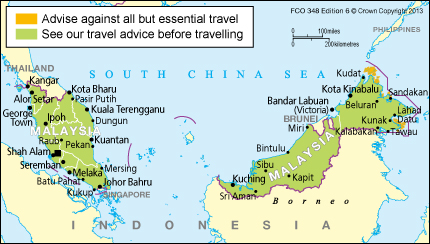
The Foreign and Commonwealth Office (FCO) advise against all but essential travel to all islands off the coast of eastern Sabah from Kudat to Tawau, including (but not limited to) Lankayan, Mabul, Pom Pom, Kapalai, Litigan, Sipadan and Mataking.
There was a magnitude 6.0 earthquake in Sabah on 5 June 2015, affecting Mount Kinabalu. Limited climbing activities have now resumed. Please see the Sabah tourism website for more information and continue to monitor local media for updates.
There are regular political demonstrations in central Kuala Lumpur. Popular gathering points are Masjid Jamek, Dataran Merdeka (Independence Square) and KLCC. Rallies may be called at short notice. Monitor local media, be vigilant and avoid large political gatherings.
In 2015, there’s a chance of increased haze as meteorologists predict an extended dry season. Haze can cause disruption to local, regional air travel and to government and private schools. See Health
There is a general threat from terrorism. Attacks could be indiscriminate, including in places frequented by expatriates and foreign travellers. There is a threat to foreigners of kidnapping and criminality on the eastern coast of Sabah and in particular the islands close to the Sulu Archipelago in the southern Philippines.
Recent incidents involving tourists include:
On 14 May 2015, armed men entered the Ocean King seafood restaurant on the Sandakan seafront and abducted the Malaysian restaurant manager and another Malaysian national.
On 12 July 2014, gunmen killed a member of the police and kidnapped another at the Mabul Water Bungalows Resort on the island of Mabul, off Semporna.
On 2 April 2014, armed men abducted 2 women, a Chinese tourist, and a Philippine hotel worker, from Singamata Reef Resort. Singamata Island is situated off the coastal town of Semporna in eastern Sabah.
On 15 November 2013, 2 Taiwanese tourists were attacked in their room at the Sipadan Pom Pom Resort, off the coast of eastern Sabah. A male tourist was killed and his wife kidnapped.
You should take great care in the town of Sandakan and along the coastal area south to Tawau. You should also take great care in areas east of Lahad Datu and around Semporna following the confrontation in March 2013 between insurgents and Malaysian security forces. Keep up to date with developments, and follow the advice of your tour operator and the local authorities. See Terrorism and Local travel - Sabah
Malaysia is a multicultural, but mostly Muslim country. See Local laws and customs
Around 435,500 British nationals visit Malaysia each year. Most visits are trouble free, but incidents of petty crime, especially bag snatching, can affect visitors. See Crime.
Take out comprehensive travel and medical insurance before you travel.

Safety and security

Local travel - Sabah

In February 2013, around 100 armed men from the Sulu archipelago landed on the eastern coast of Sabah and occupied the small village of Kampung Tanduo approximately 100 km east of Lahad Datu. On 1 March 2013 there was an exchange of fire and a number of fatalities. On 3 March 2013 there were reports of further incidents on the coast between Lahad Datu and Semporna. Additional Malaysian security forces were sent to the area on 4 March 2013 and on 5 March 2013 airstrikes and other military action was reported against locations held by the armed group from Sulu around Kampung Tanduo.
Some areas of eastern Sabah have been designated by the Malaysian authorities as coming under the Eastern Sabah Security Command (ESSCOM). The Malaysian security forces have strengthened their presence in this area and introduced measures to reduce the risk to the civilian population.  Engagements with those involved in the insurgency have been mainly limited to the area in the immediate vicinity of Kampung Tandao, some 120km to the east of Lahad Datu.  Major towns and transit points have been unaffected.

Crime

In the early hours of 9 October 2014, a hand grenade was thrown in front of a nightclub at the Sun Complex, off Bukit Bintang in Kuala Lumpur. One person was killed and 13 people were injured in the blast. Take extra care in the area.
Take sensible precautions to protect yourself from petty crime. Avoid carrying valuables and take particular care of your passport whilst walking, in aircraft, cafes, airport and railway terminals, and hotel rooms. Don’t open your hotel room door to strangers, especially late at night. This applies particularly to women travelling alone. Credit card and ATM fraud is widespread. Take great care when using your card.
In August 2014, 2 British nationals were killed in an incident in Kuching while returning to their hostel. Take care, especially at night.
Incidents of bag snatching are common, including by thieves on motorbikes. Bags with shoulder straps should either be carried with the bag towards the pavement rather than the road, or tucked under the arm. Don’t wrap the strap around your arm or shoulder and do not try to hold on to your bag. People have been injured or killed by being pulled to the ground by their bag straps.
There have been reports of taxi drivers dropping off passengers at the airport and then driving off with their luggage while the passenger is getting a trolley. Unload all of your belongings from taxis as soon as you get out.
Taxi coupon systems are in place at airports and the larger shopping centres; in other areas taxis should use a meter.
Be careful if you’re offered a drink by a stranger, even in a reputable bar or restaurant. These approaches can involve spiked drinks, and have resulted in cases of robbery and assault. Be aware of scams involving gambling.
If you are a victim of crime, inform the local police and get a police report.

Road travel

You can drive using a UK licence for up to 3 months. If you intend to stay in Malaysia for longer than 3 months you should get a Malaysian driving licence or an International Driving Permit.
Road conditions in Peninsular Malaysia are generally good, but less so in East Malaysia. Vehicles (particularly motorcycles) don’t always stop at traffic lights or pedestrian crossings. If you are involved in a road accident you are obliged by law to stay at the scene until the police have arrived. If a crowd gathers, it may be safer to leave the scene and report to the nearest police station.
There have been a number of fatal bus crashes, particularly on overnight journeys. Choose a reputable operator for your journey.
If you rent a motorbike you should take at least the same safety precautions as in the UK. Malaysian law states that helmets must be worn.
Driving under the influence of alcohol is a serious offence and the traffic police regularly carry out breath tests. Anyone over the legal limit can face a heavy fine or a jail sentence.

Sea and river travel

Piracy in South East Asian waters is an ongoing problem. There have been a number of attacks against ships in and around Malaysian waters, particularly in the Strait of Malacca and the waters between Sabah and the southern Philippines. Be vigilant and take appropriate precautions. Reduce opportunities for theft, establish secure areas on board and report all incidents to the coastal and flag state authorities.
Some passenger boats have sunk due to overloading and/or poor maintenance. Take care at all times when travelling by passenger ferry or speedboat and avoid travelling on vessels that are clearly overloaded or in poor condition. Make sure life jackets are available.

Water sports and scuba diving

If you rent jet skis or any other type of water sports equipment, make sure adequate safety precautions are in place. Only use reputable licensed operators, insist on training before use and make sure you’re insured.
Check dive operators’ credentials carefully and make sure you’re insured. Check that safety equipment is available on the boat, including oxygen. Ask about contingency plans, which should include the ability to call for help while at sea and to evacuate divers to the nearest hyperbaric chamber if necessary.
The sites of HMS Repulse and HMS Prince of Wales, which lie in international waters off Kuantan, have been declared ‘protected places’ under the Protection of Military Remains Act 1986. You should only dive there on a ‘look not touch’ basis. Don’t attempt to penetrate the wrecks, which lie in deep water. You should also take great care. One British diver died in November 2011 while diving on HMS Repulse.

Political Situation

Police have sometimes used tear gas and water cannons to control public protests. Monitor local and international media and avoid all demonstrations.


  • There are confirmed cases of Swine Flu (H1N1) in Malaysia. Passengers entering Malaysia from countries with confirmed cases of H1N1 will be thermally or manually screened for any increase in body temperature. Any passengers displaying flu-like symptoms, and passengers travelling on flights with confirmed cases, may be placed in quarantine.
  • The World Health Organisation (WHO) has raised its Pandemic Threat Alert Phase to Level 6. The WHO website at http://www.who.int/csr/disease/swineflu/en/index.html has further details. Check Swine Flu for further information. Guidance on Pandemic Flu can be obtained on the UK Department of Health website at www.dh.gov.uk.
  • For information about the situation in Malaysia please monitor the Malaysian Ministry of Health website: http://www.moh.gov.my.
  • The Ministry of Health have an operations room for the public to call, the numbers are 03 8881 0200 and 03 8881 0300.
  • There is a general threat from terrorism in Malaysia. Attacks could be indiscriminate, including in places frequented by expatriates and foreign travellers. See the Terrorism section of this advice for more details.
  • Foreign nationals have been kidnapped in the past in East Malaysia and we believe that this threat remains.Boats travelling to and from offshore islands and dive sites are possible targets. If you wish to visit resorts on, and islands off, Eastern Sabah, you should exercise extreme caution.
  • If you plan to travel over the border to Thailand you should be aware that there has been a resurgence of terrorism in southern Thailand, particularly in the far southern provinces of Pattani, Yala, Narathiwat and Songkhla. We advise against all but essential travel to these Thai provinces. See the travel advice for Thailand for more details.
  • You should not become involved with drugs of any kind: possession of even very small quantities can lead to imprisonment or the death penalty. See the Local Laws and Customs section of this advice for more details.
  • Around 250,000 British nationals visit Malaysia each year (Source: Immigration Malaysia). Most visits are trouble-free. The main types of incident for which British nationals required consular assistance in 2007 were for replacing lost and stolen passports; assisting victims of bag snatching and gambling scams; and deaths, mostly from natural causes.
  • Malaysia is a multicultural but predominantly Muslim country, and as such you should respect local social conventions at all times. See the Local Laws and Customs section of this advice for more details.
  • We strongly recommend that you obtain comprehensive travel and medical insurance before travelling. You should check any exclusions, and that your policy covers you for the activities you want to undertake. See the General (Insurance) section of this advice and Travel Insurance for more details.

Safety and security

Terrorism
There is a general threat from terrorism in Malaysia. Attacks could be indiscriminate, including in places frequented by expatriates and foreign travellers. For further information see Terrorism Abroad.
In neighbouring Indonesia, Westerners were killed and injured following the terrorist attacks in Bali (October 2002 and October 2005) and Jakarta (August 2003 and September 2004).
Foreign tourists were kidnapped from the Malaysian island of Sipadan in 2000, and foreign workers from a resort near Lahad Datu in Eastern Sabah in 2003. On 12 April 2004, a Malaysian vessel was hijacked and three crew members taken hostage just outside Malaysian waters off the eastern coastline of Sabah. We believe that the threat from kidnapping remains. Boats travelling to and from offshore islands and dive sites are possible targets. If you wish to visit resorts on, and islands off, Eastern Sabah (from Kudat eastwards to Tawau), you should exercise extreme caution.
You should be aware that the long-standing policy of the British Government is not to make substantive concessions to hostage takers. The British Government considers that paying ransoms and releasing prisoners increases the risk of further hostage taking.
The Malaysian Government has put in place measures to combat terrorism and has arrested a number of terrorist suspects. In Sabah, the authorities have increased security, but there is a continuing risk of further incidents. If you wish to go to remote areas, you are advised to register your itinerary with the local police or your hotel/tour operator beforehand.
If you plan to travel over the border to Thailand you should be aware that since January 2004 there has been a resurgence of terrorism in southern Thailand, particularly in the far southern provinces of Pattani, Yala, Narathiwat and Songkhla. We recommend against all but essential travel to these four Thai provinces. Since January 2004, there have been almost daily attacks in the far south. These include arson, bombings and shootings. Over 2500 people have been killed and several thousand more injured. Tourist hotels and bars, shops, market places, transport infrastructure, in particular rail tracks and in trains, have all been targeted. No British nationals have been killed in these attacks, but some foreign citizens have been killed and injured. For more information you should read the Travel Advice for Thailand.
Crime
You should be aware of the dangers of street crime, particularly bag snatching and pickpockets - and scams involving gambling or spiked drinks. You should:
  • Incidents of bag snatching are common. There have been many cases of bags being snatched by thieves on motorbikes. Deaths have occurred where victims held on to their bags. When going out, avoid carrying valuables you, and be aware of your surroundings.
  • Take particular care of your belongings especially your passport, as visitors' passports have been stolen on aircraft, cafes, airport and railway terminals, and from hotel rooms.
  • There have been a number of tourists taken in by gambling scams. This has usually involved being befriended by a stranger in an attempt to gain the victim’s confidence. Organised groups have used this approach as a ploy to take you back to their house where the victim has been encouraged to play cards, at the end of which they are intimidated into paying large sums of money, or making forced purchases of jewellery as payment of gambling debts. These groups are sometimes armed and are known to operate in major tourist areas, including shopping centres, food malls and around hostels/hotels.
  • Be careful if offered a drink by a stranger, even in a reputable bar or restaurant. Such approaches can involve spiked drinks, and have resulted in cases of robbery and assault.
  • Do not open your hotel room door to strangers, even those wearing hotel uniform, and especially late at night. This applies particularly to women travelling alone.
  • Credit card and ATM fraud is widespread. Take great care when making payments by credit card and using ATMs. There have been many instances where cards have been duplicated and skimming devices added to ATMs.
For more general information see Victims of Crime Abroad.

Political Situation

Malaysia Country Profile
.

Police permission is required for certain kinds of public gatherings in Malaysia. Since October 2007 there have been demonstrations which did not have the required police permission. Police have sometimes used tear gas and water cannons to control crowds. You should exercise caution and avoid any demonstrations or large gatherings of people which might place you at risk.

Local Travel

Road Travel


A UK driving licence can be used in Malaysia for three months only. If you intend staying in Malaysia for longer than three months you should get either a Malaysian driving licence or an annually renewable International Driving Permit.

If you intend to hire cars, motorcycles or any motorised water sport equipment, talk to your travel insurer to check if it is covered by your insurance policy.

Road conditions in Peninsular Malaysia are generally good but less so in East Malaysia. Traffic (particularly motor cyclists) will not always stop at traffic lights or on pedestrian crossings. Visitors should take care when crossing the street to avoid accidents. If you are involved in a road accident you are obliged by law to remain at the scene until the police have attended. However, if a crowd should gather, it would be prudent to leave the scene and report to the nearest police station.

There have been a number of fatal bus crashes in Malaysia, particularly on overnight journeys. Choose a reputable operator for your journey.

If you rent a motorbike you should take the same safety precautions as in the UK. Malaysian law states that helmets must be worn.

Driving under the influence of alcohol is a serious offence in Malaysia and the traffic police regularly carry out breath tests. Anyone over the legal limit can face a heavy fine or a jail sentence.

For more general information see Driving Abroad.

Sea and River Travel

Piracy in South East Asian waters is an ongoing problem. There have been a number of attacks against ships in and around Malaysian waters, particularly in the Strait of Malacca and in the waters between Sabah and the southern Philippines. Mariners should be vigilant and take appropriate precautions; reduce opportunities for theft; establish secure areas onboard; and report all incidents to the coastal and flag state authorities. Vessels which encounter problems at sea should contact the Maritime Rescue Co-ordinating Centre on the standard distress channel.

There have been instances of passenger boats sinking, usually due to overloading and/or poor maintenance. You should exercise care at all times when travelling by passenger ferry or speedboat and avoid travel on vessels that are clearly overloaded or in poor condition. You should also ensure that life jackets are available.

Water sports and scuba diving


If you choose to rent jet skis or any other type of water sports equipment, you should first consider the dangers involved and satisfy yourself that adequate safety precautions are in place. Once satisfied about this, rent only from reputable operators and insist on sufficient training before use. Also ensure that the operator is licensed and has adequate insurance cover.

The standards maintained by diving schools and rescue services are not always as high and comprehensive as they might be in the UK. Check a dive operator's credentials carefully before using them and ensure that your insurance covers you for all of the activities that you undertake. If you are an experienced diver you should purchase dive specific insurance and check that your qualifications and experience fall within the cover provided. You should contact your issuing authority if you are in any doubt (i.e. PADI or BSAC). If you have had no previous diving experience you should ask your dive operator to explain what cover they offer before signing up for a course; you should also be satisfied that sufficient safety equipment is available on the boat, particularly oxygen. You should also ask about contingency plans, which should include the ability to call for help whilst at sea and to evacuate divers to the nearest hyperbaric chamber if necessary.

The sites of HMS Repulse and HMS Prince of Wales, which lie in international waters off Kuantan, have been declared “Protected Places” under the Protection of Military Remains Act 1986. You should only dive there on a "look not touch" basis and should not attempt to penetrate the wrecks, which lie in deep water. You should also exercise extreme caution. One British diver recently died while diving on HMS Repulse. If you have evidence of any other type of activity on or near the wrecks, please report it to the British High Commission in Kuala Lumpur.

For more general information see River and Sea Safety
Air Travel

Airport departure tax is included in the ticket price.

Local laws and customs

Malaysia is a multicultural but predominantly Muslim country. You should respect local traditions, customs, laws and religions at all times and be aware of your actions to ensure that they do not offend other cultures or religious beliefs, especially during the holy month of Ramadan or if you intend to visit religious areas. For more general information see Travelling During Ramadan.
You should also dress modestly in conservative and rural areas, and when visiting places of worship. Homosexual acts are illegal.
If you are a Muslim you should be aware that you may also be subject to local Shari'a law.
There are severe penalties for all drug offences in Malaysia: trafficking (defined here as the possession of a certain quantity of drugs) incurs a mandatory death penalty; possession incurs a custodial sentence and possible whipping. This includes the possession of or trafficking in Amphetamine-type stimulants. You could be asked to take a urine test on arrival in Malaysia if you are suspected of having used drugs before your visit. Should the test prove positive, you could be referred for rehabilitation treatment or be deported.
The importation of unlicensed firearms and ammunition into Malaysia is prohibited. Possession can carry the death penalty.
For more general information for different types of travellers see Travel Advice Relevant to You.

Entry requirements

Visas
British nationals do not need a visa to enter Malaysia as a visitor. You will normally be given permission to stay for three months on arrival. Visas for longer stays or for non-tourist purposes must be obtained from the nearest Malaysian diplomatic mission before travel.
The Malaysian authorities are running a vigorous campaign against illegal immigration and are therefore inspecting immigration documents, such as work permits, very closely.
It is important that you neither overstay your visa, nor infringe the terms of entry. Persons doing so (even overstaying for just a few days) will incur a fine and possibly detention and deportation.
UK citizens travelling from Peninsular Malaysia to East Malaysia (sometimes known as Malaysian Borneo and comprising the states of Sabah and Sarawak) need to carry their passports to enter East Malaysia.
Passport validity
Entry to Malaysia is normally refused to visitors holding passports with less than six months' validity.
Dual nationals
Dual nationals should also be aware that Malaysia does not recognise dual nationality, so technically you can be refused entry if you are found to be holding two passports of different nationality. If you are a dual national it is advisable to enter Malaysia on the passport on which you exited your last country of departure.
Exchange control rules
Under current Malaysian exchange control rules, you may import or export up to 1,000 Malaysian Ringgit per person without prior approval. There are no limits on the amount of foreign currency (notes and or travellers' cheques) you may import. Non-residents may export foreign currency (notes and or travellers' cheques) up to the amount they previously imported, provided they have documentary evidence of the amount they imported. All travellers must complete travellers' declaration forms on entering Malaysia. Penalties for offences under the Exchange Control Act 1953 are a fine of up to 10,000 Malaysian Ringgit, three years' imprisonment or both.
Travelling with children
Single parents or other adults travelling alone with children should be aware that some countries require documentary evidence of parental responsibility before allowing lone parents to enter the country or, in some cases, before permitting the children to leave the country. They may want to see birth certificates, a letter of consent from the other parent or some evidence as to your responsibility for the child. Malaysian authorities do not normally require such evidence but if you have any concerns please check with Malaysian representation in the UK.

Health

Emergency medical care in all hospitals is good. However standards of care in government hospitals can be variable. Both government and private hospitals charge for all services. Private care is expensive.

Malaysia has periodic problems with air quality reaching hazardous levels because of smoke haze. For more information on the air quality in Malaysia please visit the website of the Malaysian Department of Environment.

Dengue, malaria and other mosquito borne illnesses (including chikungunya fever) occur in Malaysia. Dengue fever is prevalent in all states and serious outbreaks occur from time to time. We recommend that you take precautions against being bitten by mosquitoes, including using insect repellent at all times. There are no vaccinations against these diseases but there are preventative measures that you can take, as advised on the National Travel Health Network and Centre (NaTHNaC) website. You should visit your GP to discuss malaria prevention tablets.

There are occasional outbreaks of Hand, Foot and Mouth Disease (HFMD) across Malaysia.

In the 2008 Report on the Global AIDS Epidemic the UNAIDS/WHO Working Group estimated that around 79,000 adults aged 15 or over in Malaysia were living with HIV; the prevalence rate was estimated at around 0.5% of the adult population. This compares to the prevalence rate in adults in the UK of around 0.2%. You should exercise normal precautions to avoid exposure to HIV/AIDS. For more general information on how to do this see HIV and AIDS.

You should seek medical advice before travelling to Malaysia and ensure that all appropriate vaccinations are up-to-date. For further information on vaccination requirements, health outbreaks and general disease protection and prevention you should visit the websites of the National Travel Heath Network and Centre (NaTHNaC) or NHS Scotland's Fit For Travel or call NHS Direct on 0845 46 47.
For more general health information see Travel Health and for food/drink hygiene see Eat and Drink Safely.

Swine Flu (H1N1)
There are confirmed cases of Swine Flu (H1N1) in Malaysia. Passengers entering Malaysia from countries with confirmed cases of H1N1 will be thermally or manually screened for any increase in body temperature. Any passengers displaying flu-like symptoms, and passengers travelling on flights with confirmed cases, may be placed in quarantine.
The World Health Organisation (WHO) has raised its Pandemic Threat Alert Phase to Level 6. The WHO website at: www.who.int/csr/disease/swineflu/en/index.html has further details. You should also monitor local media reports for any developments and advice. There is a dedicated Swine Flu page on the FCO website: http://www.fco.gov.uk/en/travelling-and-living-overseas/swine-flu. Guidance on Pandemic Flu can be obtained on the UK Department of Health website at www.dh.gov.uk.

For information about the situation in Malaysia please monitor the Malaysian Ministry of Health website: http://www.moh.gov.my/MohPortal/index.jsp?lang=en The Ministry of Health have an operations room for the public to call, the numbers are 03 8881 0200 and 03 8881 0300.

Avian Influenza (Bird Flu)
There have been outbreaks of Avian Influenza (Bird Flu) in domestic poultry in Malaysia (most recently in June 2007). No human infections have been reported.
The risk to humans from Avian Influenza is believed to be very low. As a precaution, you should avoid visiting live animal markets, poultry farms and other places where you may come into close contact with domestic, caged or wild birds; and ensure poultry and egg dishes are thoroughly cooked.
You should read this advice in conjunction with Avian and Pandemic Influenza, which gives more detailed advice and information.

Natural disasters


Between the months of October to February Malaysia is affected by seasonal storms, which occasionally result in heavy flooding.

General

Insurance
We strongly recommend that you obtain comprehensive travel and medical insurance before travelling. You should check any exclusions, and that your policy covers you for all the activities you want to undertake. See Travel Insurance for more details.
If things do go wrong when you are overseas then this is how we can help.
Consular Registration

Register with our LOCATE service to tell us when and where you are travelling abroad or where you live abroad so our consular and crisis staff can provide better assistance to you in an emergency. More information about registering with LOCATE can be found here.

Travel advice for this country