Saturday, December 5, 2009

Antigua & Barduda travel advice

This advice has been reviewed and reissued with amendments to the Summary (consular assistance figures). The overall level of the advice has not changed.

Travel Summary

  • The hurricane season in Antigua and Barbuda normally runs from June to November. See Natural Disasters section of this advice and the tropical cyclones page of the FCO website for more details.

  • There are confirmed cases of Influenza A (H1N1) (Swine Flu) in Antigua and Barbuda. The World Health Organisation (WHO) has raised its Pandemic Threat Alert Phase to Level 6. The WHO website l has further details. You should monitor media reports for any developments and advice. There is a dedicated Swine Flu page on the FCO website. Guidance on Pandemic Flu can be obtained on the UK Department of Health website .

  • There is no British High Commission in Antigua and Barbuda. For emergency consular assistance, please contact the British High Commission in Bridgetown, Barbados. See the Contact Details of this advice for more details.

  • Around 97,000 British nationals visited Antigua and Barbuda in 2007 (Source: Ministry of Tourism, Antigua). Most visits to Antigua and Barbuda are trouble-free. 6 British nationals required consular assistance in Antigua & Barbuda in the period 01 April 2008 – 31 March 2009 for the following types of incident; deaths (2 cases); hospitalisations (1 cases); and arrests, for a variety of offences (0 cases). During this period assistance was also requested with regard to lost or stolen passports (8 cases). There has been an overall increase in crime in Antigua over recent months, including gun crime, and three foreign tourists have been killed in the past year. See the Crime section of this advice for more details.

  • There is a low threat from terrorism. But you should be aware of the global risk of indiscriminate terrorist attacks which could be in public areas, including those frequented by expatriates and foreign travellers.

  • We strongly recommend that you obtain comprehensive travel and medical insurance before travelling. You should check any exclusions and that your policy covers you for all the activities you want to undertake. See the General (Insurance) section of this advice and travel insurance for more details.

Safety and security

Terrorism

There is a low threat from terrorism. But you should be aware of the global risk of indiscriminate terrorist attacks which could be in public areas, including those frequented by expatriates and foreign travellers. For more general information see terrorism abroad.

Crime

Around 97,000 tourists visit Antigua and Barbuda each year (source: Ministry of Tourism, Antigua) and the vast majority of visits are trouble-free. Antigua and Barbuda is a friendly and welcoming country and overall crime rates are relatively low. Despite the relaxed atmosphere however, there have been incidents of violent crime including murder. These tend to occur within the local community but can sometimes affect tourists.

There has been an overall increase in crime in Antigua over recent months, including gun crime. Two British nationals died as a result of a shooting on 27 July 2008, in their room, at a resort near Valley Church in the south west. An Australian yacht captain died following a shooting in the Nelson's Dockyard area of English Harbour on 22 January 2009.

You should therefore maintain at least the same level of security awareness as you would in the UK and ensure that your living accommodation is secure. Apply the same measures if you are staying on a yacht. You should take sensible precautions and be vigilant at all times. Avoid isolated areas, including beaches after dark. Do not carry large amounts of cash or jewellery. Valuables and travel documents should be left, where possible, in safety deposit boxes and hotel safes.

For more general information see victims of crime abroad.

Political situation

Antigua and Barbuda Country Profile

Local Travel

Road travel

In order to be able to drive a car in Antigua and Barbuda you must purchase a local driving licence, usually from the car hire company, at a cost of US$ 20 (EC$50). You must show your current driving licence to obtain this.

You should drive with care and attention at all times. The national speed limit is 40mph and there is a limit of 20 mph in built up areas.

Motorists drive on the left in Antigua and Barbuda. Main roads are generally well maintained, although they lack road markings. Pot holes, even on main roads, and poorly marked speed bumps can catch the unwary. Overtaking on blind corners and cutting corners when turning right are commonplace. Stray cattle, goats and dogs are an additional hazard. Pavements are few and very narrow so pedestrians walk on the road. Few streets are lit at night.

For more general information see driving abroad.

Air travel

An airport departure tax is payable by visitors staying more than 24 hours. In October 2007 this departure tax amounted to 50 East Caribbean Dollars (per person over 12 years).

For more general information see airline security.

Local laws and customs

You should note that there are severe penalties for all drug offences. Pack all luggage yourself and do not carry anything through customs for anyone else.

You should be aware that it is an offence for anyone, including children, to dress in camouflage clothing.

Certain homosexual acts are illegal under the laws of Antigua and Barbuda.

Entry requirements

Visas

British Passport holders do not require visas to visit Antigua and Barbuda. On entry, you are granted a stay of one month. If you wish to stay longer, you must apply and pay for an extension of stay through the Antigua and Barbuda Immigration Department. It is an offence to overstay the entry period or to work without a work permit.

Passport validity

Your passport should be valid for at least six months.

Foot and mouth disease

You are banned from bringing meat products into Antigua and Barbuda from the United Kingdom in your personal luggage.

Health

There is a confirmed case of Influenza A (H1N1) (Swine Flu) in Antigua and Barbuda. The World Health Organisation (WHO) has raised its Pandemic Threat Alert Phase to Level 6. The WHO website has further details. There is a dedicated swine flu page on the FCO website. Guidance on Pandemic Flu can be obtained on the UK Department of Health website.

You should note that the private medical clinic, Adelin, will not accept medical travel insurance as payment for treatment. You must pay a deposit (US$4,000 in October 2007) via a credit card before treatment will be given. If funds deposited exceed the cost of the treatment, a refund will be given. Before being treated at Adelin you should check if your insurance company is willing to cover the cost of treatment. If not, you will need to use the General Hospital.

Dengue Fever is common to Latin America and the Caribbean and can occur throughout the year. In 2007 there was a marked increase in the number of reported cases of dengue across the region. It is found throughout Antigua and Barbuda.

You should exercise normal precautions to avoid exposure to HIV/AIDS. For more general information on how to do this see HIV and AIDS.

You should seek medical advice before travelling to Antigua & Barbuda and ensure that all appropriate vaccinations are up-to-date. For further information on vaccination requirements, health outbreaks and general disease protection and prevention you should visit the websites of the National Travel Health Network and Centre (NaTHNaC) and NHS Scotland’s Fit for Travel or call NHS Direct on 0845 46 47.

For more general health information see travel health.

Natural disasters

Hurricanes

The hurricane season in the Caribbean normally runs from June to November. You should monitor local and international weather updates from the World Meteorological Organisation and the National Hurricane Centre. For more general information see Tropical Cyclones.

General

Insurance

We strongly recommend that you obtain comprehensive travel and medical insurance, which includes medical evacuation by air ambulance, before travelling. Be especially careful about cover for recurring illnesses, as this may not be included in all insurance policies. You should check any exclusions, and that your policy covers you for all the activities you want to undertake. For more general information see travel insurance.

If things do go wrong when you are overseas then this is how we can help.

Registration

Register with our LOCATE service to tell us when and where you are travelling abroad or where you live abroad so our consular and crisis staff can provide better assistance to you in an emergency.

Package holidays

If you are on a package holiday, you must travel on the specified return date. If you fail to do so it is likely that you will have to pay the cost of a return ticket yourself.

Passports

In the event of loss of your passport you will need to apply to the Passport Office at the British High Commission, Barbados for a replacement. There is no British High Commission in Antigua and Barbuda. Urgent applications are sent to Bridgetown by courier, incurring courier costs for the applicant. But even so, the issue of a replacement passport will take several days.

Keep a copy of the photopage of your passport and relevant entry stamp in case your documents are stolen.

Friday, December 4, 2009

Anguilla ( British Overseas Territory) travel advice

This advice has been reviewed and reissued with an amendment to the Health and Passport sections. The overall level of the advice has not changed.

Travel Summary


  • You should monitor local media reports for any developments and advice. There is a dedicated swine flu page on the FCO website. Guidance on Pandemic Flu can be obtained on the UK Department of Health website .

  • Anguilla is a British Overseas Territory. There is no formal British diplomatic or consular representation in Anguilla and the local authorities deal with all requests for consular assistance. See the General (Consular Assistance) section of this advice for more details.

  • Most visits to Anguilla are trouble-free. However, you should not become complacent about safety and security as cases of robbery and other crimes against people do occur. See the Crime section of this advice for more details.

  • The hurricane season in Anguilla normally runs from June to November. See the Natural Disasters section of this advice and Tropical Cyclones for more details.

  • British passport holders do not require visas to enter Anguilla as a visitor but accommodation must be booked prior to arrival. For visa enquiries, non-British passport holders should contact the Identity and Passport Service at the Home Office on 020 7901 2334 from 1000 to 1600 GMT (Mon-Fri). See the Entry Requirements of this advice for more details.

  • The threat from terrorism is low, but you should be aware of the global risk of indiscriminate attacks which could be in public places, including those frequented by expatriates and foreign travellers.

  • We recommend that you obtain comprehensive travel and medical insurance before travelling. You should check any exclusions and that your policy covers you for all the activities you want to undertake. See the General (Insurance) section of this advice and Travel Insurance for more details.

Safety and security

Terrorism

The threat from terrorism is low. But you should be aware of the global risk of indiscriminate terrorist attacks, which could be in public places, including those frequented by expatriates and foreign travellers. For more general information see terrorism abroad.

Crime

There is a relatively low rate of crime in Anguilla. Nevertheless you should take sensible precautions such as locking doors and windows at night and securing your car when you leave it. Avoid isolated areas, including beaches after dark. Do not carry large amounts of cash or jewellery. Valuables and travel documents should be left, where possible, in safety deposit boxes and hotel safes. Do not offer resistance in the attempt of an armed robbery.

For more general information see victims of crime abroad.

Political Situation

The next election is due by March 2010.Anguilla Country Profile

Local Travel

Road Travel

There is no public transport except taxis but car rental is widely available. You will need to bring your driving licence if you plan to rent a car (and obtain a local driving licence from the car rental company at a cost of US $20). Most rental cars are automatic, but manual ones can be obtained – it is best to order in advance. If driving a vehicle, remember to drive on the left, the same as in the UK, and exercise caution when overtaking as most vehicles are left hand drive. Observe speed limits and do not drink and drive. For more general information see driving abroad.

Air Travel

Since 11 September 2001, all airlines require earlier check-in times for passengers and luggage. All items of luggage are subject to search. You should allow extra time at the airport and should check with the individual airline for the recommended check-in time for your flight.

For more general information see airline security.

Local laws and customs

There are harsh penalties if you are caught with drugs of any kind.

Topless/nude bathing is not permitted.

You should observe the customs regulations on the importation and exportation of agricultural products and the protection of marine and animal life. There are a number of marine and animal specimens that may not be taken from the island. If in doubt you should check with the local customs authorities prior to the purchase, importation or exportation of such items.

For those returning to the UK, please observe the UK Customs and Excise rules on the illegal importation of meat and animal products

For more general information for different types of travellers see your trip.

Entry requirements

Visas

British nationals do not require a visa.

For visa enquiries, non-British passport holders should contact the Identity and Passport Service at the Home Office on 020 7901 2334 from 1000 to 1600 GMT (Mon-Fri).

Passport validity

A full British passport of at least six months validity is required for all British nationals visiting Anguilla.

Travelling with children

Single parents or other adults travelling alone with children should be aware that some countries require documentary evidence of parental responsibility before allowing lone parents to enter the country or, in some cases, before permitting the children to leave the country.

Health

With just one small hospital and three private clinics on the Island, medical facilities are relatively limited. Serious cases that require major surgery may need you to be transferred to a neighbouring island.

You should exercise normal precautions to avoid exposure to HIV/AIDS. For more general information on how to do this see HIV and AIDS.

You should seek medical advice before travelling to Anguilla and ensure that all appropriate vaccinations are up-to-date. For further information on vaccination requirements, health outbreaks and general disease protection and prevention you should visit the websites of the National Travel Health Network and Centre (NaTHNaC) and NHS Scotland’s Fit for Travel or call NHS Direct on 0845 46 47.

A (H1N1) - Swine Flu

You should monitor local media reports for any developments and advice. There is a dedicated swine flu page on the FCO website. Guidance on Pandemic Flu can be obtained on the UK Department of Health website.

For more general health information see Travel Health.

Natural disasters

The hurricane season in the Caribbean normally runs from June to November. You should monitor local and international weather updates from the World Meteorological Organisation and the National Hurricane Centre. For more general information see Tropical Cyclones.

General

Insurance

We advise you to take out adequate medical insurance before travelling. This must cover air ambulance charges and other medical costs in a third country. You should check any exclusions, and that your policy covers you for all the activities you want to undertake. For more general information see travel insurance.

If things do go wrong when you are overseas then this is how we can help.

Consular Assistance

Anguilla is a British Overseas Territory and as such there is no formal British Consular Representation. The Governor's Office will assist British nationals in a genuine emergency, but all enquiries regarding passport services should be made to the UK Passport Service Centre in Washington D.C.

The mailing address is:
The UK Passport Service Centre for the Americas and Caribbean
British Embassy
19 Observatory Circle, NW
Washington, DC 20008
USA

Further information, guidance and copies of application forms can be obtained online at www.ukinusa.fco.gov.uk or www.ukinbarbados.fco.gov.uk.

Registration

Register with our LOCATE service to tell us when and where you are travelling abroad or where you live abroad so our consular and crisis staff can provide better assistance to you in an emergency.

Money

Most major credit cards are accepted in local shops, hotels and restaurants. The local currency is the Eastern Caribbean dollar (EC$). It is fixed to the US Dollar at EC$2.7 = 1 US Dollar. US Dollars are widely accepted. The territory has modern banking facilities, including ATM machines.

Thursday, December 3, 2009

Yemen travel advice

This advice has been reviewed and reissued with amendments to the Summary and the Kidnap, Local Travel and Studying in Yemen section. The overall level of the advice has not changed

Travel Summary


  • We advise against all travel to the Governorate of Sa’ada. In August 2009 renewed hostilities broke out in Sa’ada (see section on the political situation for further detail). There have been clashes on the Saudi – Yemen border between the rebels and the Saudi Government since early November. Please check this advice for further updates.

  • We also advise against all but essential travel to the rest of Yemen due to the threat of terrorism, kidnapping and tribal violence. Unless you have an essential reason to be in Yemen you should consider whether you need to remain. See the Political Situation and Terrorism sections of this advice for more details.

  • There is a high threat from terrorism in Yemen including against Western, and British, interests. The renewed conflict in Sa’ada has further heightened tensions. You should avoid places frequented by expatriates and foreign travellers, including in Sana’a and other urban centres. Recent examples of attacks include an attempted suicide attack on the airport road, attacks against tourist sites and against the US Embassy. We believe that terrorists continue to plan attacks. See the Terrorism section of this advice for more details.

  • The British Embassy are investigating the kidnap of a British national who went missing in the Governorate of Sa’ada in the north of Yemen on 12 June 2009. There have been a number of kidnappings of foreign nationals since mid-2005, including in the Governorates of Ma’rib, Shabwa, ‘Amran and Abyan. On 16 November 2009 a Japanese national was kidnapped on the road between Sana’a and Marib. If your visit to Yemen is essential you should exercise extreme caution. See the Kidnaps section of this advice for more details.

  • Developments in the region may trigger public unrest. You should take care to avoid demonstrations, which can turn hostile,and be particularly vigilant in public places.

  • If you wish to drive to Governorates outside Sana'a, you will need prior permission from the Yemen Tourist Police. Travelling without such permission is likely to result in detention and possible deportation. You should be aware that consular assistance outside Sana’a is limited due to the restrictions on travel.

  • Four British nationals required consular assistance in Yemen in the period 01 April 2008 – 31 March 2009. During this period assistance was also requested with regard to lost or stolen passports (10 cases).

  • We recommend that you obtain comprehensive travel and medical insurance before travelling. You should check any exclusions, and that your policy covers you for all the activities you want to undertake. See the General (Insurance) section of this advice and the Travel Insurance page of the FCO website for more details.

Safety and security

Terrorism

There remains a high threat from terrorism in Yemen. We believe that terrorists continue to plan attacks. Attacks could be indiscriminate, including against Western and British interests, such as residential compounds, military and oil facilities, and transport and aviation interests. For more general information see Terrorism Abroad.

You should take all the necessary steps to protect your safety, and you should make sure that you have confidence in your individual security arrangements. You should maintain a high level of vigilance in public places and avoid places frequented by foreign travellers and expatriates such as hotels, restaurants, and popular sites, which we judge to be of particular risk, including in Sana’a and other urban areas.

We advise against all travel to the Governorate of Sa'ada. We also advise against all but essential travel to the rest of Yemen due to the threat of terrorism, kidnapping and tribal violence.

There have been a number of other terrorist incidents in Yemen over the past 10 years. Recent examples of such attacks include:

  • On 18 March 2009 there was an attempted suicide attack against a convoy of vehicles on the airport road in Sana’a, approximately 1.5 – 2kms from the entrance to Sana’a International Airport. There were no casualties.
  • On 15 March 2009 a group of South Korean nationals were attacked whilst visiting a popular tourist site in Shibam, Hadramaut Governorate. Four South Koreans and one Yemeni national died in the attack. At least four others were injured.
  • On 17 September 2008, at least 17 people were killed in an attack on the US Embassy in Sana'a, including six terrorists.
  • On 30 April 2008, there was a mortar attack against the Italian Embassy in Sana'a.
  • On 10 April 2008 an improvised explosive device exploded at an oil company headquarters in Sana'a, and a second device was disarmed.
  • On 6 April 2008 there was a mortar attack against a residential compound in Sana'a.
  • On 18 March 2008 there was a grenade attack against the US Embassy in Sana'a.
  • On 18 January 2008, two Belgian and two Yemeni nationals were shot dead, with four other Belgians seriously injured, in an incident in the Governorate of Hadramaut.
  • On 9 July 2007, an explosive device was found in Aden but was not detonated.
  • On 2 July 2007, eight Spanish and two Yemeni nationals were killed, and a number of others injured, in a suicide bomb attack in Ma’rib, 100 km east of Sana'a.
For further information please also check the British Embassy website: http://www.ukinyemen.fco.gov.uk/en/.
Kidnaps

Some tribes are heavily armed and have a tradition of kidnapping foreigners to publicise their grievances or to further their case in disputes with the government. Such kidnappings have occurred in the capital Sana’a as well as in the Governorates of al-Jawf, Abyan, Sa'ada, Dhamar, ‘Amran, Ma’rib, Shabwah and Abyan. You should exercise caution when travelling outside urban areas and you should not travel outside cities at night. We recommend that travel outside the major cities is only undertaken when accompanied by a military escort.

The British Embassy are investigating the kidnap of a British national who went missing along with eight other foreign nationals in the Governorate of Sa’ada Governorate in the north of Yemen on 12 June 2009. Three of those kidnapped were killed and the other six (including the Briton) remain missing. On 16 November 2009 a Japanese national was kidnapped on the road between Sana’a and Marib, he is still being held. On 31 March 2009 two Dutch expatriates were kidnapped outside Sana’a. They were released unharmed after being held for two weeks. Other recent incidents of kidnappings include a German national and his two Yemeni colleagues were kidnapped in Shabwa Governorate. The hostages were released unharmed on 18 January 2009. Three South African nationals, including two children, were kidnapped on the Aden/Abyan road in the south of Yemen. They were released unharmed on 2 January 2009, and on 14 December 2008 three German nationals were kidnapped in Bait Bous, on the outskirts of Sana'a. All of those hostages were released unharmed. You should be aware that the long-standing policy of the British Government is not to make substantive concessions to hostage takers. The British Government considers that paying ransoms and releasing prisoners increases the risk of further hostage taking.

Crime

Incidents of violent crime against foreigners are rare, but the easy availability of weapons makes it a possibility. Tribal disputes over land are common, including in major cities, and may involve the use of weapons. You should exercise caution at all times.

For more general information see Victims of Crime Abroad.
Political Situation
Since 2004, the Yemeni government have been fighting an armed uprising by the al Huthi movement and their supporters in Sa’ada, northern Yemen. There have also been clashes on the Saudi – Yemen border between the rebels and the Saudi Government since early November. Foreigners have not been targeted, but hundreds of Yemeni soldiers and civilians have been killed in the fighting. The area affected by the conflict has gradually spread from the northern part of the Sa’ada Governorate into the neighbouring Governorates of ‘Amran and al Jawf. In 2008, there have also been pockets of fighting in Wadi Bani Hushaish, some 20 kilometres east of Sana’a. The fighting has varied in intensity, with lulls in hostilities and several agreed cease-fires, most recently in July 2008. August 2009 however saw a revival of heavy fighting in Sa’ada Governorate including the use of air strikes and heavy artillery and there have also been reports of further outbreaks of fighting in Amran and Al Jawf as a result of this new round of conflict. We advise against all travel to the Sa’ada Governorate, access to which is in any case limited by Yemeni government restrictions.
You should follow news reports and be alert to local and regional developments, which might trigger public disturbances. Developments in Iraq and on the Middle East Peace Process continue to have an impact on local public opinion in the region. You should be aware of local sensitivities on the issue. There have been demonstrations in both Sana’a and Aden following the escalation of violence in Gaza since late December 2008. Since March 2009 there has been an increase in demonstrations in the south in particular in the governorates of Aden, Abyan, Lahj, and Al-Dhali’. Some of these demonstrations have resulted in violence. You should take precautions for your personal safety and avoid public gatherings and demonstrations.
Local Travel
If you wish to drive outside Sana'a you will need prior permission from the Yemen Tourist Police. Travel permits may take at least 24 hours to be issued and are easiest to obtain through a travel agent. Travellers without such permission is likely to result in detention and possible deportation. You should be aware that the consular assistance we can offer outside Sana’a is limited due to restrictions on travel.
There have been disturbances in Aden, Lahij and al-Dhali', which have resulted in closures of the Aden-Sana'a road. These have been short-lived but if you intend to travel by road you should check that the road is open before starting your journey.
Road Travel
You can drive in Yemen on an International Driving Licence.
Driving standards are poor and mountain roads hazardous.
You should avoid all road travel at night. Care should also be taken to avoid minefields left over from Yemen's civil wars. Travelling off well-used tracks without an experienced guide could be extremely hazardous, particularly in parts of the south and the central highlands.

For more general information see Driving Abroad.
Air Travel
All flights should be reconfirmed during your stay.
Sea Travel
Mariners should be aware of an increasing number of pirate attacks against ships off the Gulf of Aden in 2008, including against private yachts. We advise against yachting in this area. Incidents of piracy have also been known to occur in parts of the Red Sea.

Mariners can find more general information at River and Sea Safety.

Local laws and customs

Local laws reflect the fact that Yemen is an Islamic country. You should respect local traditions, customs, laws and religions at all times and be aware of your actions to ensure that they do not offend other cultures or religious beliefs, especially during the holy month of Ramadan or if you intend to visit religious areas. For more general information see Travelling During Ramadan (August/September 2008).
You should dress modestly and you should not consume alcohol in public.
Care should be exercised using cameras anywhere near military or religious sites, or taking pictures of people without their consent.

For more general advice for different types of travellers see Your Trip.

Entry requirements

Visas

British citizens require visas to enter Yemen. Visas may be obtained in advance from the Yemeni Embassy, 57 Cromwell Road, London SW7 2ED (tel: 020 7584 6607; website: http://www.yemenembassy.org.uk) British and EU citizens can also obtain tourist visas at the airport upon arrival.

Passport validity
The Yemeni authorities have no minimum validity requirements for passports being used to enter Yemen.

Studying in Yemen

Yemeni authorities require persons wishing to study in Yemen to obtain a letter from the British Embassy in Sana’a. This letter will not be issued to minors without parental consent.


Travelling with children

Single parents or other adults travelling alone with children should be aware that some countries require documentary evidence of parental responsibility before allowing lone parents to enter the country or, in some cases, before permitting the children to leave the country. For further information on exactly what will be required at immigration please contact the Yemeni Embassy in London (see contact details above).

Health

Medical facilities in Yemen, particularly away from the main towns, are poor.

Polio and malaria are common to Yemen. Polio is present in some Red Sea coastal towns and malaria is also present in low-lying areas along the Red Sea.

There have been reports of a dengue fever outbreak in the Arabian Gulf coast and in the western coastal towns of al-Hodeidah and Mokha and the hill area of al-Dali’. The most recent outbreak occurred in Shabwa province, in southern Yemen, where nearly 1,000 people have been infected with dengue since mid-May 2008. Three of the province's 17 districts have reported cases: Mayfaa, Hotaib, and al-Saeed.

You should exercise precautions to avoid exposure to HIV/AIDS. For more general information on how to do this see HIV and AIDS.

You should seek medical advice before travelling to Yemen and ensure that all appropriate vaccinations are up to date. For further information on vaccination requirements, health outbreaks and general disease protection and prevention you should visit the websites of the National Travel Health Network and Centre (NaTHNaC) and NHS Scotland’s Fit for Travel or call NHS Direct on 0845 46 47.

For more general health information see Travel Health and Swine Flu.

General

Insurance

We recommend that you obtain comprehensive travel and medical insurance before travelling. You should check any exclusions, and that your policy covers you for all the activities you want to undertake. For more general information see Travel Insurance.

If things do go wrong when you are overseas then this is How We Can Help.

Consular registration

Register with our LOCATE service to tell us when and where you are travelling abroad or where you live abroad so our consular and crisis staff can provide better assistance to you in an emergency. More information about registering with LOCATE can be found here.

Money

ATMs are very scarce outside Sana’a. You are advised to bring US dollars in cash as the most easily convertible currency.

Wednesday, December 2, 2009

Western Sahara travel advice

This advice has been reviewed and reissued. The overall level of the advice has not changed.

Travel Summary

  • The World Health Organisation (WHO) has raised its Pandemic Threat Alert Phase to Level 6. The WHO website at http://www.who.int/csr/disease/swineflu/en/index.html has further details. Check Swine Flu for further information.

  • Western Sahara is a disputed territory and the UK regards its status as undetermined. There is no British diplomatic or consular presence in Western Sahara. All enquiries should be made to the British Embassy in neighbouring Morocco. You should be aware that, in most cases, emergency consular assistance can only be done by telephone. See the General section of this travel advice for more details.

  • There is a high threat from terrorism, as there is in neighbouring Morocco. Attacks could be indiscriminate, including in places frequented by expatriates and foreign travellers.

  • Developments in the region may trigger public unrest, especially after Friday prayers. You should avoid large gatherings of people and demonstrations, which can turn hostile. Be particularly alert in public places.

  • You should register with the British Embassy in Rabat (Morocco) before you visit the territory.

  • There is a high risk of unexploded mines in more remote areas. You should avoid driving off road and take care on main roads, especially when driving in more remote areas.

  • We are not aware of any British nationals who required consular assistance in Western Sahara in 2008 but we are aware of difficulties with entering and exiting from the territory. Travel is restricted and while organised groups are generally permitted, independent overland travellers should be aware that they could be turned back at the border.

  • We strongly recommend that you obtain comprehensive travel and medical insurance before travelling. You should check any exclusions, and that your policy covers you for all the activities you want to undertake. See the General (Insurance) section of this advice and Travel Insurance for more details.

Safety and security

Terrorism

There is a high threat from terrorism, as there is in neighbouring Morocco. Attacks could be indiscriminate, including in places frequented by expatriates and foreign travellers. For more general information see Terrorism Abroad.
Although there have been no recent attacks in Western Sahara, there have been serious incidents in both Morocco and Mauritania. Please refer to our Morocco and Mauritania travel advice for further details.

Political Situation

The status of the territory of the Western Sahara is disputed between Morocco and the Polisario Front, and the UK regards sovereignty as undetermined. There has been a UN-monitored cease-fire in the territory since 1991.

There are occasional violent demonstrations in the territory. You should also be aware of the impact that the situation in Iraq, as well as wider Middle East issues (for example in Israel, Lebanon) has across the Arab world. You should follow news reports and be alert to developments in the Middle East that might trigger public disturbances, especially after Friday prayers. You should take sensible precautions for your personal safety and avoid public gatherings and demonstrations. Any increase in regional tension might affect travel advice.

Local Travel

Travel is restricted and, while organised groups are generally permitted, independent travellers should be aware that they could be turned back at the border.

You should also be aware that the border between neighbouring Algeria and Morocco is closed, and no attempt should be made to cross it at any point.

There is no rail service.

Road Travel

You don’t need an international drivers licence. An EU licence is sufficient.

There are thousands of unexploded mines in the Western Sahara, and occasional reports of fatal explosions. You should avoid driving off road and take care on main roads especially when driving in more remote areas. The territory also has a poor road safety record more generally.
For more general information see Driving Abroad.

Local laws and customs

Local laws reflect the fact that the territory is predominantly Muslim. You should respect local traditions, customs, laws and religion at all times and be aware of your actions to ensure that they do not offend other cultures or religious beliefs, especially during the holy month of Ramadan or if you intend to visit religious areas. For more general information see: Travelling During Ramadam.
Women, especially when travelling alone, will attract attention. To minimise hassle, dress respectfully, avoid wearing clothes that could be regarded as provocative (eg short skirts and low-necked, sleeveless tops), except on the beach.
Homosexuality is considered a criminal offence. Sexual relations outside marriage are also punishable by law.
The penalties for possession of even small amounts of drugs are severe; up to ten years' imprisonment, with no remission for good behaviour, heavy fines and confiscation of your vehicle/vessel.
It is against the law to carry bibles in Arabic, to attempt to distribute any non-Muslim/evangelical literature, or be involved in any such activity.
For more general information for different types of travellers see Your Trip.

Entry requirements

Visas
British nationals do not require entry visas for the purpose of tourism. You should ensure when entering the country, particularly during the busy summer months, that your passports are stamped. You will then be able to stay for up to three months. Some tourists have experienced difficulties leaving the country because their passports had no entry stamp.
Passport validity
Your passport will need to be valid for at least six months after your arrival.
Travelling with children
Single parents or other adults travelling alone with children should be aware that some countries require documentary evidence of parental responsibility before allowing lone parents to enter the country or, in some cases, before permitting the children to leave the country.

Health

Medical facilities are generally good in the main cities (eg Laayoune, Dhakla and Smara) - all have hospitals, clinics and pharmacies. For more sophisticated medical treatment (scans etc) you may need to go to a major centre in Morocco (eg Agadir, Casablanca or Rabat). Medical facilities are almost non-existent in desert areas.
You should exercise normal precautions to avoid exposure to HIV/AIDS. For more general information on how to do this see HIV and AIDS.
You should seek medical advice before travelling to Western Sahara and ensure that all appropriate vaccinations are up-to-date. For further information on vaccination requirements, health outbreaks and general disease protection and prevention you should visit the websites of NaTHNaC and NHS Scotland's Fit For Travel or call NHS Direct on 0845 46 47.
For more general health information see Travel Health.

General

Insurance
We strongly recommend that you obtain comprehensive travel and medical insurance before travelling. You should check any exclusions, and that your policy covers you for all the activities you want to undertake. For more details see Travel Insurance.

If things do go wrong when you are overseas then this is How We Can Help.

Consular Registration

Register with our LOCATE service to tell us when and where you are travelling abroad or where you live abroad so our consular and crisis staff can provide better assistance to you in an emergency. More information about registering with LOCATE can be found here.
British Representation
There is no British diplomatic or consular presence in Western Sahara. The British Embassy in Rabat (Morocco) can provide only emergency consular services in Western Sahara. For other services, such as replacement passports, you will need to travel to Rabat. You should also register with the British Embassy in Rabat before your visit to the territory.
Money
Credit cards are accepted in larger hotels. Banking and ATM facilities beyond the main cities of Laayoune, Dhakla and Smara are very limited.
The Moroccan dirham, the local currency, is non-convertible and cannot be exported.

Tuesday, December 1, 2009

United Arab Emirates

This advice has been reviewed and reissued with amendments to the Summary (consular statistics). The overall level of the advice has not changed.

Travel Summary

  • There are confirmed human cases of the H1N1 virus (Swine Flu) in the UAE (source UAE Ministry of Health). You can check for updates on the number of cases and their location through the Ministry of Health website at: www.moh.gov.ae/en . Contrary to recent media reports the UAE Ministry of Health has not introduced a requirement for expats to provide medical reports when re-entering the country after the summer break. The World Health Organisation (WHO) Pandemic Threat Alert Phase has been raised to Level 6. The WHO website at: http://www.who.int/csr/disease/swineflu/en/index.html has further details. You should monitor local media reports for any developments and advice. There is a dedicated Swine Flu page on this website. Guidance on Pandemic Flu can be obtained on the UK Department of Health website at: www.dh.gov.uk .

  • Around 1.1 million British nationals visited the UAE in 2007. (Source: Abu Dhabi and Dubai Immigration Authorities). Most visits are trouble-free. 462 British nationals required consular assistance in the UAE in the period 01 April 2008 – 31 March 2009 for the following types of incident; deaths (77 cases); hospitalisations (31 cases); and dealing with arrests, for a variety of offences (294 cases) many from failing to observe the UAE's zero tolerance policy towards possession and use of illegal drugs. Possession of even the smallest amount of illegal drugs can lead to a minimum four year jail sentence. Care should also be taken about the import of prescription drugs and some over-the-counter drugs. See the Local Laws and Customs section of this advice for more details. During this period assistance was also requested with regard to lost or stolen passports (247 cases).

  • There is a high threat from terrorism. We believe terrorists may be planning to carry out attacks in the UAE. Attacks could be indiscriminate and could happen at any time, including in places frequented by expatriates and foreign travellers. You should maintain a high level of security awareness, particularly in public places.

  • Since 1 January 2009, the length of visit visas given on arrival has changed. See the Entry Requirements section of this advice for more details.

  • We strongly recommend that you obtain comprehensive travel and medical insurance before travelling. You should check any exclusions, and that your policy covers you for the activities you want to undertake. See the General (Insurance) section of this advice and Travel Insurance for more details.

Safety and security

Terrorism

There is a high threat from terrorism. We believe terrorists may be planning to carry out attacks in the UAE. Attacks could be indiscriminate and could happen at any time, including in places frequented by expatriates and foreign travellers. You should maintain a high level of security awareness, particularly in public places. For more general information see Terrorism Abroad.

Crime

Over a million British visitors travelled to the UAE in 2007 and more than 100,000 British nationals are resident there. The vast majority of visits are trouble-free. Incidents of street crime are rare. Female visitors should take care when walking or travelling alone and are advised to use a reputable taxi company, particularly at night.

In 2007 our Consular staff helped a number of British nationals who were the victim of a serious sexual offence in the UAE.For more general information see Victims of Crime Abroad.

Political Situation

United Arab Emirates Country Profile

Developments in Iraq and on the Middle East Peace Process continue to have an impact on local public opinion in the region. You should be aware of local sensitivities on these issues. You should follow news reports and be alert to local and regional developments, which might trigger public disturbances. You should take sensible precautions for your personal safety and avoid public gatherings and demonstrations.

Road Travel

Recent changes to the law now allow British nationals who are in the UAE on a visit visa to drive a car using their British driving licence.. A British national living in the UAE with a residence permit must obtain a UAE driving licence. UAE licences can be obtained from the traffic department by expatriates with valid residency visas.

Excursions to the desert can be dangerous unless undertaken in adequately equipped 4 x 4 vehicles. You should always travel in convoy with other cars, take a supply of water and a mobile telephone and leave travel plans with friends or relatives.

Driving standards are not always as disciplined as in the UK and the rate of traffic accidents is significantly higher. A report released by the World Health Organisation has reported that UAE road users are almost seven times more likely to be killed than their counterparts in the UK. The report shows that the UAE has one of the highest rates of road deaths. The authorities are increasing their efforts to address this and have launched the "Safety Awareness. For the Emirates Campaign". More details can be found at: www.gulftraffic.com/safety.html.

If you have a motor accident, you should ensure you follow the rules of the Emirate you are in. In Abu Dhabi, if no one has been hurt and vehicle damage is minor, drivers should move their vehicles to the side of the road to avoid blocking traffic; otherwise, the vehicles should not be moved. In Dubai, you should only move your vehicle if it is causing an obstruction to other motorists. In the other Emirates, you may only move your car if it is a minor accident and both parties agree on the responsibility for the accident. In all cases, the police must be called, and it is an offence to leave the scene of the accident before the police have arrived. Even minor expressions of 'road rage', such as rude gestures, can attract significant penalties. It is in your own interests to display calm at all times.

Statistics recently released by the UAE Ministry of Interior reported that 2,022 pedestrians were hit by vehicles when crossing the road in 2008. Pedestrians should exercise caution and ensure that they cross roads using only designated pedestrian crossings. While there are zebra crossings similar to UK marked on the roads, vehicles often do not stop for pedestrians waiting at these types of crossings.

Because it is a criminal offence in the UAE to drink and drive, no matter how small the amount, your insurance is likely to be invalidated, leaving you to pay the claims of other parties involved. You also risk imprisonment. If you are in the slightest doubt, take a taxi.

For more general information see Driving Abroad.

Sea Travel

Many areas of the Gulf are highly sensitive, including near maritime boundaries and the islands of Abu Musa and the Tunbs in the southern Gulf. Vessels entering these areas have been detained and inspected; and there have been occasional arrests. Mariners should make careful enquiries before entering these waters or considering visiting ports.

On 30 March 2006, a Dhow capsized in Bahrain. There were 58 fatalities, including 12 British nationals. You should exercise care when travelling by Dhow, as the safety of these vessels may not be up to UK standards. You should also ensure that life jackets are available.
For more general information see River and Sea Safety.

Local laws and customs

In 2009, the holy month of Ramadan is expected to start around 20/21 August and to end around 28 days later (precise timings will depend on sighting of the new moon). Ramadan is an important time for all Muslims. Fasting during Ramadan is one of the "Five Pillars of Islam" and observant Muslims not only abstain from food, drinking and smoking from dawn to dusk, but in general practise restraint from all activities or behaviours that are not compatible with Islamic values. Muslims are instructed to behave more patiently and tolerantly than usual and more time is spent on religious instruction and reflection.

Ramadan also has implications for non-Muslims in the UAE. You should take care to show respect to those who are fasting and pay particular attention not to offend Islamic values. You should note the following:

  • Do not eat, drink or smoke in public view during daytime (including in your car). This is considered highly disrespectful and even sips of water should be taken discreetly. Pregnant and nursing women, and young children are exempt from this provision, but discretion should be exercised.
  • Be careful about your attire during Ramadan. Skimpy clothes should not be worn at any time in the UAE, but standards may be policed even more carefully than usual.
  • Many eating and drinking establishments will be close during daylight hours. Others will be screened from public view. Please plan accordingly.
  • Driving may be more erratic than usual, particularly during the late afternoon and early evening.


Local laws reflect the fact that the UAE is a Muslim country. You should respect local traditions, customs, laws and religions at all times and be aware of your actions to ensure that they do not offend other cultures or religious beliefs.

Women should dress in a modest way, particularly in Sharjah and Ajman Emirates where Islamic law is rigorously enforced. Clothes should cover the tops of the arms and legs, and underwear should not be visible.

Public displays of affection are frowned upon, and there have been several arrests for kissing in public. Sex outside of marriage is illegal, and problems will be encountered if an unmarried woman gives birth in the UAE. These problems can range from a refusal to issue a birth certificate to arrest and imprisonment. A marriage certificate has to be provided to the UAE authorities to obtain a birth certificate. Cohabitation, adultery and homosexual behaviour are also illegal.

Swearing or making rude gestures is considered an obscene act and offenders can be prosecuted. It has been known for offenders to receive a six-month jail sentence for such an act. Particular caution should be exercised when dealing with the police and other officials.

You should exercise the same caution as you would in the UK in not accepting lifts from strangers and in only using licensed taxis or other recognised forms of public transport. In Abu Dhabi, it is advisable to avoid the gold, green and white street taxis, which can be badly maintained and erratically driven.

Residents can obtain liquor licences to consume alcohol in private homes. These licences only permit the holder to purchase or consume alcohol in the Emirate that issued the licence e.g. a permit issued in Abu Dhabi is not valid in Dubai. Alcoholic drinks are served in licensed hotels and clubs. But it is a punishable offence to drink or to be drunk in public. The legal age for consumption of alcohol is 18 in Abu Dhabi, although a Ministry of Tourism by-law only allows hotels to serve alcohol to over 21s, and 21 in Dubai and the Northern Emirates, except Sharjah where any alcohol consumption is illegal.

It is an offence in the UAE to drink and drive (no matter how small the amount). There is zero tolerance policy for drinking and driving, and the penalties can be severe.
The importation of narcotics, pork products and pornographic books and material is forbidden. Videos, books and magazines are subject to scrutiny and may be censored.

The penalties for drug trafficking, smuggling and possession, of even residual amounts, of drugs are severe. The possession and/or import of even the smallest amount of drugs can result in a minimum prison sentence of four years. The presence of drugs in the blood stream is counted as possession.

Some prescribed and over the counter medicines that are available in the UK are considered to be controlled substances in the UAE. Any such medication is not allowed into the UAE without prior permission from the UAE Ministry of Health. If a passenger arrives in the UAE without prior approval and the required documentation, the medication will not be allowed into the UAE and the person may be subject to prosecution under the laws of the UAE.

Under FAQ's on the English pages of the UAE Health Ministry's website (http://www.moh.gov.ae/en/default.aspx ) it says: " Individuals may bring medicine in to the country for their personal use. Up to three months supply of a prescription item can be brought in to the country by a visitor and 12-months supply by a resident if they can produce a doctor's letter or a copy of the original prescription. Narcotic items should not be brought in to the country. In exceptional cases they can be brought in to the country but only with prior permission from the director of medicine and pharmacy control who will assess the individual case. These guidelines relate to medicines brought in by an individual through an airport or border crossing and medicines arriving by post."

The Embassy therefore recommends that you contact the Ministry of Health Drug Control Department (DCD) to check whether your medication is on the controlled list and as such requires prior permission for importation. The Customer Service Centre of the DCD can be contacted by e-mailing drugcl.csc@moh.gov.ae, by telephone on (00) 971 2 611 7240 or by fax (00) 971 2 632 7644.

The Embassy is unable to make these enquiries on your behalf.

If you want to buy property in the UAE, you should, as in the UK, seek appropriate professional advice. A list of lawyers for Abu Dhabi and Dubai can be found on our website, www.ukinuae.fco.gov.uk.

Fraud, including bouncing cheques and the non-payment of bills (including hotel bills), is regarded seriously in the UAE and can often result in imprisonment and/or a fine. Bail is generally not available to non-residents of the UAE who are arrested for crimes involving fraud. Convicted debtors will not generally be released from jail until the debt is paid or waived.

Photography of certain government buildings and military installations is not permitted. You should not photograph people without their permission.

For more general information for different types of travellers see Your Trip.

Entry requirements

Visas

British citizens do not require a visa before their arrival in the UAE. British citizens will be given a 30 day visa on arrival. This visa can be extended for a further 30 days in the Emirate in which you arrived. Once the second 30 day period has expired, you will need to leave the country. If you do not pay the 30 day extension fee you will be liable to a fine. In Abu Dhabi, if you are over 40 and intend to apply for an extension you will be required to purchase local health insurance for the extra month before the visa extension will be granted. If you wish to stay in the UAE for longer than 60 days, you can apply for the appropriate visa at the nearest UAE Consulate before travelling.

British nationals do not need to be out of the UAE for any period of time before re-entering but Immigration Officials can refuse immediate re-entry if they are not satisfied that the person wishing to re-enter is a genuine visitor. You can get further information from the following:


Please note: the above applies to British Citizens only. If you hold any other type of British nationality such as British Overseas Citizen or British National (Overseas), you will need to arrange a visa before you arrive in the UAE. Contact the Embassy of the United Arab Emirates in London.

British citizens are advised to cancel their work visa before permanently leaving the country. If you do not do this, you will be at risk of being reported as an absconder and could be arrested if you return to the UAE - even if you are in transit to another country. Failure to repay debts or resolve any outstanding cases against you may also result in you being arrested on return to the UAE. If you have any doubt about your status on returning to the country we recommend you seek advice from a local lawyer (you can get a list of local lawyers from the Embassy's website: www.ukinuae.fco.gov.uk).

Residence Permits/Visas for Abu Dhabi

The Abu Dhabi authorities have recently introduced a new law stating that if a husband wishes to sponsor his wife and his wife holds different nationality to him then his wife must have permanent residence in the husband’s home country. This means that if a British man wishes to sponsor his wife and his wife holds a non-EU passport his wife must have Indefinite Leave to Remain in the UK.

Passport validity


If you are visiting the UAE your passport must be valid for at least six months beyond the end of your intended stay. If you hold a residence permit, your passport must be valid for at least three months in order to travel in and out of the country.

Travelling with children


Single parents or other adults travelling alone with children should be aware that some countries require documentary evidence of parental responsibility before allowing lone parents to enter the country or, in some cases, before permitting the children to leave the country. In the UAE this may be required when obtaining a residence visa. For further information on exactly what will be required at immigration please contact the Embassy of the United Arab Emirates in London.

Health

There are confirmed human cases of the H1N1 virus (Swine Flu) in the UAE (source UAE Ministry of Health). You can check for updates on the number of cases and their location through the Ministry of Health website at: www.moh.gov.ae/en. The World Health Organisation (WHO) Pandemic Threat Alert Phase has been raised to Level 5. The WHO website at: http://www.who.int/csr/disease/swineflu/en/index.html has further details. You should monitor local media reports for any developments and advice. There is a dedicated Swine Flu page on this website. Guidance on Pandemic Flu can be obtained on the UK Department of Health website at: www.dh.gov.uk.

The National Committee for Combating Swine Flu is responsible for the UAE's response to the current situation. They work closely with the Ministry of Health and other interested bodies.

The Ministry of Health have advised that the UAE has adequate stocks of Tamiflu. Tamiflu can be bought locally at pharmacies.

Contrary to recent media reports the UAE Ministry of Health has not introduced a requirement for expats to provide medical reports when re-entering the country after the summer break. However, recent statements suggest that if a passenger appears to be suffering from flu-like symptoms, presenting a medical certificate which states what illness they are suffering from and the medications prescribed will help speed up airport procedures.

You should be aware that a new Health Insurance law has been implemented and affects all travellers to Abu Dhabi. You should also be aware that if you require medical treatment you will have to cover the cost of any medical fees incurred.
Healthcare facilities in the UAE are generally comparable with those of the UK, but visitors may be prevented from using them without travel insurance or without the means to settle any charges incurred themselves. For more information on carrying UK medicines in the UAE, please see the Local Laws and Customs section of this advice.

You should exercise normal precautions to avoid exposure to HIV/AIDS. For more general information on how to do this see HIV and AIDS.
You should seek medical advice before travelling to the UAE and ensure that all appropriate vaccinations are up-to-date. For further information on vaccination requirements, health outbreaks and general disease protection and prevention you should visit the websites of NaTHNaC and NHS Scotland's Fit For Travel or call NHS Direct on 0845 46 47.
For more general health information see Travel Health.

General

Insurance

We recommend that you obtain comprehensive travel and medical insurance before arriving in the UAE. You should check any exclusions, and that your policy covers you for the activities you want to undertake.
If things do go wrong when you are overseas then this is How We Can Help.
Registration

Register with our LOCATE service to tell us when and where you are travelling abroad or where you live abroad so our consular and crisis staff can provide better assistance to you in an emergency. More information about registering with LOCATE can be found here and the website for the British Embassies in Abu Dhabi and Dubai, www.ukinuae.fco.gov.uk/en.

Monday, November 30, 2009

Tunisia travel advice

This advice has been reviewed and reissued with amendments to the Summary (consular assistance figures). The overall level of the advice has not changed.


Travel Summary

* There are confirmed human cases of A (H1N1) Swine Flu in Tunisia (source: Tunisian Public Health Ministry). Since 1 May 2009, the Tunisian authorities have been screening all arrivals at Tunisian airports using temperature-seeking cameras. You should monitor local media reports and the British Embassy in Tunisia website (http://ukintunisia.fco.gov.uk/en) for any further developments and advice. The World Health Organisation (WHO) has raised its Pandemic Threat Alert Phase to Level 6. The WHO website at http://www.who.int/csr/disease/swineflu/en/index.html has further details. Check Swine Flu for further information and the Health section of this advice for more details.

* There is a general threat from terrorism in Tunisia. Attacks cannot be ruled out and could be indiscriminate, including in places frequented by British expatriates and foreign travellers. See the Terrorism section of this advice for more details.

* You are advised to use and be accompanied by a reputable tour operator or an approved local guide if you plan travel in the southern border areas with Algeria. Tourists have to obtain permission from the Tunisian authorities to enter certain desert areas bordering Algeria and southern military zones. Given the threat of kidnap in the southern border regions you should follow the advice of the Tunisian authorities on travel in these regions. See Travel Advice: Algeria for more details.

* Most visits are trouble-free. 40 British nationals required consular assistance in Tunisia in the period 01 April 2008 – 31 March 2009 for the following types of incident; deaths (14 cases); hospitalisations (12 cases); and arrests, for a variety of offences (5 cases). During this period assistance was also requested with regard to lost or stolen passports (25 cases). You should watch out for petty criminals such as pickpockets, and bag snatchers, particularly in crowded market places.

* We recommend that you obtain comprehensive travel and medical insurance before travelling. You should check any exclusions, and that your policy covers you for all the activities you want to undertake. See the General (Insurance) section of this advice and Travel Insurance for more details.

Safety and security

Terrorism

There is a general threat from terrorism in Tunisia. Attacks cannot be ruled out and could be indiscriminate, including in places frequented by British expatriates and foreign travellers. You are advised to maintain a high level of vigilance with regard to your personal security whilst you are in Tunisia. For more general information see Terrorism Abroad.

There is a risk of kidnap in Tunisia from terrorists operating in the area of the southern Tunisia/Algeria border, and we advise caution when travelling in such areas. Tourists must seek permission from the Tunisian authorities to enter certain desert areas bordering Algeria and the southern military zones and must travel with licensed guides and/or military escorts. We advise that such trips are undertaken with a reputable tour company. On 22 February 2008, two Austrian tourists were kidnapped in the south of Tunisia, close to the border with Algeria. The tourists were released in October 2008.

You should be aware that the long standing policy of the British Government is not to make substantive concessions to hostage takers. The British Government considers that paying ransoms and releasing prisoners increases the risk of further hostage taking.

The Tunisian authorities announced that they had disrupted a terrorist group on 3 January 2007, in the area of Grombalia (south of Tunis), 12 of the group were killed and 15 arrested. There have been some indications that the group may have been intending to attack tourist hotels.

There have been no bomb attacks in Tunisia since April 2002, when a group of German tourists died in a terrorist suicide car bomb attack outside a synagogue on the island of Djerba, which resulted in 19 deaths. An Al-Qa’ida spokesman later acknowledged responsibility for the attack.

Crime

There is little violent crime in Tunisia but you should watch out for petty criminals such as pickpockets, particularly in crowded market places.

There are periodically incidents of bag snatching in tourist areas and you are advised to ensure that bags are kept close to your person at all times. Where possible, you should avoid carrying all your important documents, money etc in the same bag. You should take sensible precautions to protect yourself and your belongings - as you would do in the UK.

For more general information see Victims of Crime Abroad.

Political Situation

Tunisia Country Profile

You should be aware of the impact that the situation in Iraq, as well as the violence between the Israelis and Palestinians, has across the Arab world and the potential risk of public disturbance in response.

You should follow news reports and be alert to developments that might trigger public disturbances. You should avoid political gatherings and demonstrations.

Local Travel

You are advised to travel with a reputable tour operator or an approved local guide if you plan to travel in the southern border areas with Algeria. Tourists have to obtain permission from the Tunisian authorities to enter certain desert areas on the borders with Algeria and the southern military zones and must travel with licensed guides and/or military escorts – you should seek advice from a reputable agent. See Travel Advice: Algeria for more details.

Road Travel

Driving in Tunisia is more erratic than in Europe. There is little lane discipline and pedestrian crossings are ignored. You should take particular care when crossing roads, even where there is a signal allowing you to do so. Driving tends to be fast, even in towns.

Roads are of a reasonable standard although large pot-holes can appear quickly following heavy rain. There are three motorways in Tunisia, running from Tunis to Bizerte in the north, to Sousse on the coast and west to Beja.

For more general information see Driving Abroad.

Air Travel

The EU has published a list of air carriers that are subject to an operating ban or restrictions within the community. You should check the following link to see whether this will affect your travel - European Commission Transport - Air.

For more general information see Airline Security.

Rail Travel

Rail travel is generally considered safe, but you should ensure that you remain vigilant against petty criminals at all times.
Local laws and customs

Local laws reflect the fact that Tunisia is an Islamic country. You should respect local traditions, customs, laws and religions at all times and be aware of your actions to ensure that they do not offend other cultures or religious beliefs, especially during the holy month of Ramadan or if you intend to visit religious areas. For more general information see Travelling During Ramadan.

In the coastal holiday resorts and main cities, the dress code is very much like any European city or tourist areas. If visiting religious sites or more remote areas of Tunisia, you should dress more modestly and avoid any articles of clothing which may cause offence. Topless sunbathing on beaches may cause offence.

Possession, use and trafficking of controlled drugs are all serious criminal offences in Tunisia. The possession of even a small amount of 'soft' drugs could result in a prison term.

If you have any concerns about taking medication with you to Tunisia, you should contact the {InternalLink:4}, for further information. Additionally in the case of prescription medication, we recommend that you carry a note from your GP confirming that the medication has been prescribed for an existing condition.

You should also be aware that it is not permitted to remove antiquities from Tunisia without first obtaining permission from Customs authorities. Failure to do so could result in lengthy delays on departure, fines and/or imprisonment.

Only married couples are permitted to cohabit in Tunisia. Homosexuality is illegal.

You should avoid taking any photographs near sensitive political or military sites.

Tunisian family law is very different from UK law and particular caution is needed when, for example, child custody becomes an issue.

For more general information for different types of travellers see Your Trip.

Entry requirements

Visas

British passport holders do not require visas for a stay of three months or less. On arrival, security checks are sometimes run on British passport holders who are not UK-born. This can take a few hours and such visitors are advised to be patient until clearance is given. There is unlikely to be a similar checking process or delay on departure.

Passport validity

You should ensure that your passport has at least six months validity before you travel to Tunisia.

Currency declarations

Tunisian regulations require you to declare on entry any large amounts of money being brought in. You will also be asked to declare if you expect to have more than £500 on you when you leave. The export of Tunisian dinars is expressly prohibited. You could be required to show the currency declaration on departure.

Travelling with children

Single parents or other adults travelling alone with children should be aware that some countries require documentary evidence of parental responsibility before allowing lone parents to enter the country or, in some cases, before permitting the children to leave the country. For further information on exactly what will be required at immigration please contact the Embassy of Tunisia in London.

Dual Nationals

Dual nationals should enter and leave Tunisia on their Tunisian passports.
Health

There are confirmed human cases of A (H1N1) Swine Flu in Tunisia (source: Tunisian Public Health Ministry). Since 1 May 2009, the Tunisian authorities have been screening all arrivals at Tunisian airports using temperature-seeking cameras. You should monitor local media reports and the British Embassy in Tunisia website (http://ukintunisia.fco.gov.uk/en) for any further developments and advice. The World Health Organisation (WHO) has raised its Pandemic Threat Alert Phase to Level 6. The WHO website at http://www.who.int/csr/disease/swineflu/en/index.html has further details. You should monitor local media reports for any developments and advice. There is a dedicated Swine Flu page. Guidance on Pandemic Flu can be obtained on the UK Department of Health website at www.dh.gov.uk.

There is no provision for free medical attention for non-Tunisians. All doctors' fees, medication and hospitalisation in private (as opposed to state run) clinics have to be paid for on the spot. These costs can be quite high.

In the 2008 Report on the Global AIDS Epidemic the UNAIDS/WHO Working Group estimated that around 3,600 adults aged 15 or over in Tunisia were living with HIV; the prevalence rate was estimated at around 0.1% of the adult population. This compares to the prevalence rate in adults in the UK of around 0.2%. You should exercise normal precautions to avoid exposure to HIV/AIDS. For more general information on how to do this see HIV and AIDS.

You should seek medical advice before travelling to Tunisia and ensure that all appropriate vaccinations are up-to-date. For further information on vaccination requirements, health outbreaks and general disease protection and prevention you should visit the websites of NaTHNaC and NHS Scotland's Fit For Travel or call NHS Direct on 0845 46 47.

For more general health information see Travel Health.

General

Insurance

We strongly recommend that you obtain comprehensive travel and medical insurance before travelling. You should check any exclusions, and that your policy covers you for the activities you want to undertake.

If things do go wrong when you are overseas then this is How We Can Help.

Consular registration

Register with our LOCATE service to tell us when and where you are travelling abroad or where you live abroad so our consular and crisis staff can provide better assistance to you in an emergency. More information about registering with LOCATE can be found here.

Replacing a lost or stolen Passport

The Consular Section at the British Embassy in Tunisia offers a full passport issuing service. If you lose your passport while on holiday, you should immediately report the loss first to the nearest police station, and then to the Consular Section, who will advise on the arrangements for a replacement passport to be issued.

You should carry a copy of your passport for identity and leave the passport itself in a safe place such as a deposit box at your hotel.

Purchasing Property

There have been numerous instances recently where British nationals wishing to buy property in Tunisia have been advised to do so through a Tunisian "friend" on the pretence that it is illegal for foreign nationals to purchase property in Tunisia. If you are considering purchasing property in Tunisia, you should immediately consult a local lawyer who will be best placed to offer advice. Do not make private arrangements, which in themselves may be illegal and may result in large financial loss.

Money

ATMs are widely available in Tunisia. Almost all ATMs will accept Visa cards, and many (most notably Bank of Tunisia and BIAT) will also accept Maestro (Switch) cards for cash withdrawals. Visa and Mastercard are widely acceptable for payment in shops, restaurants and hotels although there are frequent problems in obtaining authorisation for Mastercard purchases.

Sunday, November 29, 2009

Syria travel advice

Summary


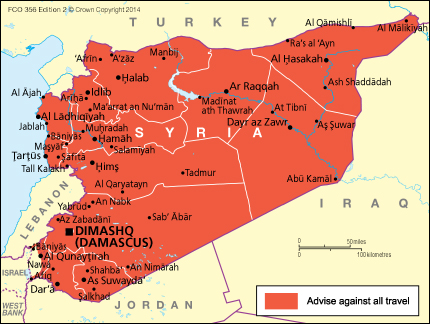
The Foreign and Commonwealth Office (FCO) advise against all travel to Syria. British nationals in Syria should leave now by any practical means. The FCO is not able to provide consular services, and won’t be able to help your evacuation from the country.
The situation remains extremely volatile and dangerous. There is widespread fighting throughout Syria, including in Damascus and its suburbs. Full scale military operations involving the use of small arms, tanks, artillery and aircraft are ongoing. The Syrian government no longer exercises control of large parts of Syria, notably the north, south and east of the country. Areas of eastern Syria are under the effective control of the Daesh (formerly referred to as ISIL), which is fiercely hostile to the United Kingdom. Beginning on 30 September, Russia has also embarked on a wave of air strikes in Syria backing an offensive launched by troops loyal to the Assad regime. From 3 December, UK has extended British military action against Daesh into Syria.
In Aleppo and elsewhere, the regime has been undertaking an indiscriminate campaign of aerial bombardment since mid-December 2013, using so called ‘barrel’ bombs – huge containers packed with explosives and shards of metal dropped by helicopter – against largely civilian targets. A number of chemical weapons attacks have taken place across Syria, most notably on 21 August 2013, where a major attack took place in the suburbs of Damascus. Latest estimates are of over 250,000 dead, including well over 10,000 children.
Fighting has caused the temporary suspension of commercial flights, closed roads, impeded access to land border crossing points and led to the closure of some border crossings.
There is a high threat from terrorism. There are continued attacks across Syria including in major cities, leaving large numbers of people dead or injured.
There is a very high threat of kidnapping throughout Syria. There have been a number of kidnappings, including of British nationals and other Westerners, including by Daesh (formerly referred to as ISIL).
If you choose to travel to Syria against FCO advice, you should make sure you and your family have valid exit stamps on your travel documents if you need one and take out comprehensive travel and medical insurance.
As a result of the ongoing political and security instability and the implementation of sanctions against some Syrian institutions, financial transactions have become significantly more difficult. See Money.

Safety and security

Civil Unrest/Political Tension

The situation remains extremely volatile and dangerous. There is widespread fighting throughout Syria, including in Damascus and its suburbs. Full scale military operations involving the use of small arms, tanks, artillery and aircraft are ongoing. The Syrian government no longer exercises control of large parts of Syria, notably in the north, south and east of the country. Areas of eastern Syria are under effective control of the Daesh (formerly referred to as ISIL), which is fiercely hostile to the United Kingdom. Russia has also embarked on a wave of air strikes in Syria backing an offensive launched by troops loyal to the Assad regime. From 3 December, UK has extended British military action against Daesh into Syria.
There is a reduced number commercial flights due to the implementation of sanctions, the security situation and the high level of violence. This severely limits options for air travel and seat availability. Fighting in the vicinity of airports has caused the temporary suspension of flights. Road networks have been blocked without warning. Several major highways including Tartous-Latakia, Tartous-Homs, Latakia-Aleppo, Homs-Hama, Homs-Damascus and Damascus-Jordan continue to be intermittently closed. There are security force checkpoints on major road routes.
Fighting and road closures have affected access to some land border crossing points. Some border crossings are in the hands of opposition groups, vulnerable to attack, and/or closed. You should check the status of all routes before travelling. Don’t attempt to enter Iraq via the Syrian border, which is subject to restrictions on both sides.
Be particularly vigilant in public places and keep a low profile. Don’t film or take photographs of public gatherings, military activity or any other sensitive matter.
All foreign journalists entering Syria need special permission from the Syrian authorities. Those journalists and other foreigners in opposition-held areas are vulnerable to mistreatment by the armed groups there. A number of foreign journalists have been killed. Others have been detained by the Syrian security forces or other armed groups during the crisis. The security forces have confiscated phones, cameras and video cameras.
There are severe restrictions on unlicensed political and religious activity in Syria. The Syrian authorities have detained and deported several British nationals for unauthorised activity. Activity in opposition-held areas will also attract attention. If you are deported by the local authorities, you will not be able to return to Syria.

Crime

The escalating conflict has led to a rise in crime in some areas, including violent robbery, carjacking and kidnapping.

Road travel

Road travel remains very dangerous in many parts of the country due to fighting. Driving standards and traffic systems are poor, and the accident rate is high. When there is a car accident with a pedestrian, the car driver is always legally responsible. You should avoid driving at night.

Humanitarian crisis

Humanitarian needs in Syria have increased significantly since the beginning of the crisis with over 13.5 million people in dire need of humanitarian aid and 4.9 million refugees in the region. The ongoing conflict has seriously affected public infrastructure and services. This widespread destruction has led to high unemployment, scarcity/prohibitive cost of food, lack of water, sanitation, health services and fuel.

Travel Summary

  • The World Health Organisation (WHO) Pandemic Threat Alert Phase remains at Level 6. The WHO website at http://www.who.int/csr/disease/swineflu/en/index.html has further details. Check Swine Flu for further information.
  • There is a general threat from terrorism. Attacks cannot be ruled out and could be indiscriminate, including in places frequented by expatriates and foreign travellers. On 27 September 2008 a car bomb exploded on a main road outside a military facility in Damascus. Seventeen people were killed and many injured.
  • Developments in the region may trigger public unrest. You should take care to avoid demonstrations, which can turn hostile, and be particularly vigilant in public places.
  • You should not attempt to enter Iraq via the Syrian border, which is subject to restrictions on both sides.
  • 28 British nationals required consular assistance in Syria in the period 01 April 2008 – 31 March 2009 for the following types of incident; hospitalisations (3 cases); and arrests, for a variety of offences (10 cases). During this period assistance was also requested with regard to lost or stolen passports (9 cases) and for child abduction cases.
  • The British Embassy in Damascus offers a full consular service, but by appointment only. See the General (Consular and Public Services) section of this advice, or the British Embassy website for more details.
  • We recommend that you obtain comprehensive travel and medical insurance before travelling to Syria. You should check any exclusions, and that your policy covers you for all the activities you want to undertake. See the General (Insurance) section of this advice and Travel Insurance for more details.

Safety and security

Terrorism
There is a general threat from terrorism. Attacks cannot be ruled out and could be indiscriminate, including in places frequented by expatriates and foreign travellers.

On 27 September a car bomb exploded outside a military facility at the intersection of the Airport Road and Damascus South Circular Road in Damascus. Seventeen people were killed and many injured.

On 12 February 2008 an explosion in a car in the Damascus neighbourhood of Kaffr Sousseh killed one person and injured several others. The target of the attack was Imad Mughniyeh, Head of Lebanese Hizballah's military wing.

You should be aware of the global risk of indiscriminate terrorist attacks, which could be against civilian targets including places frequented by foreigners.

For more general information see Terrorism Abroad.

Crime
Personal crime levels are low. But care should be taken in the choice of accommodation - reputable hotels are safer than guesthouses. - You should also take care downtown, where there have been cases of pickpocketing. There has been an increase in the number of passports being reported stolen within the Old City you are advised to leave your passport somewhere secure and carry a photocopy with you.
For more general information see Victims of Crime Abroad.

Political Situation

Syria Country Profile

Tensions between Israel, Lebanon and Syria, or between Israelis and Palestinians, or developments in Iraq, can have an effect on public opinion in the whole of the region, including Syria.

You should follow news reports and be alert to regional developments, which might trigger public disturbances.
You should take sensible precautions for your personal safety and avoid public political gatherings and demonstrations, which can turn hostile, and be particularly vigilant in public places.

You should be aware that there are restrictions on unlicensed political and religious activity in Syria. The Syrian authorities have recently detained and deported several British nationals for unauthorised activity. If you are deported by the local authorities, you will not be able to return to Syria.

Local Travel

The situation on the Syria/Iraq border is unclear. Traffic across is restricted to certain categories of individuals (businessmen amongst others, but not tourists). You should not attempt to enter Iraq via Syria.

Road Travel

Buses/coaches are available between the major cities and tourist sites, but you should check timetables on arrival. Taxis are cheap and widely used.
Driving standards and traffic systems are poor and the accident rate is high. Self-drive hire is best left to the experienced. Driving at night outside main cities is unsafe and should be avoided when possible.
For more general information see Driving Abroad.

Local laws and customs

You should respect local traditions, customs, laws and religions at all times and be aware of your actions to ensure that they do not offend other cultures or religious beliefs, especially during the holy month of Ramadan or if you intend to visit religious areas. For more general information see Travelling during Ramadan.
Syria is a multi-faith country with a long history of religious tolerance. Alongside the majority Sunni population, there are large practising Shia, Christian, Druze and Alawite communities, as well as other smaller sects and religions. However, you should be aware of restrictions on unlicensed political and religious activity, particularly political Islam. Please see the Political Situation section for more details.

You should exercise discretion in behaviour and dress, especially when visiting religious sites.
The punishment for possession of drugs is life imprisonment. For drug trafficking, the death penalty applies.
You are advised to carry a photocopy of the information page and the page displaying your visa and entry stamp of your passport, as proof of identity at all times.
Homosexuality is illegal.
Photography near military and many other government installations is prohibited. These zones are not always marked; you should exercise common sense and limit photography to traditional tourist sites.
For more general information for different types of travellers see Your Trip.

Entry requirements

Visas

You require a visa for Syria. Whether or not you have a visa you should be aware that if your passport contains an Israeli stamp or stamps from other countries’ border crossing points with Israel, you will be refused entry to Syria.
If you are planning to add in side-trips to Lebanon or Jordan, you should apply for a double or multiple entry visa for Syria, as these are otherwise difficult to obtain after arrival.
If you intend staying for more than fifteen days you will need to have your visa extended at the immigration office, otherwise you may face difficulties when trying to leave the country. For further information contact the Syrian Embassy in London.
Passport validity
Passports should have a minimum of six months remaining validity on entry.
Travelling with children
Single parents or other adults travelling alone with children should be aware that Syria requires documentary evidence of parental responsibility before allowing lone parents to enter the country or, in some cases, before permitting the children to leave the country.

Health

Medical treatment is inexpensive but standards vary from one hospital to another, although most are well equipped. Doctors are generally well qualified though nursing standards vary. Many medical staff speak French or English.

You should exercise normal precautions to avoid exposure to HIV/AIDS. For more general information on how to do this see HIV and AIDS.
You should seek medical advice before travelling to Syria and ensure that all appropriate vaccinations are up-to-date. For further information on vaccination requirements, health outbreaks and general disease protection and prevention you should visit the websites of NaTHNaC and NHS Scotland's Fit For Travel or call NHS Direct on 0845 46 47.
For more general health information see Travel Health.

General

Insurance
We recommend that you obtain comprehensive travel and medical insurance before travelling. You should check any exclusions, and that your policy covers you for all the activities you want to undertake. For more general information see Travel Insurance.
If things do go wrong when you are overseas then this is How We Can Help.
Consular registration
Register with our LOCATE service to tell us when and where you are travelling abroad or where you live abroad so our consular and crisis staff can provide better assistance to you in an emergency. More information about registering with LOCATE can be found here.
Consular services

The British Embassy in Damascus operates a full consular service, but by appointment only. The Public Consular Office is only open one day a week. This is due to security constraints at our current location. A new secure Embassy building is currently under construction. We apologise for any inconvenience that this may cause.
The Consular Section is open for telephone and written enquiries 0800-1530 (Sunday-Wednesday) and 0800-1400 (Thursday); we are closed on Fridays and Saturdays. You can contact us directly on +963 (0) 11 339 1541 or +963 (0) 933 315 948 or write to us by post at British Embassy Consular Section, Kotob Building, 11 Mohd Kurd Ali Street, Malki, PO Box 37, Damascus.

Consular appointments

Customers requiring passport or notarial services need to book an appointment before coming to the Embassy; for other services, please speak to the Consular Section. The current waiting time for an appointment is 1-2 weeks. You can either book an appointment through the British Embassy website – http://ukinsyria.fco.gov.uk – or contact the Consular Section directly on +963 (0) 11 339 1541 or +963 (0) 933 315 948.

Consular emergencies

In case of genuine emergency outside of normal working hours, for example the death or detention of a British national, you can contact the Embassy Duty Officer on +963 (0) 933 214 342.
See the British Embassy website for more details.
Money
Cash can be obtained from cash points (ATMs) in Damascus and Aleppo, but not easily elsewhere in Syria Most shops and restaurants do not take any bank cards. Even those that do may not recognise cards issued outside Syria. Travellers’ cheques are not accepted at most banks in Syria. In the rare cases where they are accepted, the handling process is complicated and time-consuming.
It is illegal to change money on the street. You should only change money in recognised exchange shops, banks and hotels.