Tuesday, February 16, 2010

Ghana travel advice

This advice has been reviewed and reissued with amendments to the Crime section (Increase in financial and internet scams against British nationals). The overall level of the advice has not changed.

Travel Summary

  • There are confirmed human cases of the A (H1N1) virus (Swine Flu) in Ghana (source: Ghana Ministry of Health). The Ghana Ministry of Health have informed us that all regional hospitals can take samples for Swine Flu testing, which is done at a laboratory in Accra. Tamiflu is available through regional hospitals or at various pharmacies throughout the country. The World Health Organisation (WHO) Pandemic Threat Alert Phase has been raised to Level 6. The WHO website has further details. Check our Swine Flu page for further information. Guidance on Pandemic Flu is available on the UK Department of Health website.

  • The parliamentary and presidential elections held in December 2008 passed generally peacefully throughout Ghana. Political rallies and demonstrations in this post election period may still occur. You should avoid any large public gatherings (including political rallies and demonstrations) which although mainly peaceful have the potential to turn violent. You should monitor daily developments through the local media.

  • While most visits to Ghana are trouble-free, violent crime can occur at any time. You are advised to exercise a high level of vigilance in public areas, and when travelling by road. See the Crime section of this advice for more details.

  • Localised outbreaks of civil unrest can occur at short notice due to ongoing local Chieftancy and land disputes particularly in the north of Ghana. See the Local Travel section of this advice for more details.

  • Around 70,000 tourists from the UK visit Ghana every year (Source: Ghana tourist board). 52 British nationals required consular assistance in Ghana in the period 01 April 2008 – 31 March 2009 for the following types of incident; deaths (19 cases); hospitalisations (9 cases); and arrests, for a variety of offences (4 cases). During this period assistance was also requested with regard to lost or stolen passports (93 cases).

  • There is a low threat from terrorism. But you should be aware of the global risk of indiscriminate terrorist attacks which could be in public areas, including those frequented by expatriates and foreign travellers.

  • You need to obtain a visa before travelling to Ghana. Overstaying on your visa without proper authority is a serious matter and can lead to detention or you being refused permission to leave the country until a fine is paid. See the Entry Requirements section of this advice for more details.

  • We recommend that you obtain comprehensive travel and medical insurance before travelling. You should check any exclusions, and that your policy covers you for all the activities you want to undertake. See the General (Insurance) section of this advice and our Travel insurance page for more details.

Safety and security

Terrorism


There is a low threat from terrorism. But you should be aware of the global risk of indiscriminate terrorist attacks which could be in public areas, including those frequented by expatriates and foreign travellers.
For more general information see our Terrorism abroad page.

Crime


Most visits to Ghana are trouble-free, provided sensible precautions are taken. However, there are incidents of crime (and violent crime - see below), particularly in and around Accra and the other main urban areas. You should avoid carrying large sums of money or valuables and be very wary when drawing cash from any of the ATM's in central Accra. Incidents of fraud involving the misuse of credit cards have been reported (credit card use is relatively rare outside the international hotels). You should exercise vigilance, particularly after dark. If possible, you should avoid travelling alone in taxis after dark because of attempted robberies.

Armed robbery does occur in Ghana, and in the last few months has seen an increase in most of the major cities and towns. Foreign nationals have been held at gun-point in their homes or when driving in Accra, usually at night. Some of these incidents are opportunistic crimes targeted at foreigners, but in other cases the perpetrators were acting on information about the potential availability of money or goods. One European national was recently murdered in the course of an armed robbery in Tema (city east of Accra). We have also received reports of foreigners (including British nationals) being targeted by armed robbers following their arrival at Kotoka airport. An increasingly used tactic is to deliberately cause a minor road traffic accident to make a car stop, and to then rob the occupants. If your car is clipped or hit by other car it is best to drive to the nearest police station to sort out the incident. Otherwise, all drivers, particularly at night, should remain vigilant, and drive with doors locked.

All visitors should be discreet when carrying sums of money or items of potential value, and not draw attention to themselves.

Care should also be taken at public beaches around Ghana. Theft is the main problem, but there have been isolated incidents of foreign women receiving unwanted attention and sexual assaults. For further information see Rape and sexual assault abroad. If you plan to visit a public beach avoid taking any valuables with you and travel in the company of a group of friends or family.

Thefts of both luggage and travel documents occur at Kotoka International Airport, Accra and in the hotels across Ghana. You should ensure your documents are kept secure at all times (including when leaving the airport) and that your baggage is never left unattended.

You should also be wary of all offers of unsolicited assistance at the airport unless from uniformed porters or officials. All permanent staff at the airport wear a current ID card bearing their name and photograph. ID cards without a photograph are not valid. If you are being collected at the airport you should confirm the identity of your driver, either by requesting ID or being satisfied that the driver is an official from the organisation or hotel looking after you. There has been a growing incidence of impostors approaching British visitors before the main arrivals area, pretending to be their driver. They will have seen the name on a board displayed by the official driver in the arrivals area outside the airport. We have reported incidents of the impostors threatening their victims for money when they have managed to get them into their car.

British nationals resident in the UK and European nationals are increasingly becoming targets by scam artists operating in West Africa. The scams come in many forms: romance and friendship (see paragraph below on internet dating scams), business ventures, work and employment opportunities, the facilitation of money and can pose great financial risk to victims. Relatives or friends in the UK should first check with the person who has travelled to West Africa before becoming involved in the transfer of money. If you are concerned about a British national who has travelled to Ghana you should contact the Consular Section of the British High Commission, Accra (E-mail: high.commission.accra@fco.gov.uk). Schemes in operation by West African criminal networks are designed to facilitate victims parting with money.

There is an increase in British nationals being targeted by West African scam artists through internet based dating/relationship sites. The scam artists assume the false identity of a foreign national (sometimes British) working and living in Ghana or use a false Ghanaian identity. In some instances the impostor has informed their foreign friend that they have been hospitalised or arrested and need money quickly. In other cases British nationals have come to Ghana to meet the person with whom they have been in contact only to be kidnapped and become the victim of financial extortion.Homosexual relationships are also exploited by these scam artists - we are aware of two cases where gay British men have been lured to Ghana to meet someone they have been in contact with over the internet, only to be abducted and be subjected to extortion.

The Ghanaian Police have limited resources to deal with these scam crimes. There is no official channel for the transfer of funds, and the police cannot easily investigate these crimes and help retrieve any money that has already been sent. If you have sent money to someone you believe has scammed you and are contacted by a police officer for more money to help get your money back, then this is possibly another part of the scam.

You will wish to treat with considerable caution any requests for funds, a job offer, a business venture or a face to face meeting from someone you have been in correspondence with over the internet who lives in West Africa. For further information on advance fee fraud please see: http://www.met.police.uk/fraudalert.

Scam artists have also been known to use the identity of officials at the British High Commission in Accra in their attempts to make certain types of scams (business ventures, facilitation of money offers) look credible. They use an email address similar to the email addresses of officials at the British High Commission. If you receive an email from someone claiming to be an official at the British High Commission, which you suspect may be a scam, please contact the officer using the phone numbers or contact details for the British High Commission at the top of this webpage. The email format for a BHC official is usually firstname.surname@fco.gov.uk.
For more general information see our Victims of crime abroad page.
Political Situation

The parliamentary and presidential elections held in December 2008 passed generally peacefully throughout Ghana. Political rallies and demonstrations in this post election period may still occur. You should avoid any large public gatherings (including political rallies and demonstrations) which although mainly peaceful have the potential to turn violent. You should monitor daily developments through the local media.

Local Travel

As a result of ongoing local Chieftancy and land disputes isolated inter-ethnic violence and civil unrest can occur at any time, including in the Northern, Upper East and Volta Regions. Bawku and Gushegu are subject to a curfew from 2200 to 0400 for an indefinite period to reduce the risk of election-related violence. In addition, the situation in the Tamale municipality and Yendi District of the Northern Region of Ghana remains volatile. The burial of the late king (Ya Naa) took place on 10 April 2006, some four years after his murder, and the installation of a Regent took place on 21 April 2006. There have been isolated instances of inter-ethnic violence since the burial.

If you are considering travelling to the Northern Region, you should remain alert to the potential for new outbreaks of fighting. We recommend you keep in touch with daily developments through the local media including for information on other potential flash points.

Floods


On 22 August 2008, 4 deaths were reported in the Upper East region (West Mamprusi and Builsa districts) due to flooding. You should follow local advice if you intend to travel to the Northern, Upper East and Upper West Regions and be alert to the possibility of future flooding.

On 12 September 2007 the Government of Republic of Ghana declared a state of emergency in the Upper West, Upper East, Northern Regions due to severe flooding. Roads and bridges were washed away; 18 fatalities were reported; and some 225,000 people displaced.

Road Travel


A UK driving licence is not valid in Ghana. However, an International Driver’s permit, issued in the UK, is valid. If driving, you should carry your driving licence at all times.

Roads are mainly in a poor condition, particularly in rural areas. Road travel can be extremely hazardous due to poor or non-existent street lighting. We recommend you avoid travelling by road outside the main towns after dark, when the risk of accidents and robbery is greater.

Safety standards on small private buses, known as Tro-Tros, and taxis are often low and do not meet UK standards.

We advise against the use of Tro-Tros outside of the major towns and cities.

Drivers should be aware that grass or leaves strewn in the carriageway often means an accident or other hazard ahead.

For more general information see our Driving abroad page.

Air Travel


The EU has published a list of air carriers that are subject to an operating ban or restrictions within the community. You should check the following link to see whether this will affect your travel - European Commission Transport - Air.

Charter flight services continue to operate from the UK to Ghana. When making travel plans you should ensure that the travel company and airline are able to provide the services booked, or offer appropriate alternative arrangements in case of problems.

The service provided by some regional air carriers is reported to be unreliable. Flights can be overbooked. Airlines have altered scheduled stops and cancelled or postponed flights at short notice. You may experience unexpected delays even after checking in. We recommend that you reconfirm your seats according to your airline’s instructions and have the seat reconfirmation stamped on your ticket. You should arrive at the airport at least two hours before the scheduled departure times.

It is wise to reconfirm your flights even if you have been told by your Travel Agent/Airline that this is not necessary.

For more general information see our Airline security page.

Sea Travel


There have been attacks against ships in and around Accra's waters. Mariners are advised to be vigilant and take appropriate precautions.

For more general information see our River and sea safety page.

Swimming


If visiting any of the beaches along the southern coast of Ghana, you should be aware that swimming is dangerous due to rip tides and undertows.

Local laws and customs

Ghana is a conservative and deeply religious country. Although modern and progressive attitudes also prevail, respect must be shown for traditional values and morals. Beachwear should be confined to the beach, and wearing immodest clothing in public is likely to cause offence or attract unwanted attention. The wearing of military apparel such as camouflage clothing by civilians is prohibited.

The Ghanaian Legal system is very much based on the British system. You must respect the laws of the land; otherwise you can expect to be dealt with in the same way as a Ghanaian citizen would.

Never become involved with drugs of any kind in Ghana. Drugs are a growing problem in Ghana and the authorities are determined to tackle and control the problem. Penalties for drugs related offences (including class C drugs) are severe including a "no bail" restriction on anyone implicated in any drug related offences. Even possession of small amounts of marijuana can lead to a prison sentence in excess of 5 years, usually after a lengthy and expensive legal process. Class A drugs such as cocaine are likely to be laced with other substances - we have had reports of foreign visitors, including British nationals, dying after taking these drugs.
On arrival in Ghana, you should carry a photocopy of your passport with you at all times, and put the original document in safe-keeping.

Homosexuality in Ghana is illegal. Although there is a small gay community, there is no "scene" and a large portion of Ghanaian society does not accept that such activity exists.

Photography near sensitive sites such as military installations or the airport is strictly prohibited. Such sites may not be clearly marked and the application of restrictions is open to interpretation. Photographers should ask permission if they want to take a photograph of a building where there are guards on duty outside. Where there are not, unless there are notices forbidding photography, there should not be a problem, but caution should be exercised. Permission should also be sought from people if you wish to take their photograph (a small tip or "dash" may be required). But beware of self-appointed officials trying to charge fees for tourists to take pictures of well-known sites of interest.

Ghanaian family law is very different from UK law and particular caution is needed when, for example, child custody becomes an issue.
For more general information for different types of travellers see our Your trip page.

Entry requirements

Visa

British passport holders require a visa to enter Ghana. Overstaying without the proper authority is a serious matter and can lead to detention or refused permission to leave the country until a fine is paid. For further information contact the Ghanaian High Commission in London.

Passport validity


Passports should be valid for at least six months when submitted to the Ghanaian authorities for a visa.

Yellow Fever vaccination certificate

You may be asked to produce a yellow fever vaccination certificate on arrival in the country.

Travelling with children


Single parents or other adults travelling alone with children should be aware that some countries require documentary evidence of parental responsibility before allowing lone parents to enter the country or, in some cases, before permitting the children to leave the country. For further information on exactly what will be required at immigration please contact the Ghanaian High Commission in London.

Health

Medical facilities are poor outside urban areas in Ghana. Emergency facilities are extremely limited. For serious medical treatment, medical evacuation would be necessary.

There are confirmed human cases of the A (H1N1) virus (Swine Flu) in Ghana (source: Ghana Ministry of Health). The Ghana Ministry of Health have informed us that all regional hospitals can take samples for Swine Flu testing, which is done at a laboratory in Accra. Tamiflu is available through regional hospitals or at various pharmacies throughout the country. The World Health Organisation (WHO) Pandemic Threat Alert Phase has been raised to Level 6. The WHO website has further details. There is a dedicated Swine Flu page on the FCO website. Guidance on Pandemic Flu is available on the UK Department of Health website.

Malaria and some water-borne diseases are common in Ghana.
The risk of cholera and other water-borne disease outbreaks are high both during the seasonal floods (April-August) in the Northern, Upper East and Upper West regions, and across Ghana (including in major urban areas) during the dry season (December-March). You should drink or use only boiled or bottled water and avoid ice in drinks. Food purchased from local street vendors may not meet adequate hygiene standards. If you suffer from diarrhoea during a visit to Ghana you should seek immediate medical attention.
In the 2008 Report on the Global AIDS Epidemic the UNAIDS/WHO Working Group estimated that around 250,000 adults aged 15 or over in Ghana were living with HIV; the prevalence rate was estimated at around 1.9% of the adult population. This compares to the prevalence rate in adults in the UK of around 0.2%. You should exercise normal precautions to avoid exposure to HIV/AIDS. For more general information on how to do this see our HIV and AIDS page.

The latter part of 2008 also saw isolated cases of polio.

You should seek medical advice before travelling to Ghana and ensure that all appropriate vaccinations are up-to-date.
For further information on vaccination requirements, health outbreaks and general disease protection and prevention you should visit the websites of NaTHNaC and NHS Scotland's Fit For Travel or call NHS Direct on 0845 46 47.
For more general health information see our Travel health page.

Avian Influenza (Bird Flu)

The World Animal Health Organisation (OIE) has confirmed that there have been five cases of Avian Influenza (Bird Flu) in different parts of the country. The last case reported was in June 2007 in the Volta Region. No human infections or deaths have been reported.
The risk to humans from Avian Influenza is believed to be very low. As a precaution, you should avoid visiting live animal markets, poultry farms and other places where you may come into close contact with domestic, caged or wild birds; and ensure poultry and egg dishes are thoroughly cooked.

You should read this advice in conjunction with our Avian and Pandemic Influenza page, which gives more detailed advice and information.

General

Insurance

We recommend that you obtain comprehensive travel and medical insurance before travelling. You should check any exclusions, and that your policy covers you for the activities you want to undertake. See our Travel insurance page for more details.

If things do go wrong when you are overseas see our how we can help page.

Volunteer programme work


If you are coming to Ghana to work in a volunteer programme or for work experience you must be fully aware of the terms and conditions of stay and be sure that you will be working for a reputable organisation before you commit yourself to travel.

On the whole Ghanaians are very welcoming and friendly toward foreign visitors. You may be besieged with insistent offers of help, friendship guidance etc. or may be left alone to do your own thing. It is wise to be aware of, and cope with both scenarios. Be friendly but firm if you are not happy with arrangements or any situation you find yourself in.

Registering with the British High Commission


Register with our LOCATE service to tell us when and where you are travelling abroad or where you live abroad so our consular and crisis staff can provide better assistance to you in an emergency. More information about registering with LOCATE

Dual nationality


Ghana recognises dual nationality. In order for Ghanaian/British Nationals to avoid visas fees, they should register with the Interior Ministry in Ghana and be issued with a Dual Nationality card. Production of this card at point of entry into Ghana will indicate that a visa and the corresponding fee are not required. There are strict limitations on UK consular assistance available to dual nationals.

Replacing your passport


Accra is a passport issuing post. Full and emergency passport issuing facilities are available. It should be noted that passports cost more overseas than they do in the UK.

Money

In large urban areas such as Accra and Kumasi, ATMs are commonplace and will accept most UK cash cards – but not Switch. Credit cards are accepted at many hotels, guesthouses and some shops, but credit card fraud is commonplace and you should exercise caution when using them. You should contact your bank if you intend to use you credit cards in Ghana as many banks do not honour any transactions attempted here either in hotels or at ATMs due to the possibility of fraud. MasterCard is not widely accepted for use in Ghana particularly at ATMs. Travellers' Cheques can be exchanged in large hotels, banks and Forex bureaux. However, Travellers Cheques from some UK banks are not accepted: check with your bank prior to travel.
The Government of Ghana has introduced new banknotes (Ghana cedi) and coins (Ghana pesewa). 10,000 cedis = 1 Ghana cedi = 100 Ghana pesewas. The old currency is no longer legal tender as of 31 December 2007. The Government of Ghana has established a website to inform the public about the currency redenomination at: http://www.ghanacedi.gov.gh/.

Monday, February 15, 2010

Gambia travel advice

This advice has been reviewed and reissued with amendments to the Summary (removal of Swine Flu information). The overall level of the advice has not changed; there are no travel restrictions in place in The Gambia.

Travel Summary

  • You should not travel by road from The Gambia to the Casamance region in southern Senegal. It remains affected by incidents involving presumed separatist groups and by incidents of banditry. See the Local Travel section of this advice and the Travel Advice for Senegal for more details.

  • Most visits to The Gambia are trouble-free. 31 British nationals required consular assistance in The Gambia in the period 01 April 2008 – 31 March 2009 for the following types of incident; deaths (9 cases); hospitalisations (2 cases); and arrests, for a variety of offences (7 cases). During this period assistance was also requested with regard to lost or stolen passports (18 cases).

  • Care should be taken when driving or walking on roads, particularly at night, due to unpredictable driving standards and lack of street lighting.

  • Malaria is common in The Gambia. See the Health section of this Travel Advice for more details.

  • There is an underlying threat from terrorism. Attacks, although unlikely, could be indiscriminate, including in places frequented by expatriates and foreign travellers.

  • We recommend that you obtain comprehensive medical and travel insurance before travelling. See the General (Insurance) section of this Travel Advice.

Safety and security

Terrorism

There is an underlying threat from terrorism. Attacks, although unlikely, could be indiscriminate, including in places frequented by expatriates and foreign travellers.

For further information and advice see Terrorism abroad.

Crime

Attacks on tourists are increasing. You should not take valuables or large sums of money to the beach or display them in public. The more popular beaches are usually manned by tourist police or hotel security. Visiting isolated beaches is riskier and you should take particular care in those instances.

Visitors, both male and female, should be particularly cautious of young men locally known as “bumsters” who approach tourists, particularly on beaches, offering unsolicited help. Bumsters often use romance in the hope of gaining money or other assistance. We advise you be polite but firm in declining unwanted help or attempts at conversation.

Theft from vehicles is also increasing. Valuables should not be left in unattended vehicles. You should take precautions in unlit areas or in places away from the Tourist Development Area. For more general information see Victims of crime abroad.

Political Situation


The Gambia Country Profile You are advised to avoid political gatherings and demonstrations. Local Travel You should not travel by road from the Gambia to the Casamance in southern Senegal. The Casamance region of south western Senegal (the area of Senegal due south of The Gambia) remains affected by incidents involving presumed separatist groups and by incidents of banditry. You should note that we advise against all road travel in the Casamance region to the west of Kolda, other than on the N4 national highway, for which we advise against all but essential road travel, and on the main road from Ziguinchor to Cap Skiring which is often used by groups of tourists during the daylight hours. See the Travel Advice for Senegal for more details. Travel to other areas in The Gambia is reasonably safe as long as precautions are taken to safeguard your baggage and personal possessions.

Road Travel

You can drive on a UK driving licence for up to three months. Driving standards are unpredictable and some local taxis are not roadworthy. Driving after dark carries added hazards because of poor road and vehicle lighting. For this reason, you should exercise particular caution when walking along roads at night. In the event of an accident, emergency medical facilities are very limited. During the rainy season (June to October) potholes on roads are common and you should take care when driving. Poor roads up-country make travel outside of the Greater Banjul area difficult year round. Security checkpoints are common on all major routes in The Gambia. They are not always well sign-posted and care should be taken when approaching them, especially at night. For more general information see Driving abroad.

Air Travel


The EU has published a list of air carriers that are subject to an operating ban or restrictions within the community. You should check the following link to see whether this will affect your travel - European Commission Transport - Air.

For more general information see Airline security.

Local laws and customs

Local laws reflect the fact that The Gambia is an Islamic country. You should respect local traditions, customs, laws and religions at all times and be aware of your actions to ensure that they do not offend other cultures or religious beliefs, especially during the holy month of Ramadan or if you intend to visit religious areas. During Ramadan, eating, drinking and smoking between sunrise and sunset is forbidden for Muslims (though children under the age of puberty are not required to fast). For more general information see Travelling during Ramadan.

The Gambian authorities will take strong action against anyone importing, exporting or found in possession of drugs or contraband. You should not accept packages on behalf of anyone without knowing the contents. New laws were introduced in 2003 to tackle the problems associated with travelling child sex offenders. In particular, there are heavy penalties for any form of sexual offence against a child. Foreign visitors to the Gambia need to carry an ID with them at all times. Although there are no laws specifically covering homosexuality in the Gambia, the Gambian Criminal Code states that any person who has, or attempts to have, "carnal knowledge" of any person "against the order of nature" is guilty of a felony and could face imprisonment. The Gambian courts may interpret homosexual acts as falling under this part of the Code. The Code also states that gross indecency between men, whether in public or private, is a felony and anyone committing this felony could face imprisonment. Any private citizen has the power of arrest for these offences. We have received reports that the police are actively enforcing this Code. There are no current reports of any attacks on homosexuals. There are no gay clubs in the Gambia.

Photography of military and official installations is prohibited. For more general information see Your trip.

Entry requirements

Visas

There are no entry requirements for British citizens visiting for up to 28 days. For visits in excess of 28 days, permission has to be obtained from the Gambian Immigration Department at their offices in Banjul. Extensions cost D250 for each additional month.

Passport Validity

Gambian authorities require that passports have a minimum of three months' validity. Travelling with children Single parents or other adults travelling alone with children should be aware that some countries require documentary evidence of parental responsibility before allowing lone parents to enter the country. For further information on exactly what will be required at immigration, please contact the Gambian High Commission.

Yellow Fever Certificate

A yellow fever vaccination certificate is required from travellers coming from areas with risk of yellow fever transmission. This is particularly relevant for those travelling to the Gambia from neighbouring African countries.

Health

Medical facilities in The Gambia are very limited and the cost of medical evacuation can be very high. Private clinics will only treat fee-paying patients. If you intend to bring prescription medication you should also bring a copy of your prescription and keep items in the original packaging. Water borne diseases and malaria are common in the Gambia throughout the year. The risk of malaria is greater during the months of June to November. In November 2005, two British nationals died from malaria after travelling to The Gambia. In the 2008 Report on the Global AIDS Epidemic the UNAIDS/WHO Working Group estimated that around 7,500 adults aged 15 or over in The Gambia were living with HIV; the prevalence rate was estimated at around 0.9% of the adult population. This compares to the prevalence rate in adults in the UK of around 0.2%. You should exercise normal precautions to avoid exposure to HIV/AIDS. For more general information on how to do this see HIV and AIDS. You should seek medical advice before travelling to the Gambia and ensure that all appropriate vaccinations are up to date. For further information on endemic diseases, like malaria, health outbreaks and vaccination requirements for The Gambia you should check the websites of the National Travel Health Network and Centre NaTHNaC and NHS Scotland's Fit For Travel or call NHS Direct on 0845 46 47. For more general information see Travel health.

Natural disasters


Floods are common during the rainy season (June‑October), but do not normally impact on tourists.

General

Insurance

We recommend that you take out comprehensive medical and travel insurance before travelling. This should include cover for medical treatment and evacuation, accidents, cancelled flights and stolen cash, credit cards, passport and luggage. You should check any exclusions, and that your policy covers you for all the activities you want to undertake. See Travel insurance. If things do go wrong when you are overseas see When Things Go Wrong.

Registration

Register with our LOCATE service to tell us when and where you are travelling abroad or where you live abroad so our consular and crisis staff can provide better assistance to you in an emergency. More information on LOCATE If you are a long-stay visitor you should register at the British High Commission in Banjul.

Money


You are advised to bring travellers' cheques or cash to The Gambia because only a few places accept credit cards. Bureaux de Change and local banks do not. There is an ATM in the tourist area of Senegambia and several other locations which accept VISA but not MASTERCARD.

Sunday, February 14, 2010

Gabon travel advice

This advice has been reviewed and reissued with amendments to the Summary and the Political Situation section. The overall level of the advice has changed. The overall level of the advice has not changed; there are currently no travel restrictions in place in Gabon.

Travel Summary

  • There is no British Embassy in Gabon. In an emergency, you can obtain consular assistance from the British Honorary Consul in Libreville. Otherwise, all enquiries should be made to the British High Commission in Yaoundé, Cameroon. See the General section of this travel advice for more details.

  • Ali Bongo, the son of Gabon's long serving President Omar Bongo, was inaugurated as the new President of Gabon on 16 October 2009. There was some unrest following the results of the elections on 3 September 2009. The situation across the country has now stabilised. There are currently no travel restrictions for Gabon. See the Political section of this travel advice for more details.

  • There has been a confirmed human case of the A (H1N1) virus (Swine Flu) in Gabon (source: World Health Organisation). The World Health Organisation (WHO) has raised its Pandemic Threat Alert Phase to Level 6. The WHO website has further details. Check Swine Flu for further information.

  • There is a low threat from terrorism. But you should be aware of the global risk of indiscriminate terrorist attacks which could be in public areas, including those frequented by expatriates and foreign travellers.

  • No British nationals required consular assistance in Gabon in 2007 or 2008. However, you should be aware that crime is increasing, particularly in Libreville and Port-Gentil. See the Crime section of this travel advice for more details.

  • We recommend that you obtain comprehensive travel and medical insurance before travelling. You should check any exclusions, and that your policy covers you for all the activities you want to undertake. See the General (Insurance) section of this advice and Travel insurance for more details.

Safety and security

Terrorism


There is a low threat from terrorism. But you should be aware of the global risk of indiscriminate terrorist attacks which could be in public areas, including those frequented by expatriates and foreign travellers. For more general information see Terrorism abroad.

Crime


Crime is increasing, particularly in Libreville and Port-Gentil, including incidents of robbery and armed attacks. You should take sensible personal security precautions and maintain a high level of vigilance in public places. We recommend that you avoid carrying valuables or wearing jewellery in public. You should avoid isolated or poorer areas of towns and walking alone at night. We advise you to be cautious on quiet or isolated beaches in and around Libreville, and to avoid them altogether at night.

Following a number of car-jackings within Libreville we recommend that you keep your car windows closed and car doors locked if you are travelling at night. Do not stop to pick up strangers. To avoid the risk of serious injury do not resist car-jackers. You may find that an immobiliser that operates after the vehicle has been driven a short distance or a tracking device can help with the recovery of your vehicle. For more general information see Victims of crime abroad.

Political Situation

Gabon Country Profile

Omar Bongo, Gabon’s President since 1967, died on 8 June 2009.

Omar Bongo’s son, Ali Bongo, was inaugurated as the new President of Gabon on 16 October 2009. There was unrest in some areas following the announcement of the election results on 3 September. The economic capital of Port-Gentil was worst affected by the disturbances, having been subject to rioting and looting for a period of three days following the elections. A curfew was put in place for Port Gentil, but was officially lifted on 14 January 2010. The situation has stabilised across the country. Transport and other infrastructure is functioning normally.


You should nevertheless avoid demonstrations, rallies and large public gatherings; even peaceful demonstrations have the potential to escalate. We advise UK citizens in Gabon to monitor this travel advice regularly.

Local Travel


Road conditions are poor in most local areas and driving can be hazardous. During the rainy season from October to mid-December and mid-February to May many roads are passable only with a four-wheel drive vehicle. You should avoid travelling by road at night. Police checkpoints are common, where you may be asked to show your passport, driving licence or vehicle registration documents.

Air Travel


The EU has published a list of air carriers that are subject to an operating ban or restrictions within the community. You should check the following link to see whether this will affect your travel - European Commission Transport - Air. British Government employees do not use domestic flights run by Gabonese airline companies unless this is unavoidable. You should bear this in mind when making your travel plans.

For more general information see Airline security.

Local laws and customs

Penalties for the use and possession of drugs are severe and usually include a prison sentence. Homosexuality is not widely accepted in central African society and some sexual acts between members of the same sex are illegal. Taking photographs of military sites and government buildings is forbidden. For more general information for different types of travellers see Your trip.

Entry requirements

Visas

British nationals require a visa to visit Gabon. To apply for a visa and to obtain further information on entry requirements, please contact the Gabonese Embassy in London.

Yellow Fever Certificate


You will be asked to produce a yellow fever vaccination certificate on arrival in the country. Failure to do so may result in a further vaccination being administered, for which a charge is made.

Travelling with children


Single parents or other adults travelling alone with children should be aware that some countries require documentary evidence of parental responsibility before allowing lone parents to enter the country or, in some cases, before permitting the children to leave the country. For further information on exactly what will be required at immigration please contact the Gabonese Embassy in London.

Health

Medical facilities are limited, particularly in rural areas.

You should drink or use only boiled or bottled water and avoid ice in drinks. If you suffer from diarrhoea during a visit to Gabon you should seek immediate medical attention.

There has been a confirmed human case of the A (H1N1) virus (Swine Flu) in Gabon (source: World Health Organisation). The World Health Organisation (WHO) Pandemic Threat Alert Phase has been raised to Level 6. The WHO website has further details. Check the FCO Swine Flu page for further information.
In the 2008 Report on the Global AIDS Epidemic the UNAIDS/WHO Working Group estimated that around 46,000 adults aged 15 or over in Gabon were living with HIV; the prevalence rate was estimated at around 5.9% of the adult population. This compares to the prevalence rate in adults in the UK of around 0.2%. You should exercise normal precautions to avoid exposure to HIV/AIDS. For more general information on how to do this see HIV and AIDS. You should seek medical advice before travelling to Gabon and ensure that all appropriate vaccinations are up-to-date. For further information on vaccination requirements, health outbreaks and general disease protection and prevention you should visit the websites of NaTHNaC and NHS Scotland's Fit For Travel or call NHS Direct on 0845 46 47. For more general health information see Travel health.

General

Insurance

We recommend that you obtain comprehensive travel and medical insurance before travelling. You should check any exclusions, and that your policy covers you for all the activities you want to undertake. For more general information see Travel insurance.

If things do go wrong when you are overseas then this is How we can help.

British Representation

There is no British Embassy in Gabon. In an emergency, you can obtain consular assistance from the British Honorary Consul in Libreville (tel: + 241 769 899 during office hours; or + 241 0626 3994 at other times). The nearest British diplomatic mission is in Yaoundé, Cameroon (see contact details).

Consular registration


Register with our LOCATE service to tell us when and where you are travelling abroad or where you live abroad so our consular and crisis staff can provide better assistance to you in an emergency. More information about registering with LOCATE

Saturday, February 13, 2010

Ethiopia travel advice

Summary


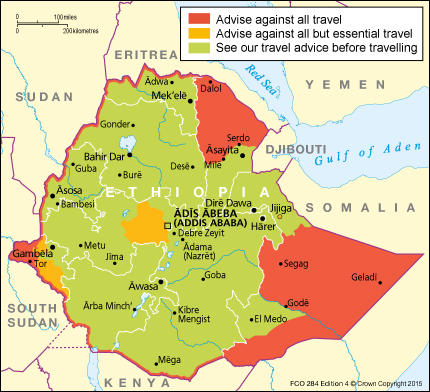
The Foreign and Commonwealth Office (FCO) advise against all travel to:
  • within 10 km of the border with Eritrea, with the exception of the main road through Axum and Adigrat, and tourist sites close to the road (e.g. Debre Damo and Yeha)
  • areas off the principal roads/towns within 10 km of the borders with Sudan and Kenya
  • within 10 km of the border with South Sudan
  • the Nogob (previously Fik), Jarar (previously Degehabur), Shabelle (previously Gode), Korahe and Dollo (previously Warder) zones of the Somali region.
  • within 100 km of the Ethiopian border with Somalia and Kenya in the Afder and Liben zones of Ethiopia’s Somali region
  • the Danakil desert area: north of the Mille-Djibouti and Mille-Chifra roads, and east of the towns of Bere-Ale, Shehet, Didigsala and Chifra
  • the four woredas (districts) (Akobo, Wantawo, Jikawo and Lare) of the Nuer zone and the Jore woreda of the Agnuak zone of the Gambella region
The FCO advise against all but essential travel to:
  • west and south-west Shewa zones in the Oromia region (this area includes the popular tourist destination of Wenchi Crater)
  • Jijiga town
  • Three woredas of the Agnuak zone of the Gambella region that border on South Sudan (Dima, Goge, and Etang) and the Gambella Wildlife Reserve (taking into account the advice against all travel to within 10km of the border with South Sudan)
Widespread protests have occurred across the Oromia region in recent weeks; some have turned violent resulting in casualties and others have caused disruption to road travel. There is a heightened risk of travel across the region. If you travel there, seek information about the situation before you leave and avoid large crowds and demonstrations.
There have been heavy clashes including gunfire between protesters and security forces on 17 December in Sululta, 20km north of Addis Ababa on the road to Bahir Dar. Localised clashes in the Galabat area resulted in the closure of the Metema-Galabat border post with Sudan on 15 and 16 December 2015 and further crossing point closures may occur.
There was an explosion at the Anwar Mosque in the Merkato area of central Addis Ababa on 11 December. You should remain vigilant.
There were reports of a shooting incident in the Mago Park in the Omo Valley in December 2014. No injuries were reported. Take extra care if you’re in this region.
There is a high threat from terrorism. There are credible reports that Al Shabaab plan, and have the capability, to attack targets in Ethiopia. In October 2014 the US Embassy in Addis Ababa issued a travel warning advising “those in Addis Ababa to avoid areas where both Ethiopians and westerners frequent”, and citing threat reports of Al Shabaab’s intent to target the Bole area of the city.
You should be vigilant at all times, especially in crowded areas and public places like transport hubs, hotels, restaurants, bars and places of worship and during major gatherings like religious or sporting events. There is a high threat of kidnapping in Ethiopia’s Somali region, particularly in the eastern areas to which the FCO advise against all travel. See Terrorism
Crime levels are low, but you should avoid large gatherings and public demonstrations and be alert to the risk of street crime. See Crime
The Ethiopia-Eritrea border remains closed. Several security incidents have taken place along the border. The risk of cross-border tensions remains. There is a threat of kidnapping along the border. See Local travel
Owning ivory is strictly prohibited in Ethiopia. Anyone caught in possession of ivory can expect to be detained by police. See Local laws and customs
Around 20,000 British nationals visit Ethiopia every year. Most visits are trouble free.
The Overseas Business Risk service offers information and advice for British companies operating overseas on how to manage political, economic, and business security-related risks.
Take out comprehensive travel and medical insurance before you travel.

Safety and security

Crime

Petty theft and mugging is common and on the rise. Take particular care when visiting crowded public places, especially at night. There have been incidents of assaults occurring around the Bole area at night. Keep valuables like cameras and passports out of sight. Be aware of the risk of pick-pocketing, and bag and jewellery snatching including from vehicles stopped at traffic lights in Addis Ababa. Incidents involving parked and unattended cars are on the increase. When parking in Addis Ababa, leave your car in a well lit and guarded area. Consider fitting anti-shatter film to all windows on your vehicle.
Large crowds are common on key national and religious dates. These include 7 January (Ethiopian Christmas); 19 January (Epiphany/’Timket’); 2 March (Victory of Adawa); 5 May (Ethiopian Patriots’ Victory Day); 28 May (Downfall of the Derg); 11/12 September (Ethiopian New Year); 27 September (The Finding of the True Cross/’Meskel’). Large crowds also gather on Ethiopian Easter; Eid (End of Ramadan); Eid Al Arafa and the Birthday of the Prophet Mohammed.
There have been a small number of cases of arbitrary detention of British nationals in Ethiopia in recent years. There is a risk that this could reoccur – particularly where tensions are heightened (for example around major events, or in locations that might be deemed sensitive for security reasons). You should carry copies of your passport and the contact details of the British Embassy, Addis Ababa at all times. This may help if you’re questioned or detained. However, you should be aware that the Ethiopian authorities have in many cases failed to meet their international obligations to notify Embassies when foreign nationals have been detained. Even if requested, adequate consular access is not always granted.

Local travel

When travelling outside Addis Ababa consider travelling in a party and leave details of your travel itinerary with a reliable person. Carry a comprehensive medical pack. Telephones, including the sole mobile network, are unreliable. Wherever possible do not leave vehicles unattended. The Entoto hills near Addis Ababa are a popular spot with tourists and expatriates but there has been a recent increase in break-ins on unattended vehicles. In January 2014 there was an attempted robbery against a lone female on the Entoto walking trail.
There have been widespread protests across the Oromia Region in recent weeks, some of which have reportedly turned violent and resulted in casualties, and others which have caused severe disruption to road travel.
Since September 2014, there have been reports of ethnic conflict between communities in the Gambella region. The clashes began in Mejenger Zone but recently have spread wider, including to Gambella town. Reports have stated that dozens of people may have died.
There is local instability, lawlessness, military activity and a general risk of banditry in the Somali region. Since the mid-1990s, insurgent groups, some affiliated with terrorist organisations, have clashed with government forces, particularly in the Ogaden. Foreigners have been caught up in the violence or targeted. There have been attacks on staff working for international NGOs. Avoid overnight stays unless you are in secure accommodation.
In December 2011, two Swedish journalists were found guilty of supporting terrorism having entered Ethiopia illegally from Somalia. Any journalist wishing to operate legitimately in Ethiopia should get the necessary accreditation.
The Ethiopian military attacked targets across the Eritrean border in March 2012. There is a risk of further violence close to the border between Ethiopia and Eritrea.
There are cross-border tensions in the Tigray and Afar regions and the security situation has deteriorated. Take great care if you travel on the road from Addis Ababa to Djibouti, including via Asaita, due the high number of road traffic accidents.
In January 2013, an Austrian tourist was shot and killed near Bahir Dar while camping near the Nile. This is an area popular with tourists.
In May 2012, a group of tourists were attacked while travelling in the Surma region near the Omo River between the towns of El Dima and Kibbish. This is an area popular with tourists visiting the Omo valley.
There is banditry in the areas bordering Sudan, South Sudan and Kenya. If you are crossing into Kenya or Sudan, keep to the main road and seek advice from local authorities about travelling in convoy.
There has been violence, inter-tribal clashes and armed attacks in the Gambella region. While foreigners have not been targeted, there is a risk of being caught up in the violence.
Health and Safety precautions like life jackets in boats or protective railings at historical sites are rarely in place in Ethiopia.
An attack on a passenger bus in the Benishangul-Gumaz Region on 15 April killed 9 people and wounded 6. There have also been reports of an inter-ethnic attack which left as many as 9 people dead on 18 May. Both events occurred in the Sherkole woreda (district).

Air travel

On 17 February, there were reports of a hijacking of an Ethiopian Airline flight leaving Addis Ababa for Rome. The flight later landed safely in Geneva.

Road travel

Drivers should also be aware that under Ethiopian laws, drivers involved in car accidents can face severe punishments, including custodial sentences and fines.
Visitors to Ethiopia should be aware that driving standards are poor, and traffic accidents are common and sadly often fatal. Visitors should be very careful when travelling by car.
You should avoid driving after dark in rural areas: vehicles often have no lights and livestock may be roaming the roads.
Traffic accidents are a regular occurrence in Ethiopia and Addis Ababa specifically. If you are involved in a traffic accident you should remain with your vehicle and call the local police. You should avoid confrontation and await the arrival of the police to resolve the matter.

Political situation

Protests and demonstrations sometimes take place in Addis Ababa and other cities. In the past, some of these have become violent. You should avoid any protests or demonstrations.

Travel Summary
The Ethiopia-Eritrea border remains closed. Several security incidents have taken place along the border, particularly in the Humera region. The risk of cross-border tensions increasing and the security situation deteriorating very rapidly continues. With the exception of the main road through Axum and Adigrat, we advise against all travel within 50 kms of the border areas with Eritrea because of the risk of landmines and banditry. See the Local Travel (North and East Ethiopia) section of this Travel Advice.
We also advise against all travel to areas off the principal roads/towns within 50 kms of the borders with Sudan and Kenya; to the Danakil desert area bounded by the Dessie-Adigrat road, the Dessie-Djibouti road and to the Gambella region outside of Gambella town itself. This is because armed groups hostile to the Government of Ethiopia operate in several of these border areas. See the Terrorism/Security and Local Travel sections of this Travel Advice.
We advise against crossing the Ethiopia/Somalia or Somaliland border by road. We also advise against travel to the Fik, Degehabur, Gode, Korahe and Warder zones of the Somali region where rebels groups are active and the situation remains volatile. This is because of ongoing military activity and lawlessness in the region. We also advise against all but essential travel to Jijiga town. See the Terrorism/Security section and the Local Travel (North & East Ethiopia) section of this Travel Advice.
There is a high threat from terrorism in Ethiopia; attacks could be indiscriminate including places frequented by expatriates and foreign travellers. As of the beginning of December 2008 the Ethiopian authorities remain on alert following their announcement in November 2008 that they had information about plans to carry out a terrorist attack in Ethiopia. As a result security has been increased around government buildings and major hotels in the capital Addis Ababa and Embassies, including the British Embassy. British nationals are advised to remain extremely vigilant at all times in public places checking this Travel Advice for updates at regular intervals.
There is a low level of crime but you should avoid any public demonstrations. We do not advise against travel to the main tourist destinations including Bahir Dar, Gonder, Lalibela, Axum and the rift valley lakes and the Omo Valley.
Around 16,000 people visit Ethiopia from Britain each year (source: Ethiopian Ministry of Culture and Tourism). 26 British nationals required consular assistance in Ethiopia in the period 01 April 2008 – 31 March 2009 for the following types of incident; deaths (13 cases); hospitalisations (2 cases); and arrests, for a variety of offences (4 cases). During this period assistance was also requested with regard to lost or stolen passports (25 cases). See the Crime section of this Travel Advice.
We recommend that you obtain comprehensive travel and medical insurance before travelling. You should check any exclusions, and that your policy covers you for all the activities you want to undertake. See the General (Insurance) section of this Travel Advice .
Safety and security
Terrorism/Security There is a high threat from terrorism in Ethiopia, including in Addis Ababa. Attacks could be indiscriminate, including in places frequented by expatriates and foreign travellers. These include government buildings, major hotels and Addis Ababa and Embassies.

Since the beginning of December 2008 the Ethiopian authorities remain on alert following their announcement that they had information about plans to carry out a terrorist attack in Ethiopia. As a result security has been increased around government buildings and major hotels in the capital Addis Ababa and Embassies, including the British Embassy.
On 15 January 2009 there was an explosion reported at the main bus station in the Mercato Market area of western Addis Ababa. Thirty two people were reported injured.
On 28 September 2008 Ethiopian police reported that there had been an explosion in the "Musna Sefer" area of Jijiga, the capital of the Somali Region. This took place at a taxi terminal near the Andinet Hotel. Four people were killed and eight injured.
On 22 September 2008 two international staff members of Medicines du Monde were kidnapped by armed gunmen near the town of Lascanood in the Warder Zone of the Somali Region, near the border of Somalia. They were released in early January 2009 in Somalia.
On 28 May 2008 Ethiopian police reported two explosions in hotels in Negelle Borena, in the Oromiya region, a town 595 kilometres (320 miles) south east of the capital Addis Ababa. Several people were reportedly killed with others injured. A Somali Islamic militant Group claimed responsibility for the attack.
On 20 May 2008, a bomb exploded on a local minibus travelling from Arat Kilo to Meskel Square near the Ethiopian Mapping Agency in the Kirkos sub-city district of the capital Addis Ababa. Six people were reported killed and seven people seriously injured.
On 14 April 2008 there were two explosions at the petrol stations near the Gergi Imperial and Lem hotels (eastern Addis Ababa). Four people were reported killed and 15 people injured. You should remain extremely vigilant at all times in public places checking this Travel Advice for updates at regular intervals.
You should remain extremely vigilant at all times in public places, particularly at transport hubs, checking this Travel Advice at regular intervals. There remains a risk of similar attacks on petrol stations.Explosive devices, such as grenades, are readily obtainable throughout Ethiopia and are occasionally used during local disputes. There is a risk of British nationals and other foreigners becoming indiscriminately caught up in attacks.Because of ongoing military activity and lawlessness in the Somali region, we advise against all travel to the Fik, Degehabur, Gode, Korahe and Warder zones. We also advise against all but essential travel to Jijiga town, due to the risk of being caught up in a bomb attack following a number of incidents in the last 24 months, and recommend against overnight stays unless in secure accommodation. Recent incidents (in addition to those above) include:
On 5 August 2007 there were two bomb explosions in the town of Jigga – one near the Protestant church the other in a market area - which reportedly killed one and injured around a dozen.
On 28 May 2007, there was an explosion in the Jijiga stadium. At least five people were killed and 52 wounded in the blast.
On 24 April 2007, a terrorist group attacked an oil exploration facility in Obele, resulting in civilians, including foreign workers being killed and kidnapped.
There has been continuing unrest, sporadic violence, banditry and inter-tribal clashes in the West and South of the Gambella region. Although the situation is improving, it remains unpredictable and we advise against all travel outside of Gambella town.In the past, groups affiliated with terrorist organisations have also been active in other border states, including Tigray, Oromiya, and Afar. On 13 March 2008 eight people were killed and 11 seriously injured when a bomb exploded on a public bus travelling from Humera to Shire. On 1 March 2007, a group of western tourists and their tour guides were abducted by an armed group in the Danakil Depression. They were subsequently released. On 20 February 2008 the Ethiopian government reported that the police had foiled the attempted kidnap of a group of foreign tourists travelling in the region (see the Local Travel section of this Travel Advice).You are reminded to remain vigilant with your personal security and to exercise caution.For more general information see Terrorism Abroad.Crime Petty theft/mugging is common particularly in the Piazza or Mercato areas of Addis Ababa and is on the increase in other areas. You should exercise particular caution when visiting crowded public places and keep valuables, particularly cameras and passports out of sight. Be aware of bag and jewellery snatching, pick-pocketing and opportunistic snatching from vehicles stopped at traffic lights in Addis Ababa.For more general information see Victims of Crime.
Political Situation
Ethiopia Country Profile There were serious disturbances in Addis Ababa and other towns across Ethiopia following disputed elections in 2005. Since then the security situation has been generally calm although politically-motivated violence, whether in Addis Ababa or elsewhere in Ethiopia, could flare up again. Universities in Addis and elsewhere are often a source of tension and there were a number of violent incidents in April 2006.You are advised to remain prudent and keep a low profile, avoid public demonstrations and remain vigilant in public places throughout the country.
Local Travel
Independent travellers should keep themselves abreast of local and international news. You should avoid driving after dark in rural areas: vehicles often have no lights and livestock may be roaming the roads. This also presents a risk to pedestrians, who should remain vigilant at all times.
North & East Ethiopia
The Danakil desert: We advise against all travel to the Danakil desert bounded by the Dessie-Adigrat road, the Dessie-Djibouti road and the Ethiopian-Eritrean border. A number of landmines have exploded in the Danakil in April 2009, including on the road between Afdera and Logia. In the latest incident a tourist vehicle travelling to Erta Ale (the active volcano) hit a landmine on 15 April, killing two Ethiopians and injuring a foreign tourist.
On 1 March 2007, a group of western tourists and their tour guides were abducted by an armed group near lake Asele in the Danakil Depression region in North Eastern Ethiopia. Five of those abducted were released on 13 March. The others were released on 23 April 2007. On 20 February 2008 the Ethiopian government reported that the police had foiled the attempted kidnap of a group of foreign tourists travelling in the region.Tigray and Afar: With the exception of the main roads through Axum and Adigrat, we advise against all travel within 50kms of the Eritrean border in the Tigray and Afar regions, which remain a predominantly military zone. On 13 March eight people were killed and 11 seriously injured when a bomb exploded on a public bus travelling from Humera to Shire. Tensions between Ethiopia and Eritrea are high and the border remains closed. Since the relocation out of Eritrea of the UN Peacekeeping Mission (UNMEE) in March 2008, the risk of cross-border tensions increasing and the security situation deteriorating very rapidly has sharpened. You should exercise extreme caution if you intend to travel on the road from Addis Ababa to Djibouti, including travelling via Asaita, due to its historically high number of road traffic accidents.Somali Region: We advise against crossing the Ethiopia/Somalia or Somaliland border by road. Since the mid-1990's, insurgent groups, some affiliated with terrorist organisations, have clashed with government forces in the Somali Region, particularly in the Ogaden. Since April 2007 there has been an increase in the violence. We advise against travel to the Fik, Degehabur, Gode, Korahe amd Warder zones of the region where rebels groups are active and the situation remains volatile. We also advise against all but essential travel to Jijiga town and recommend against overnight stays unless in secure accommodation. (See Terrorism/security section above). On 20 September 2006, ICRC confirmed that two aid workers were kidnapped near Gode who were subsequently released. It is not clear who was responsible for the abduction.
South & West Ethiopia
We advise against all travel to areas off the principal roads/towns within 50 kms of the areas bordering Sudan and Kenya. Along the border with Kenya cross-border banditry related to the drought in the region have increased. Armed groups hostile to the Government of Ethiopia operate in several areas near the border with Kenya.If crossing into Kenya or Sudan, keep to the main road and seek advice from local authorities about travelling in convoy. If travelling overland to Kenya via Moyale, we recommend that you also consult the FCO Travel Advice for Kenya.Gambella: For the time being we continue to advise against all travel outside of Gambella town due to the risk of banditry and inter-tribal clashes in the West and South of Gambella region. The situation is improving but remains unpredictable (see Terrorism/Security section above).Beneshangul-Gumuz: During May and June 2008 there has been an increase in inter-tribal clashes in the region, including along the main road from Nekemte, Oromiya Region. On 16 April 2008 a commercial bus was set alight on the road from Shokole to Kurmuk resulting in numerous casualties. We advise against all but essential travel along this road at the current time.
Air Travel
Since 1 November 2005, all airport departure taxes for international flights departing Ethiopia and for internal flights within Ethiopia are included in the price of airline tickets.For more general information see Airline Security.
Local laws and customs
The Ethiopian Highlands are predominantly Orthodox Christian with ‘fasting’ each Wednesday, Friday and during Lent when only vegetarian dishes are available (except in larger hotels). The Julian calendar is used and the current year is 2002. Christmas is celebrated on 7 January and New Year on 11 September. Some Ethiopians set their clocks from dawn to dusk and there is a six-hour difference between Ethiopian time and Western time i.e. 6 o’clock can mean 12 o’clock. So take care when making appointments.

There is a large Muslim population and generally Ethiopians dress in a conservative manner. You should respect local traditions, customs, laws and religions at all times and be aware of your actions to ensure that they do not offend other cultures or religious beliefs, especially during the holy month of Ramadan or if you intend to visit religious areas. For more general information see Travelling During Ramadan.

Ethiopian antiques need an export certificate to be taken out of the country. Major tourist outlets in Addis Ababa can offer assistance in obtaining one.

Male homosexual behaviour is illegal and carries a penalty of up to five years imprisonment. Although there is no provision under Ethiopian law for lesbianism there is the presumption that the punishment would be the same.

Drug offences are treated seriously in Ethiopia. You should not become involved with drugs of any kind.

For more general information for different types of travellers see Your trip.
Entry requirements
VisasBritish nationals require a visa to enter Ethiopia. If you are flying into Ethiopia for as a tourist you may obtain your visa on arrival at Addis Ababa (Bole) and Dire Dawa International airports. If you are arriving by other means, or at another airport, you must obtain a visa prior to arrival, even when travelling from countries without an Ethiopian Embassy or Mission. Visa applicants in the United Kingdom should contact the Embassy of the Federal Democratic Republic of Ethiopia in London. Penalties for overstaying your visa can be severe.

Passport validity

There is no minimum passport validity requirements for entry to Ethiopia.
Yellow Fever CertificateYellow Fever vaccination certificates may be required for visitors from countries where it is endemic.
Travelling with childrenSingle parents or other adults travelling alone with children should be aware that some countries require documentary evidence of parental responsibility before allowing lone parents to enter the country, or in some cases, before permitting the children to leave the country. For further information on exactly what will be required at immigration, please contact the Embassy of the Federal Democratic Republic of Ethiopia in London.
Health
Check the FCO's dedicated Swine Flu page. Guidance on Pandemic Flu can be obtained on the UK Department of Health website.
GeneralThere are a number of hospitals in Addis Ababa but only private hospitals offer a reasonable standard of basic care for minor health problems. Elsewhere medical facilities (including dentistry) are extremely poor. The British Embassy has its own clinic, which tourists may consult in an emergency only. If you intend to take up residence in Ethiopia for a period of more than one year you may officially register your family with the Clinic.

Water-borne diseases and malaria are common to Ethiopia, the latter in areas of the country below 2000 metres.

Bilharzia is present in the majority of lakes in Ethiopia. Since August 2006 there have been approximately 60,000 reported cases of Acute Watery Diarrhoea resulting in about 600 deaths. You should drink or use only boiled or bottled water and avoid ice in drinks. If you suffer from diarrhoea during a visit to Ethiopia you should seek immediate medical attention.

Addis Ababa sits at 2,400 metres above sea level. Adjusting to the altitude may take several weeks. If you have a heart condition you should seek medical advice before travelling to Addis Ababa.

In the 2008 Report on the Global AIDS Epidemic the UNAIDS/WHO Working Group estimated that around 890,000 adults aged 15 or over in Ethiopia were living with HIV; the prevalence rate was estimated at around 2.1% of the adult population. This compares to the prevalence rate in adults in the UK of around 0.2%. You should exercise normal precautions to avoid exposure to HIV/AIDS. For more general information on how to do this see HIV and AIDS.

You should seek medical advice before travelling to Ethiopia and ensure that all appropriate vaccinations are up to date. For further information on vaccination requirements, health outbreaks and general disease protection and prevention you should check the websites of the National Travel Health Network and Centre NaTHNaC and NHS Scotland's Fit For Travel or call NHS Direct on 0845 46 47.

For more general information see Travel Health.
General
InsuranceYou should ensure that you obtain adequate medical insurance before arrival. You should also carry a comprehensive medical pack when travelling out of Addis Ababa. Medical insurance should cover the cost of air ambulance evacuation out of Ethiopia in the event of serious accident or illness. You should check any exclusions, and that your policy covers you for the activities you want to undertake. For more general information see Travel Insurance.If things do go wrong when you are overseas then see When things go wrong.
Consular registrationIf you are visiting Ethiopia either on a long or short-term basis you should register with the British Embassy in Addis Ababa on arrival. Full details are on the Embassy website, see below. Please ensure that you keep your entry up to date.

Register with our LOCATE service to tell us when and where you are travelling abroad or where you live abroad so our consular and crisis staff can provide better assistance to you in an emergency.

Money

Credit cards are accepted at only a very few outlets in Addis Ababa. It is not normally possible to obtain currency advances against a credit card in Ethiopia. You should ensure you have an adequate supply of hard currency or travellers-cheques.

Friday, February 12, 2010

Eritrea travel advice


Summary update


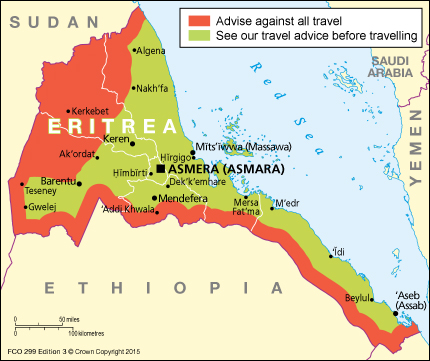
The FCO advise against all travel within 25km of Eritrea’s border with Ethiopia. Tensions between Eritrea and Ethiopia are high. See Local travel
The FCO advise against all travel within 25km of Eritrea’s border with Djibouti. See Local travel
The FCO advise against all travel to Eritrea’s border with Sudan, including the town of Tesseney and areas north and west of Nakh’fa, Ak’ordat and Barentu. See Local travel
All foreign nationals must apply in advance for a travel permit to leave Asmara. This includes diplomats. The British Embassy is unlikely to be able to provide consular support outside the capital. See Travel permits and Consular assistance
The Eritrean authorities consider all British nationals holding either Eritrean or PFDJ identity documents (including out of date documents) as Eritrean nationals. The British Embassy is unable to offer consular assistance to dual nationals in Eritrea. See Dual nationals
Eight British nationals were provided with consular assistance in Eritrea in 2015.  
There is a low threat from terrorism. See Terrorism
All British nationals travelling to Eritrea should register with the British Embassy in Asmara on arrival.
Take out comprehensive travel and medical insurance before you travel.

Safety and security

Crime

Crime levels are low but take sensible precautions with your personal safety. Don’t walk around late at night alone. Keep valuables, particularly cameras and passports, out of sight. Keep a photocopy of the personal details page of your passport in a safe place, or with friends or family in the UK.
A large proportion of the population has access to arms under the government of Eritrea’s civilian militia programme. We have no evidence that these weapons have increased the threat of violent crime.

Local travel

The FCO advise against all travel within 25km of Eritrea’s border with Ethiopia. In most places the border is neither marked nor obvious. There have been serious border clashes between Eritrea and Ethiopia in the past. Tensions remain high and there is a risk of further violence.
The border remains closed and is reported to be mined. In September 2011 a landmine exploded on the road between Senafe and Afoma killing five people.
The FCO advise against all travel within 25 km of Eritrea’s border with Djibouti. In 2008 there was fighting between Djibouti and Eritrea after an incursion of Eritrean forces into the disputed Djibouti border region. The situation remains unresolved.
The FCO advise against all travel to Eritrea’s border with Sudan, including the town of Tesseney and areas north and west of Nakh’fa, Ak’ordat and Barentu. In 2009, an attack on an international mining company vehicle on a road 35km north of Keren caused the deaths of one employee and two contractors.
There are extensive mine fields in Eritrea. Driving on main roads away from border areas is generally safe. Avoid driving on non-metalled roads and walking or hiking in the countryside.
Avoid travelling after dark in rural areas. Road signage and barriers are scarce, and steep drops are common. In many parts of the country roads are difficult or impassable during the rainy season.

Mobile telephones

Telephone networks are often unreliable and may only work for limited periods each day outside Asmara and larger towns. There are no agreements between Eritrean mobile telephone providers and international providers. You will not be able to receive or send calls or SMS text messages from any overseas mobile phone network on arrival in Eritrea. Local SIM cards can’t be purchased without a resident’s permit.

Electronic items

All electronic items (laptops, mobile phones, cameras etc) should be declared upon arrival. Failure to do so may result in their confiscation by Eritrean customs officials when you depart.

Travel permits

All foreign nationals need a travel permit to leave Asmara. Those working outside Asmara also need a travel permit to leave their area of residence or work. Applications in Asmara are handled by the relevant Ministry. For business travellers, applications are dealt with by the Ministry of Trade and Industry. Applications outside Asmara are handled by the local Zoba (Region) Administration Offices. Permission may take several days to be granted and is sometimes refused or delayed. Tourists wishing to travel outside Asmara should apply for a travel permit at the Ministry of Tourism located on Harnet Avenue in Asmara. Processing usually takes around 24 hours.
Restrictions on travel by foreign nationals apply equally to foreign diplomats. Staff from the British Embassy may therefore find it difficult or impossible to provide consular assistance to British nationals outside Asmara.

Sea travel

There have been attacks of piracy and armed robbery against ships in the Horn of Africa area. Be vigilant and take appropriate precautions.
Mariners must seek permissions and entry visas before attempting to land in Eritrea.
See our Piracy in the Indian Ocean page.

Consular assistance

There are serious constraints on what the British Embassy can do to help British nationals in Eritrea. Foreign diplomats in Asmara must apply ten days in advance for permission to travel outside Asmara. This means that the Embassy is unlikely to be able to offer consular assistance to British nationals outside Asmara.
There are obstacles to the provision of consular assistance even in Asmara. The Eritrean authorities may not inform the relevant Embassy if a foreign national is in need of help and there have been recent instances where the Eritrean authorities have refused consular access to detained foreign nationals.

Travel Summary

  • We advise against all travel within 25 kms of Eritrea’s border with Ethiopia and Djibouti. We also advise against travel to Eritrea's border with Sudan, including the town of Tesseney; and in the area north and west of Nakfa, Agordat and Barentu. See the Local Travel section of this advice for more details.
  • The Ethiopia-Eritrea border remains closed and unmarked. Several security incidents have taken place in recent months along the border, particularly in the areas of Humera, Tsorona and Zalambessa. Since the relocation out of Eritrea of the UN Peacekeeping Mission (UNMEE) in March 2008 the risk of cross-border tensions increasing and the security situation deteriorating very rapidly remains. See Local Travel section of this advice for more details.
  • All foreign nationals, including resident diplomats, are required to apply ten days in advance for travel permits to leave Asmara – these are not always granted. This means that diplomatic staff from the British Embassy are unable to offer emergency assistance to British nationals outside Asmara quickly. Eritrean authorities have not always informed the relevant Embassy when a foreign national is in need of consular assistance - this potential lack of any assistance outside Asmara is something to take into account fully before travelling. See the Local Travel (Travel Permits) section and General sections of this advice for more details.
  • Dual British/Eritrean nationals should be aware that, under the Vienna Convention on Consular Relations, the British Embassy is unable to offer assistance in Eritrea. The Eritrean authorities consider all British nationals holding either Eritrean or PFDJ identity documents (including out of date documents) as Eritrean nationals.
  • 4 British nationals required consular assistance in Eritrea in the period 01 April 2008 – 31 March 2009 for the following types of incident; deaths (1 cases); hospitalisations (0 cases); and arrests, for a variety of offences (0 cases). During this period assistance was also requested with regard to lost or stolen passports (2 cases).
  • The World Health Organisation (WHO) Pandemic Threat Alert Phase has been raised to Level 6. The World Health Organisation website has further details. You should monitor local media reports for any developments and advice. There is a dedicated Swine flu page on the FCO website. Guidance on Pandemic Flu can be obtained on the UK Department of Health website. Please see the Health section of the travel advice for further information.
  • There is an underlying threat from terrorism in Eritrea. Attacks could be indiscriminate, including in places frequented by expatriates and foreign travellers.
  • All British nationals travelling to Eritrea should register with the British Embassy in Asmara on arrival.
  • We recommend that you obtain comprehensive travel and medical insurance before travelling. You should check any exclusions, and ensure that your policy covers you for the activities you want to undertake. See the General (Insurance) section of this advice and Travel Insurance for more details.

Safety and security

Terrorism


There is an underlying threat from terrorism. Attacks could be indiscriminate, including in places frequented by expatriates and foreign travellers. For more general information see Terrorism Abroad.

A number of terrorist incidents have been reported along the border with Ethiopia.

Crime


Street crime such as theft and robbery is relatively rare in Asmara and other cities and towns, but appears to be on an upward trend. You should take normal and sensible precautions with regard to personal safety. We advise against walking around any town, late at night alone. Valuables, particularly cameras and passports should be kept out of sight.
Away from the main towns, crime is also rare but the usual precautions should be taken.
For more general information see Victims of crime.

Political Situation


Eritrea Country Profile

Local Travel

We advise against all travel within 25 km of the border with Djibouti. From 10 to 12 June 2008 there was fighting between Djibouti and Eritrea after an incursion of Eritrean forces into the disputed Djibouti border region. This led to casualties on both sides. The situation remains unresolved.

We advise against all travel within 25 km of Eritrea’s border with Ethiopia. It is important to note that in most places the border is neither marked nor obvious.

The Ethiopia-Eritrea border remains closed. Several security incidents have taken place in recent months along the border, particularly in the areas of Humera, Tsorona and Zalambessa. Since the relocation out of Eritrea of the UN Peacekeeping Mission (UNMEE) in March 2008 the risk of cross-border tensions increasing and the security situation deteriorating very rapidly remains.

We advice against all travel to Eritrea's border with Sudan, including the town of Tesseney; and the area north and west of Nakfa, Agordat and Barentu. In October 2009, an attack on a International Mining Company vehicle to a road 35km north of Keren caused the deaths of one employee and two contractors. A British national was killed in the area west of Agordat in April 2003. In August 2003, an attack on an NGO vehicle north of Nakfa led to the deaths of two aid workers.

There are extensive mine fields in Eritrea, particularly near the border with Ethiopia. Driving on main roads outside of the border areas is generally safe, though a landmine killed eight and injured several people along the same road in November 2008. We advise against driving on non-metalled roads and off-road driving. We also advise against walking or hiking in the countryside for the same reason.

We advise against travelling after dark in rural areas, where road signage/road barriers are scarce and steep drops common. You should be aware that in many parts of the country roads are difficult or impassable during the rainy season.

Telephone (including mobile) networks are often unreliable and may only work for limited periods a day outside Asmara and larger towns. You should take this into account when travelling, particularly in rural areas.

Travel Permits

All foreign nationals are required to have a travel permit to leave Asmara. This includes Embassy officials and other foreign nationals resident / working in Eritrea. Those working outside Asmara are also required to have a travel permit to leave their area of residence or work. Applications for such travel permits in Asmara are handled by the Department of Protocol of the Ministry of Foreign Affairs (or relevant ministry). Applications outside Asmara are handled by the local Zoba (Region) Administration Offices. Permission may take several days to be granted and is sometimes refused or delayed.

Tourists seeking to travel outside Asmara should apply for travel permits at the Ministry of Tourism located on Harnet Avenue in Asmara. Such permits usually take around 24 hours to process. There is no guarantee that permits will be issued.

This also means that diplomatic staff from the British Embassy are unable to offer emergency assistance to British nationals outside Asmara quickly. If travel permits were not granted, the British Embassy is unlikely to be able to offer any Consular assistance outside Asmara. The potential lack of any assistance outside Asmara is something you should take into account fully before travelling.

Air Travel


There are currently international flights (some direct) from Asmara to Cairo (Egyptair), Frankfurt (Lufthansa), Sana’a (Yemenia), Khartoum (Sudan Airways) and Dubai (Nasair). Please see the airline websites for specific details on flight schedules, ticketing and other information.

There is currently an airport departure tax of US$20 per passenger, it cannot be paid in Nakfa, unless you hold resident’s permit. You are advised to convert any excess Nakfa back to hard currency at one of the “Himbol” exchanges in town, as there are limits to what can be converted at the “Himbol” branch at the airport. To convert Nakfa back to hard currency you will need the original currency transaction receipt. Nakfa are not convertible outside Eritrea. The Nakfa is currently pegged at the rate of 15 Nakfa to one US dollar.

For more general information see Airline Security.

Sea Travel

There have been attacks of piracy and armed robbery against ships in the Horn of Africa area. Mariners are advised to be vigilant and to take appropriate precautions.
Mariners should be aware that permissions and entry visas must be sought in advance before seeking to land in Eritrea.
For more general information see River and Sea Safety.

Local laws and customs

Photography of government buildings and military installations is not allowed. If in doubt, ask first.

You are advised to dress modestly, especially in lowland and predominantly Muslim areas. Shorts and T-shirts are likely to draw attention.

Homosexual behaviour is illegal, although the penalties are unclear. Discretion is advised.

For more general information for different types of travellers see Your trip.

Entry requirements

Visas

British nationals need a visa to enter Eritrea.
You should ensure that any necessary travel documentation (including exit visas) remain valid for the duration of your stay. The Eritrean authorities take breaches of their immigration laws seriously and travellers who have overstayed can face lengthy delays in regularising their position before departure or even detention.

Dual Nationals

Dual British/Eritrean nationals who enter Eritrea will be classed as Eritrean nationals by the Eritrean authorities. The British Embassy is unable to gain consular access to or obtain information on such dual nationals if they are detained by the authorities or otherwise in need of assistance.
Dual nationals who enter Eritrea on an Eritrean identity card rather than an Eritrean passport should be aware that they are required to obtain an exit visa from the Immigration Office in Asmara before they are able to leave Eritrea.

Foreign currency


All foreign visitors are required to declare all foreign currency upon entering the country – filling in a form and showing funds. There is no limit on the amount that can be brought in. You should ensure that you have had your completed foreign currency declaration form approved and stamped before you leave the airport.
On departure, you will have to show (using your foreign currency declaration form) that any foreign currency missing was exchanged at a branch of “Himbol”, the State foreign currency exchange. You may face prosecution leading to a heavy fine, as well as a delay to your departure from Eritrea, if you fail to comply with these regulations.

Yellow Fever vaccination certificate


Yellow Fever Vaccination certificates are an entry requirement for all visitors over the age of one year arriving from a country where the disease is present.

Health

A (H1N1) - Swine Flu


Currently there are no reported cases of Swine Flu in Eritrea, however there are cases in neighbouring countries (Ethiopia/Sudan). Our Embassy in Asmara receives regular updates from local WHO representative.

There is screening on arrival at Asmara airport and all arriving passengers are required to complete a health questionnaire. If any passenger declares or exhibits flu-like symptoms they are quarantined at the nominationed isolation hospital, Villagio, whilst tests are done to check for the A (H1N1) virus. There have been a few suspected cases but so far all have been declared infection free and released from isolation. Currently the swabs are sent back to the UK for testing as there are no facilities to test for the virus in-country. There are limited stocks of anti-viral medication (Tamiflu) in-country but it is unclear if passengers would have access to these. The Embassy would not able to provide Tamiflu.

There is no screening on departure.

The World Health Organisation (WHO) has raised its Pandemic Threat Alert Phase to Level 6. The World Health Organisation website has further details. You should monitor local media reports for any developments and advice. There is a dedicated Swine flu page on the FCO website. Guidance on Pandemic Flu can be found on the UK Department of Health website.

General


There is one private and three public hospitals in Asmara. Public hospitals here and in other towns are often poorly equipped. Elsewhere medical facilities are even more limited. If you are travelling away from the large towns, we advise that you carry a comprehensive medical pack with you.

If you are taking prescription medicines, you should ensure that you have a sufficient supply for the length of your stay in Eritrea.

In the 2008 Report on the Global AIDS Epidemic the UNAIDS/WHO Working Group estimated that around 35,000 adults aged 15 or over in Eritrea were living with HIV; the prevalence rate was estimated at around 1.3% of the adult population. This compares to the prevalence rate in adults in the UK of around 0.2%. You should exercise normal precautions to avoid exposure to HIV/AIDS. For more general information on how to do this see HIV and AIDS.

You should seek medical advice before travelling to Eritrea and ensure that all appropriate vaccinations are up-to-date. For further information on vaccination requirements, health outbreaks and general disease protection and prevention you should visit the websites of NaTHNaC and NHS Scotland's Fit For Travel or call NHS Direct on 0845 46 47.

For more general health information see Travel Health.

General

Insurance

We recommend that you obtain comprehensive travel and medical insurance before travelling. You should check any exclusions, and ensure that your policy covers you for the activities you want to undertake. You should ensure that your medical insurance covers the cost of air ambulance evacuation out of Eritrea in the event of a serious accident or illness.
Here's how we can help if things go wrong.

Consular assistance outside Asmara

There are limits to what the British Embassy can do to assist British nationals outside Asmara. All diplomatic staff in Asmara are required to apply for permission to travel 10 days in advance. This means that diplomatic staff from the British Embassy are unable to offer emergency assistance to British nationals outside Asmara. You are advised to take this into account before deciding whether or not to travel to Eritrea.
You should be aware that the Eritrean authorities have not always informed the relevant Embassy if a foreign national is in need of consular assistance (for example, if they have been taken into detention or are in need of medical attention). This applies inside Asmara as well as more widely in the country.

Consular registration


Register with our LOCATE service to tell us when and where you are travelling abroad or where you live abroad so our consular and crisis staff can provide better assistance to you in an emergency.

Passports

Applications for British passports can be lodged at the British Embassy in Asmara. However, because all applications are forwarded to the High Commission in Nairobi for processing, the issuing of a full passport usually takes three-four weeks.
Emergency passports, good for a single trip back to the United Kingdom, can usually be issued by the British Embassy Asmara within two working days. You will need to provide satisfactory proof of nationality: we advise that all travellers keep a photocopy of the biodata (photograph and personal details) page of their passport in a safe place or with friends or family in the UK.

Money

The economy is completely cash-based. There are no ATMs in Eritrea. Credit cards are not accepted anywhere except a few hotels such as the Asmara Palace, Sunshine and Crystal hotels. It is illegal to exchange currency other than at a branch of “Himbol”. It is illegal to attempt to use foreign currency to make purchases in Eritrea.
For more information on bringing currency into and out of Eritrea see the Entry Requirements section of this travel advice.